
The fastest, lowest-risk way to fill multi-state CDL recruiting needs is to source FedEx-experienced drivers through a dedicated platform like UCEP and run compliance checks the same day you find a candidate. That means a full FMCSA Clearinghouse query with electronic consent, an ELDT check for first-time CDL applicants, and an immediate MVR order. Documents must land in the driver qualification file within 30 days of hire, and ELDT has to be finished before state testing for new CDL holders.
TL;DR:
- Running the FMCSA Clearinghouse query with driver consent is the first compliance step and must be done before extending any offer.
- MVR requests should be made within 30 days of hire, and good-faith effort documentation is necessary if states do not respond promptly.
- ELDT certification for first-time CDL applicants must be verified in the FMCSA registry before state testing, with providers submitting records within two business days.
- Prior FedEx experience, consistent license tenure, and a clean MVR across all prior states predict better fit and lower safety risks in multi-state hiring.
- Streamlining sourcing and compliance checks by running them concurrently with recruitment significantly accelerates onboarding without risking audit failure.
Table of Contents
- Priority checklist for the day you identify a candidate
- Compliance essentials: what each check does and why it matters
- Sourcing FedEx-experienced drivers across multiple states
- Screening and onboarding workflow that keeps files audit-ready
- Retention and audit risk: fixing the most common gaps
- Retention and turnover considerations specific to service providers
- Cost structure and total expenses in multi-state CDL recruiting
- Average timeline from recruitment to hire completion
- Compliance challenges specific to different states
- Strategies for effective multi-state candidate sourcing and screening
- Key evaluation criteria for multi-state CDL candidates
- Onboarding adaptations for different state regulations
- What FedEx Service Provider recruiters keep getting wrong
- Start hiring FedEx-experienced drivers on UCEP today
- Sources
- FAQ
Priority checklist for the day you identify a candidate
Once a candidate applies, the clock starts. Here is the order that keeps you compliant without slowing down the hire.
- Get the driver's electronic consent inside the FMCSA Clearinghouse and run the full pre-employment query.
- Confirm whether the candidate is a first-time CDL applicant. If so, request their ELDT certificate and verify it against the training provider's submission to the FMCSA Training Provider Registry.
- Order MVRs from every state where the driver held a license in the past three years.
- Collect the driver's current medical examiner's certificate and note the expiration date for renewal tracking.
- Confirm ELD applicability for the assigned route and flag any unassigned driving time policy the driver needs to know before their first shift.
- Place all documents into a labeled driver qualification file, ready for an audit on day one.
If a state MVR request goes unanswered, document the date and method of your request. Auditors expect proof of a good-faith effort, not silence.
Pro Tip: Assign one recruiter to own consent and Clearinghouse queries same day, and a second to own MVR follow-up within the 30-day window. Splitting ownership keeps neither task waiting on the other.
Compliance essentials: what each check does and why it matters
Each pre-hire check protects a different part of the hiring decision, and skipping one creates a specific, identifiable risk.
- Clearinghouse queries come in two types: a full query, required before hire, and a limited query, used for annual checks on current drivers. A full query requires the driver's electronic consent before you can see results, and a disqualifying record means the driver cannot perform safety-sensitive functions until they complete the return-to-duty process.
- ELDT applies to first-time applicants for a Class A or B CDL and to certain license upgrades. Training providers must submit completion certification to the registry within two business days, so a missing certificate in the registry is worth a direct call to the provider before you assume the candidate never finished training.
- MVR and DQ file rules require carriers to contact every state where a driver held a license in the past three years and place the resulting MVR into the driver qualification file within 30 days of hire, retained under 49 CFR 391.51.
- DOT medical certificates must be current at hire and tracked for renewal; the Driver Qualification Checklist lists required items and retention periods, generally life of employment plus three years for most records.
- ELD verification confirms the driver's assigned equipment is certified and registered with FMCSA, which matters for any FedEx route subject to hours-of-service recordkeeping.
One full Clearinghouse query and driver consent are required before every pre-employment hire decision, according to FMCSA guidance. Skipping this step is the single most common reason a driver qualification file fails an audit.
For a deeper walk-through of drug and alcohol testing rules tied to the Clearinghouse, see our CDL drug testing requirements guide.
Sourcing FedEx-experienced drivers across multiple states
Generic job boards rarely reach drivers who already understand FedEx route expectations. Role-specific categories and terminal-level posts change that.
- Post separately for linehaul, CDL-A team, and pickup and delivery roles. Drivers searching for one role rarely click into another, so mixing them into one generic listing lowers apply rates.
- Use a platform built around FedEx-experienced drivers. A platform that filters by terminal and job category can shorten the time recruiters spend screening candidates who lack relevant contract route experience.
- Write ad copy that states the route type, typical hours, pay cadence, terminal location, and any required certificates up front. Drivers skip ambiguous posts.
- Prioritize candidates with prior FedEx contractor experience, consistent tenure at previous carriers, and a clean MVR history before you schedule an interview.
For team-driver roles specifically, our team driver recruiting strategies guide covers ad copy and screening tactics that apply directly to multi-state CDL recruiting for FedEx contract routes.
Screening and onboarding workflow that keeps files audit-ready
A workflow only protects you if it runs the same way for every hire, regardless of which state the driver is coming from.
- Have the candidate complete the driver employment application required under 49 CFR 391.21 before any offer is extended.
- Run the full Clearinghouse query with signed consent, and request safety performance history from the driver's previous employers.
- After hire, place all state MVRs into the DQ file within 30 days and collect the current medical examiner's certificate.
- Retain the ELDT certificate in the file for any first-time CDL applicant, matching the item list on the Driver Qualification Checklist.
- Save a digital backup of every Clearinghouse query receipt, named consistently, for example "Clearinghouse_query_20260115_smithj," so files are easy to locate during an audit.
- Walk the new driver through ELD use and unassigned driving time procedures before their first dispatch.
Pro Tip: Build a single onboarding folder template with named subfolders for consent forms, MVRs, medical certificates, and ELDT records. New hires move through the same folder every time, so nothing gets missed when volume increases.
Our CDL onboarding guide covers additional recordkeeping habits that reduce onboarding time without cutting corners on compliance.
Retention and audit risk: fixing the most common gaps
Hiring fast only pays off if the driver stays and the file survives an audit. Both problems usually trace back to the same handful of habits.
- Give new drivers a predictable schedule and a clear orientation on route expectations. Drivers who understand their route and pay cadence from day one tend to stay longer.
- Fix missing MVRs by tracking request dates and following up in writing; a documented good-faith effort protects you even when a state is slow to respond.
- Fix disorganized DQ files by using one folder template for every hire, so an auditor can find the same documents in the same place regardless of which recruiter handled the hire.
- Run limited Clearinghouse queries annually for every active driver, and schedule MVR checks on the same annual cycle to avoid falling behind.
Keeping these habits consistent turns a surprise audit into a routine file review rather than a scramble.
Retention and turnover considerations specific to service providers
Driver turnover directly affects a Service Provider's ability to keep FedEx routes staffed and compliant. Losing a driver mid-contract means restarting the entire Clearinghouse, MVR, and DQ file process for a replacement, which adds cost and delay on top of the original hire.
Tenure matters for safety as much as for staffing. Drivers with longer tenure at a carrier tend to have fewer safety incidents, so retention efforts double as compliance protection rather than just a staffing convenience.
Practical steps that reduce turnover without adding cost include consistent dispatch communication, predictable home time where routes allow it, and a clear path for drivers to move from solo to team or from pickup and delivery into linehaul roles as openings appear. Service Providers who post these career paths in their job listings tend to attract drivers looking for stability rather than a short-term placement.
Turnover also compounds documentation work. Every replacement hire restarts the 30-day MVR clock and requires a fresh Clearinghouse consent, so a Service Provider with high turnover spends proportionally more recruiter time on compliance paperwork than one with a stable driver roster. Treating retention as a compliance lever, not just an HR metric, keeps both routes and files in better shape.

Cost structure and total expenses in multi-state CDL recruiting
Multi state CDL recruiting costs break down into three categories: platform or advertising fees, compliance processing costs, and the recruiter time spent managing both.
Platform costs vary by how you post. UCEP offers a Complimentary Trial Listing for new recruiters testing the platform, and a Standard Monthly Plan at $99 per month for ongoing job postings across pickup and delivery, CDL-A solo linehaul, and CDL-A team linehaul categories.
Compliance processing costs include the fees charged by states for MVR requests and any third-party service used to submit Clearinghouse queries. These fees vary by state and are separate from any platform subscription.
Recruiter time is the least visible cost but often the largest. Every hire requires consent collection, a Clearinghouse query, MVR requests to potentially several states, medical certificate verification, and DQ file assembly. Recruiters who use a checklist and a consistent folder template spend less time per hire than those handling each file differently, which is part of why a structured workflow pays for itself beyond the subscription cost of any platform.
Average timeline from recruitment to hire completion
A multi-state hire typically moves through three phases: sourcing and interview, compliance verification, and file completion. Sourcing and interview time depends on how targeted your job posting is, with role-specific listings on a focused platform generally producing faster applicant response than generic postings.
Compliance verification has fixed regulatory deadlines that shape the timeline regardless of how fast you source a candidate. The Clearinghouse query and consent process happens same day, once the candidate agrees. ELDT certificate verification for first-time CDL applicants can take longer if the training provider has not yet submitted certification, since providers have two business days to file after program completion.
MVR requests are the longest variable. States differ in how quickly they respond, and the 30-day placement deadline is a ceiling, not a target. Recruiters who request MVRs the day a candidate accepts an offer, rather than waiting for the first day of work, use that window more efficiently and reduce the chance of missing the deadline for a hire involving multiple states.
Compliance challenges specific to different states
Multi-state hiring means dealing with license history across state lines, and each state manages MVR requests and CDL data differently. Some states return records within days, others take longer, which is why the 30-day DQ file deadline exists as a compliance floor rather than a suggestion.
CDLIS, the Commercial Driver's License Information System, links license records across states, but a recruiter still has to actively request the MVR from every state where a driver held a license in the past three years. Missing one state's history is a common audit finding, not because recruiters skip it intentionally, but because a driver's application does not always list every prior license state clearly.
Non-domiciled CDLs, where a driver holds a license issued by a state where they do not reside, have drawn increased scrutiny following recent federal audits targeting illegally issued CDLs and non-compliant training providers. If a candidate's application lists a CDL from a state that does not match their residence, verify the license status directly and prioritize a Clearinghouse history check before extending an offer.
Strategies for effective multi-state candidate sourcing and screening
Sourcing across state lines works best when you narrow the pool to drivers already familiar with the type of route you are hiring for, rather than casting a wide net and screening everyone who applies.
Posting on a platform built around FedEx-experienced drivers, filtering by terminal and job category, and writing route-specific ad copy all reduce the number of unqualified applicants you screen. Screening then focuses on three checks in order: Clearinghouse history, MVR record across every state of prior licensure, and prior employer safety history. Running these in that order means you catch a disqualifying Clearinghouse record before spending time on MVR requests for a candidate you would not hire anyway.
For candidates listing multiple states of residence or licensure, confirm the exact states directly rather than relying on the application alone. Drivers sometimes list a current address that differs from the state that issued their CDL, and catching that early prevents a missed MVR request later in the DQ file process.
Key evaluation criteria for multi-state CDL candidates
Beyond a clean Clearinghouse record and valid CDL, a few signals reliably predict whether a driver will fit a FedEx contract route.
- Prior FedEx-related experience shortens the ramp-up period, since the driver already understands route expectations, terminal procedures, and delivery windows.
- License tenure and consistency across the states listed on their application suggest a driver who maintains their qualifications rather than one who lets certifications lapse between jobs.
- Clean MVR history across every state where they held a license, not just their current state, since a violation in a prior state still shows up in the full record.
- Willingness to complete ELDT verification promptly if they are a first-time CDL applicant, which signals they understand the process rather than treating it as an afterthought.
Weighing these consistently, rather than case by case, keeps hiring decisions defensible if a candidate is ever questioned during a route audit.
Onboarding adaptations for different state regulations
Most CDL compliance requirements are federal, set by FMCSA, and apply the same way regardless of which state a driver is licensed in. Onboarding adjustments come in at the margins, mainly around state-specific MVR request procedures and, in some cases, state drug and alcohol testing add-ons beyond federal requirements.
Recruiters handling multi-state CDL recruiting should keep a short reference list of which states respond to MVR requests through an online portal versus mail, since that affects how quickly you can meet the 30-day placement deadline. States that require a mailed request need to go out on day one after offer acceptance, not after the driver starts work.
Medical certificate requirements are federal and consistent across states, so onboarding does not need state-specific adjustment there. The one area worth double-checking per state is whether the driver's prior state of licensure has any additional reporting requirement tied to CDL status changes, since a small number of states layer extra notification rules on top of the federal Clearinghouse and MVR framework. Building this into your onboarding checklist once, rather than researching it fresh for every hire, keeps the process consistent.

What FedEx Service Provider recruiters keep getting wrong
Most recruiting advice treats compliance as a formality to finish after the hiring decision is made. That ordering is backward. A Clearinghouse query is not paperwork you complete once someone likes the candidate. It is part of the decision itself, and running it first prevents wasted time on someone who cannot legally be hired.
The bigger blind spot is treating a fast hire and a compliant hire as competing goals. They are not. A recruiter who runs the Clearinghouse query and MVR requests the same day a candidate accepts an offer moves faster than one who waits until the driver's first week, because they are not racing the 30-day deadline from a late start. Speed and compliance point the same direction when the process runs in the right order.
I have watched recruiters at FedEx Service Providers lose good candidates to slower competitors simply because their compliance steps ran sequentially instead of in parallel with sourcing. Fixing that ordering problem does more for hiring speed than any new sourcing channel.
UCEP publishes recruiting resources specifically for FedEx Service Providers, built around the compliance sequence outlined here.
— Aaron
Start hiring FedEx-experienced drivers on UCEP today
UCEP lists a Complimentary Trial Listing for recruiters posting their first FedEx route opening, and a Standard Monthly Plan at $99 per month for ongoing postings across pickup and delivery, CDL-A solo linehaul, and CDL-A team linehaul roles.
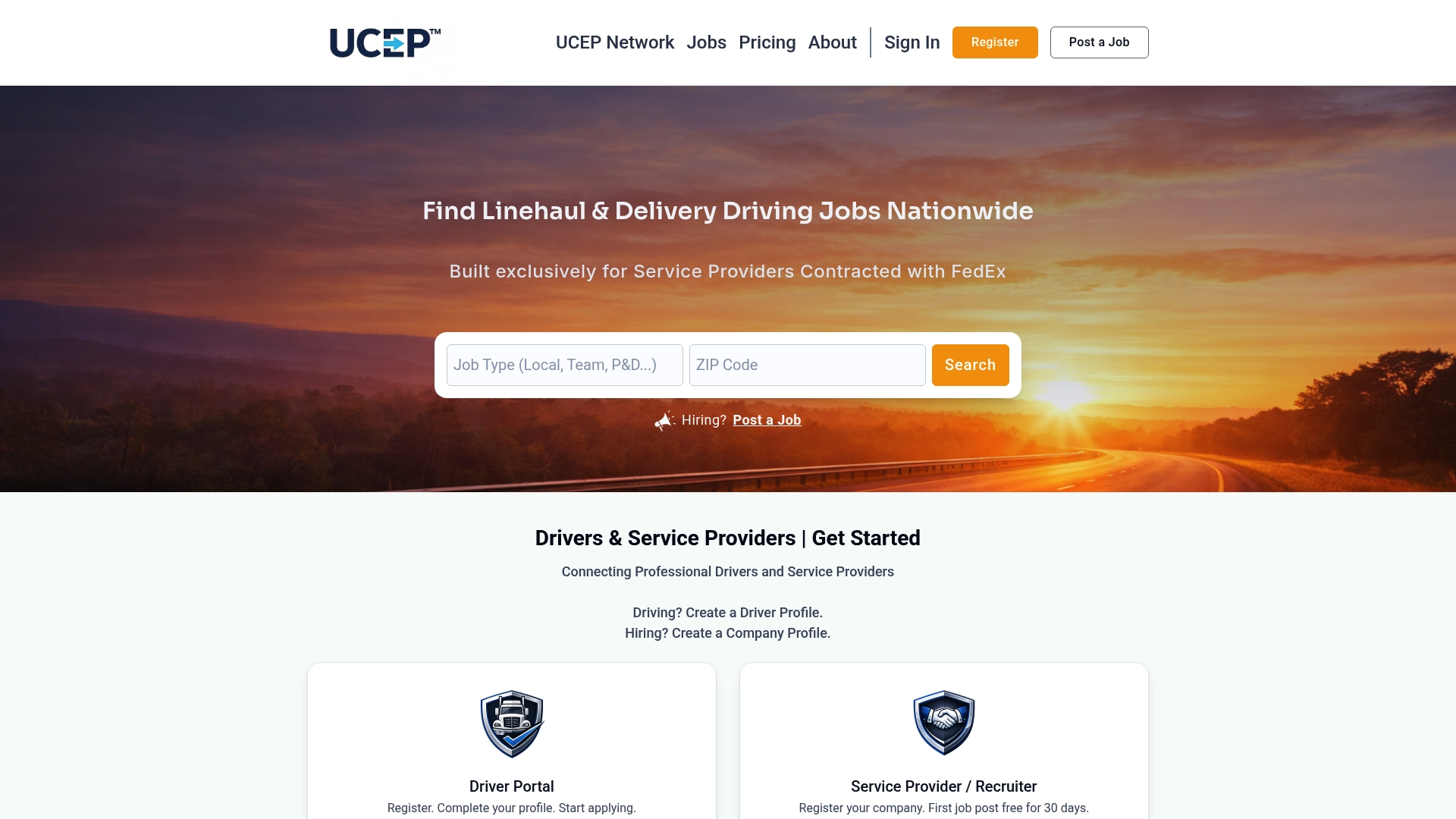
Reviewing your Clearinghouse, ELDT, and MVR process while your job listing is live keeps the compliance and sourcing steps moving together instead of one waiting on the other.
| Plan | What it covers | Price |
|---|---|---|
| Complimentary Trial Listing | First job posting for new recruiters | Free |
| Standard Monthly Plan | Ongoing postings across all job categories | $99 per month |
Ready to post? Submit a job listing and reach FedEx-experienced drivers searching UCEP's job categories directly, or browse current listings to see how your posting will appear to candidates.
Sources
- FMCSA Clearinghouse — Queries and consent requests
- FMCSA Training Provider Registry — ELDT applicability
- FMCSA — Driver qualification file requirements
- Driver qualification checklist (FMCSA)
- ELD fact sheet (FMCSA)
FAQ
What is the first compliance step for a new CDL hire?
The first step is running a full FMCSA Clearinghouse query with the driver's electronic consent, before any offer is finalized. This confirms the driver has no disqualifying drug or alcohol violation on record.
How long do I have to place an MVR in the driver qualification file?
Carriers must place a copy of the MVR into the driver qualification file within 30 days of hire, requesting records from every state where the driver held a license in the past three years. If a state does not respond in time, document your request date as a good-faith effort.
Does every new CDL driver need ELDT?
ELDT applies to first-time applicants for a Class A or B CDL and to certain license upgrades, and must be completed before state testing. Training providers submit completion certification to the FMCSA registry within two business days, so verify the certificate appears there before assuming training is incomplete.
What does UCEP cost for a Service Provider posting jobs?
UCEP offers a Complimentary Trial Listing with no published price for a first posting, and a Standard Monthly Plan at $99 per month for ongoing job listings across pickup and delivery, CDL-A solo linehaul, and CDL-A team linehaul categories.
How often should I run Clearinghouse queries on current drivers?
Employers run a full query before hire and a limited query annually for drivers already employed, according to FMCSA Clearinghouse guidance. Annual limited queries help catch any new violations without repeating the full pre-employment process.