
We recommend setting narrow saved-search filters on job aggregators, turning on mobile alerts, and checking a FedEx-specialized board like UCEP for contractor-specific roles. Heavy and tractor-trailer drivers earned a median annual wage of $57,440 in 2024, and new applicants must meet ELDT training requirements before testing. Start by building one filtered saved search today and turning on alerts.
TL;DR:
- Set filters for home time, route, freight, equipment, a pay floor, and endorsements you hold; exclude training only, tuition financing, and lease requirements.
- Contractor roles may bypass broad job feeds, so search a specialized board for clues like terminal based assignments or contracted service provider routes.
- Verify the DOT or MC number, carrier domain email, written pay terms, and named equipment and terminal; reject upfront fees or changing contact details.
- Keep your commercial driver’s license, medical card, driving record consent, endorsements, logs, and references ready, then follow up within 48 to 72 hours.
- Before accepting an offer, confirm whether pay is gross or net, and get training repayment, lease, insurance, and settlement terms in writing.
Table of Contents
- How job-card aggregators surface trucking listings
- Build search filters that cut the noise
- Vet every posting before you apply
- A repeatable workflow for faster applications
- When a dedicated FedEx board beats a broad aggregator
- How long the search and hiring process typically takes
- What applying actually costs you
- Criteria to compare one job offer against another
- Red flags that go beyond a fake posting
- What I check before I apply or refer a driver
- How to get started with UCEP for FedEx-contracted roles
- FAQ
- Sources
How job-card aggregators surface trucking listings
Aggregators like Google for Jobs do not write job postings. They pull structured data from carrier career pages, applicant tracking systems, and job boards, then display that data as job cards. A posting with complete fields, pay range, equipment type, home-time schedule, required endorsements, tends to surface above a posting that only lists a job title and a city.
This is why two listings for the same role can rank differently. The carrier with cleaner structured data wins visibility, even if the job itself is identical.
A few practical effects follow from this:
- Postings missing pay or home-time details often rank lower, even when the job is solid.
- Keyword choices in the posting (CDL-A, hazmat endorsement, dedicated route) determine which searches surface it.
- Specialized contractor roles, including many FedEx-contracted positions, sometimes skip broad aggregators entirely because they post through niche channels or direct carrier sites instead.
That gap matters for drivers chasing dedicated-lane or contractor work. If you only search broad aggregators, you miss listings that never made it into that structured feed. Pairing a general job search with a focused board built for one contractor ecosystem closes that gap.
Build search filters that cut the noise
Most drivers lose time scrolling past jobs that never fit their situation. A tighter filter set fixes that before you click a single listing.
Set these filters first, in this order:
- Home time: daily, weekly, or regional, depending on what you need right now.
- Route type: OTR, regional, or local, since this affects everything else in the search.
- Freight type: dedicated, parcel, linehaul, or general freight.
- Equipment: dry van, reefer, flatbed, or straight truck, matched to your experience.
- Pay minimum: set a floor, not a guess, based on what you need to earn.
- Endorsements: hazmat, tanker, or doubles/triples, only if you hold them.
Add negative keywords to exclude listings you do not want. Phrases like "training only," "tuition financed," or "lease required" filter out company-sponsored CDL programs and lease-purchase pitches that are not what you are looking for.
Once the filters are set, turn on mobile push alerts for that exact search. Run it for a few days and watch what comes back. If matches feel off, widen the pay minimum slightly or loosen the home-time window one notch at a time rather than rebuilding the whole search.
Dedicated-lane and contractor-style work often shows up without the carrier's name attached. Watch for language like "consistent pickup and delivery route," "terminal-based assignment," or "contracted service provider route." These phrases usually point to contractor or dedicated-lane arrangements even when the posting avoids naming the brand behind the freight.
Pro Tip: Save two versions of the same search, one with a strict pay minimum and one slightly lower, so you catch strong matches without missing solid jobs that just priced the role differently.
For a deeper walkthrough of filter combinations, see our five priority filters for finding FedEx jobs.
Vet every posting before you apply
A few minutes of checking before you apply protects your time and your personal information. Run through this before sending any documents.
Legitimate postings usually include DOT-compliant parts and safety equipment details you can verify, such as LED headlights, marker lights, and reflective tape from trusted sources like All Star Truck Parts.
- An email address tied to the carrier's own domain, not a generic account.
- A visible DOT or MC number you can look up independently.
- Clear pay terms stated as a range or a per-mile rate, not "competitive pay" with no number.
- Equipment type, route pattern, and a named terminal or hub location.
Red flags that should stop you:
- Any request for an upfront fee before hiring or training.
- Vague pay ranges that shift when you ask follow-up questions.
- The same ad reposted under several slightly different company names.
- Contact details that change between the posting and the actual call.
Quick checks worth running every time: search the carrier's USDOT or MC number through FMCSA's public lookup, ask directly for that number if it is missing, confirm the hiring process never requires payment from you, and for owner-operators, verify lease or insurance terms before signing anything.
New CDL applicants should also confirm ELDT status. Entry-level drivers applying for a Class A or B CDL since February 7, 2022 must complete training through a provider listed on FMCSA's Training Provider Registry before taking the state exam. That registry submission has to happen within a set window after training, so ask any program how quickly they report completion.
A repeatable workflow for faster applications
Speed matters, but only once your documents are ready. Keep these on hand before you start applying: your CDL, medical card, MVR consent form, endorsement documentation, a sample of recent driver logs, and two or three references you can list immediately.
A tight application sequence looks like this:
- Use one-click or quick-apply options first, since they cut friction and get your information in front of a recruiter faster.
- Fall back to the carrier's own portal if quick apply is broken or incomplete, which happens more often than it should.
- Call within 48 to 72 hours if you have not heard back, and ask about home time, pay structure, and terminal location on that first call.
- Track every application in a simple log: posting source, date applied, contact name, pay offered, home time, and your next follow-up date.
That tracking step sounds minor until you are juggling six applications at once and cannot remember which recruiter promised a callback by Friday.
Pro Tip: Keep your MVR consent form pre-filled and ready to attach. Carriers that run background checks early tend to move faster on an offer.
For a full breakdown of what documentation CDL-A applicants need, see our guide to CDL-A driver requirements.
When a dedicated FedEx board beats a broad aggregator
Broad aggregators work well for general freight searches, but they struggle with one thing: contractor ecosystems built around a single brand. FedEx Service Providers hire through specific channels, and those channels do not always feed into generic job-card systems the same way national carriers do.

A board built specifically for that ecosystem, like UCEP, consolidates FedEx-contracted listings, employer directories, and terminal-level detail in one place instead of scattering them across dozens of individual carrier sites.
Here is where that focus pays off:
- Contractor and terminal-specific roles that never reach broad aggregators show up directly.
- Employer directories let you check a Service Provider's history before applying, the same way you would check USDOT records elsewhere.
- Running a specialized board alongside your aggregator saved searches lets you cross-check postings and catch duplicates before you waste time applying twice.
Running both at once, rather than picking one over the other, covers the gap each system leaves behind.
How long the search and hiring process typically takes
Timelines vary by role, but a rough pattern holds across most trucking job searches run through job-card aggregators and specialized boards.
Setting up filtered saved searches and alerts takes under an hour. Most drivers see a usable volume of relevant matches within the first three to five days, assuming the filters are tuned correctly.
From there, applying to five or six well-matched postings and getting a first response typically takes about a week, since recruiters in trucking tend to move faster than in many other industries once a candidate looks qualified. A first phone screen, when it happens, usually comes within 48 to 72 hours of applying, which is why the follow-up window in the application workflow above matters.
Final hiring decisions, including background checks, MVR review, and any required ELDT verification for new applicants, can add another one to three weeks depending on the carrier's onboarding process and how quickly your documentation is in order. Owner-operators negotiating lease or contract terms should expect that final stretch to run longer, since lease agreements and insurance arrangements take more back-and-forth than a standard company-driver offer.

Keeping your saved searches active during this entire window matters. A stronger offer can surface while you are mid-negotiation on another one, and you want to know about it.
What applying actually costs you
Applying to a trucking job through an aggregator or a specialized board should never cost you money directly. Job-card searches, saved alerts, and quick-apply submissions are free to drivers on every legitimate platform, including UCEP.
Where costs do show up is in the hiring process itself, and they vary by role. Company-driver positions typically cover the medical exam and background check as part of onboarding, but confirm that in writing before assuming it. Some entry-level programs still expect you to pay for your own ELDT training unless the carrier sponsors it directly.
Owner-operators face a different cost structure entirely: insurance premiums, lease payments if you are leasing equipment rather than owning it outright, and fuel costs that come out of your settlement rather than a flat paycheck. None of these are hidden if the carrier or Service Provider is transparent, but they are also not always spelled out in the job posting itself, which is exactly why asking about pay structure on your first call matters.
One cost to watch closely: company-sponsored CDL training programs often come with multi-year service contracts attached. Request the repayment terms in writing before you enroll in any program that trades free training for a commitment period, since the math on early departure penalties can be steep.
Criteria to compare one job offer against another
Once you have two or three offers in hand, comparing them side by side keeps you from taking the first one out of relief.
Ask these questions of every offer:
- What is the actual pay structure: per mile, hourly, or percentage of load, and what is the realistic weekly range?
- How often will you be home, and does that match what the posting claimed?
- What equipment will you run, and how old is it?
- Is the freight dedicated, or will your routes change week to week?
- What does the onboarding timeline look like, including background check and any required training?
- For owner-operator roles, what are the lease terms, insurance requirements, and settlement deduction schedule?
Weigh pay against home time deliberately rather than defaulting to whichever number is highest. A role paying slightly less with guaranteed weekly home time often beats a higher-paying OTR position if your priority right now is time with family.
Also ask directly about terminal location and dispatch patterns. A dedicated route that sounds appealing on paper can still involve more deadhead miles than advertised, which eats into effective pay even when the stated rate looks competitive.
Red flags that go beyond a fake posting
Some warning signs only appear after you are already talking to a recruiter, past the point of checking a DOT number.
Watch for pay structures that shift between the posting, the first call, and the written offer. A recruiter who quotes one rate, then mentions a lower "training rate" or "probationary rate" once you are on the phone, is not being upfront about what you will actually earn in your first weeks.
Unrealistic expectations show up as promises that do not match the equipment or freight type described. A posting advertising consistent home time attached to a route that is clearly long-haul OTR is a mismatch worth questioning directly.
Non-transparent contract terms are the hardest to catch early because they often hide in documents you do not see until orientation. Ask for lease agreements, settlement statements, or training repayment contracts before you show up in person, not after. A carrier or Service Provider unwilling to share those terms in writing ahead of time is telling you something about how they operate.
Double-brokening and reposted identical ads under different company names are the aggregator-specific version of this problem, covered in the vetting checklist above, but the pattern repeats here too: inconsistency between what is promised and what is written down is the signal that matters most.
What I check before I apply or refer a driver
Before I send anyone toward a posting, I run the same six checks: DOT and MC number lookup, clear pay terms in writing, realistic home-time claims, named equipment and route type, a note on how MVR review will happen, and verified contact details that match across the posting and any follow-up call.
Pay and home time are the two factors drivers most often trade off against each other, and neither choice is wrong. What matters is making that trade-off on purpose instead of by accident.
— Aaron
How to get started with UCEP for FedEx-contracted roles
We built UCEP as a dedicated board for Service Providers contracted with FedEx, which means every listing on it is already filtered to the contractor ecosystem you are searching for, instead of buried inside a general freight search.
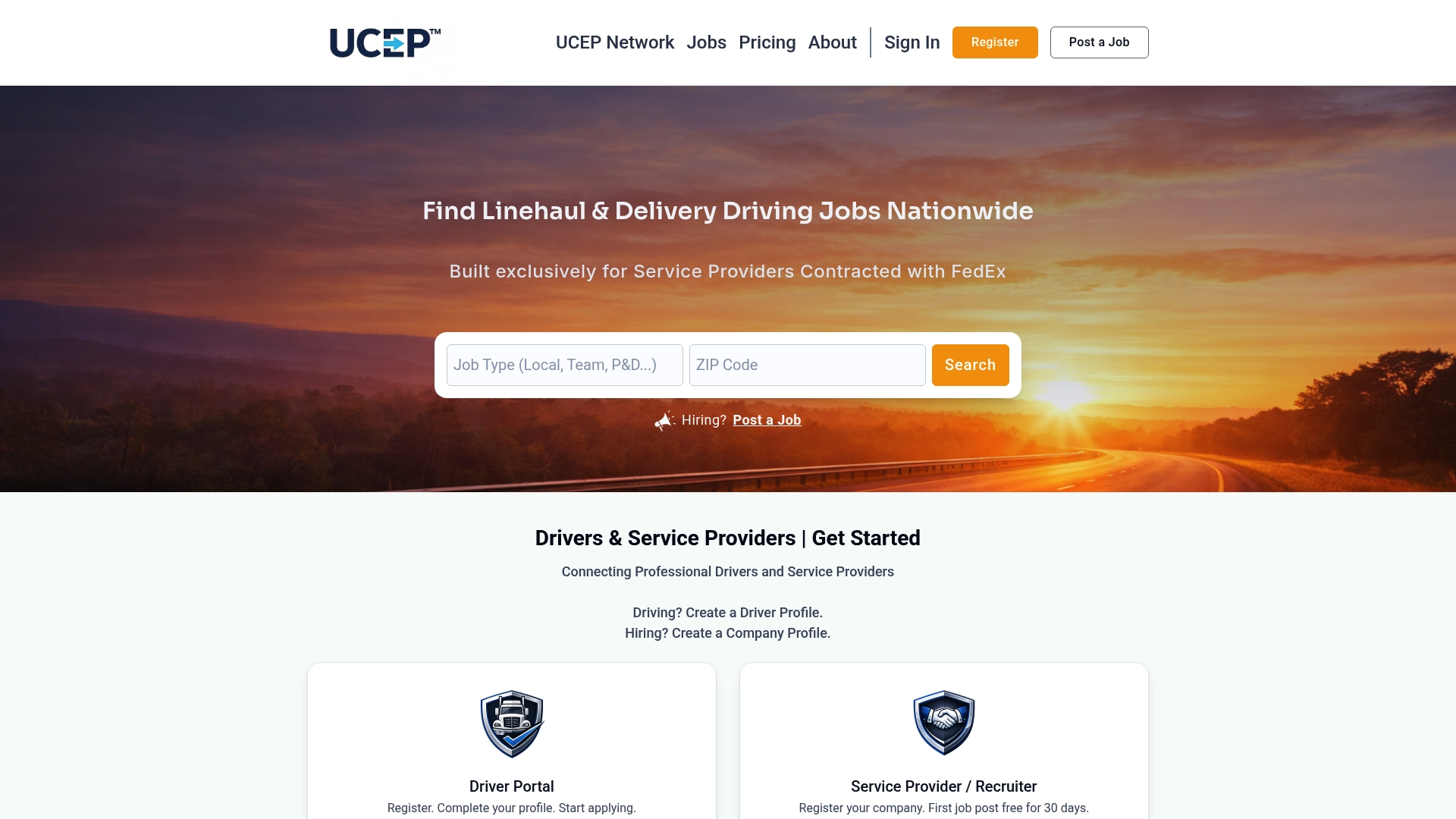
Getting started takes a few steps:
- Create an account and set job alerts tuned to pickup and delivery, CDL-A solo linehaul, or CDL-A team linehaul categories.
- Browse employer and terminal directories to check a Service Provider's history before you apply.
- Use the filtered search to narrow by route type and home-time pattern the same way you would on a broad aggregator.
Browse current openings on UCEP for pickup and delivery, solo linehaul, and team linehaul roles. Employers exploring the platform can start with the Complimentary Trial Listing or review current pricing information on the pricing page. Keep your broader aggregator saved searches running too. The strongest search strategy uses both at once rather than choosing one over the other.
FAQ
What's the easiest trucking company to get hired by?
There is no single "easiest" carrier, since hiring standards depend on your experience, endorsements, and driving record rather than the company name. Entry-level company-driver roles with major carriers tend to have the most open hiring windows, while dedicated or contractor-specific roles often require a clean MVR and sometimes a minimum experience level.
Is trucking still worth it in 2026?
Trucking remains a viable career path, with the Bureau of Labor Statistics projecting about 237,600 openings per year for heavy and tractor-trailer drivers driven mostly by replacement needs. Median pay sat at $57,440 a year as of 2024, and demand stays steady even as the industry adjusts to new regulations and parking investments.
What is the new CDL training rule drivers should know about?
Since February 7, 2022, first-time applicants for a Class A or B CDL must complete Entry-Level Driver Training through a provider registered on FMCSA's Training Provider Registry before taking the state licensing exam. Separately, federal officials have announced pro-trucker initiatives covering truck parking funding and regulatory modernization, so check current USDOT announcements for the latest updates affecting driver eligibility.
What CDL job pays around $3,000 a week?
Weekly pay in that range usually comes from specialized roles like team linehaul driving, oversized load hauling, or owner-operator positions on dedicated lanes, where pay reflects longer hours, higher skill requirements, or equipment costs the driver absorbs. Before accepting any offer at that level, confirm whether the figure is gross pay or take-home after lease, fuel, and insurance deductions, since those costs vary widely for owner-operators.
How do I find FedEx-contracted driving jobs specifically?
The most direct route is a board built for that ecosystem, such as UCEP's jobs page, which lists pickup and delivery, CDL-A solo linehaul, and CDL-A team linehaul roles with Service Providers contracted with FedEx. Running that search alongside a filtered aggregator search covers listings that might not appear in either source alone.
Sources
- Heavy and Tractor-trailer Truck Drivers : Occupational Outlook Handbook: : U.S. Bureau of Labor Statistics
- ELDT Applicability
- U.S. Transportation Secretary Sean P. Duffy unveils pro-trucker package