
Yes, FedEx requires background checks for drivers. The hiring decision hinges on three things: your motor vehicle record, your criminal history, and, for CDL roles, your DOT drug and medical clearances. Third-party vendors like First Advantage run the screening, and FMCSA Clearinghouse queries apply to CDL holders. If your report comes back wrong, you can usually fix it. Contact the screening company first, then file a dispute under the Fair Credit Reporting Act.
TL;DR:
- MVR review typically covers the past three to five years, with five-year checks often required for CDL-A positions, and serious violations can disqualify candidates regardless of age.
- Criminal records, especially felonies and DUIs within a five to seven-year window, are prioritized for disqualification, with pattern violations heavily impacting eligibility.
- Discrepancies in background reports frequently stem from identity errors, court record mixups, or outdated data, which can be corrected by disputing directly with the screening vendor.
- Testing delays for drug screens and physical exams can extend the background check process by several days, with full approval usually taking 7 to 21 days after all checks clear.
- Applicants should proactively pull their own MVR and Clearinghouse reports before applying to catch errors early and streamline the qualification process.
Table of Contents
- What a FedEx Background Check for Drivers Actually Covers
- How Far Back Checks Go and What Disqualifies Drivers
- How Long the FedEx Driver Screening Process Actually Takes
- Why Background Check Reports Come Back Wrong
- How to Dispute and Correct a FedEx Background Check Error
- What to Have Ready Before You Apply
- What Happens After Approval or Deactivation
- Where to Verify the Rules Yourself
- A Recruiter's Take on the One Thing Applicants Should Do First
- Ready to Apply to a FedEx-Related Driving Role?
- Sources
What a FedEx Background Check for Drivers Actually Covers
A FedEx driver background check is not one report. It's a bundle of separate checks, each run by a different party, each with its own rules for what disqualifies you. Knowing which check produced a red flag tells you exactly where to go to fix it.
Here's what gets pulled for most driving roles at FedEx Service Providers:
- Criminal history search. Usually a nationwide database search plus county or state-level checks in places you've lived. This looks for felony convictions, certain misdemeanors, and pending charges.
- Motor Vehicle Record (MVR). Pulled from your state's DMV, this shows license status, points, suspensions, and moving violations. For driving jobs, this carries as much weight as the criminal check, sometimes more.
- Identity verification. Confirms your Social Security number, name, and address history match across databases. This is where a surprising number of false flags originate.
- Employment verification. Confirms your work history, especially prior driving jobs, matches what you listed on your application.
- DOT drug test (safety-sensitive roles only). A standardized five-panel screen checking for marijuana, cocaine, amphetamines, opioids, and PCP under 49 CFR Part 382.
Screening companies like First Advantage typically run the criminal, identity, and employment pieces. FedEx Service Providers have commonly used First Advantage for this work, and applicants can request their own consumer background report directly from that vendor to see exactly what landed on file.
CDL applicants face an extra layer. FMCSA runs its own Clearinghouse query, a federal database that tracks drug and alcohol program violations across every employer a CDL holder has worked for. This isn't optional and it isn't something a Service Provider can skip. If you've ever tested positive or refused a test at another trucking job, it shows up here, regardless of what your paper record says.
The DOT versus non DOT distinction matters more than most applicants realize and is thoroughly addressed in industry insights on linehaul operations like those from RJR Worldwide. Non-CDL pickup and delivery roles may skip the federal drug panel depending on vehicle weight class, while CDL-A linehaul and team driving positions almost always require the full DOT physical and drug screen. If you're applying to a role that requires operating a commercial vehicle over 10,001 pounds, assume the federal requirements under 49 CFR Part 383 apply to you.
How Far Back Checks Go and What Disqualifies Drivers
Lookback windows aren't uniform, and that catches a lot of applicants off guard. Most Service Providers apply a layered approach rather than one blanket rule.
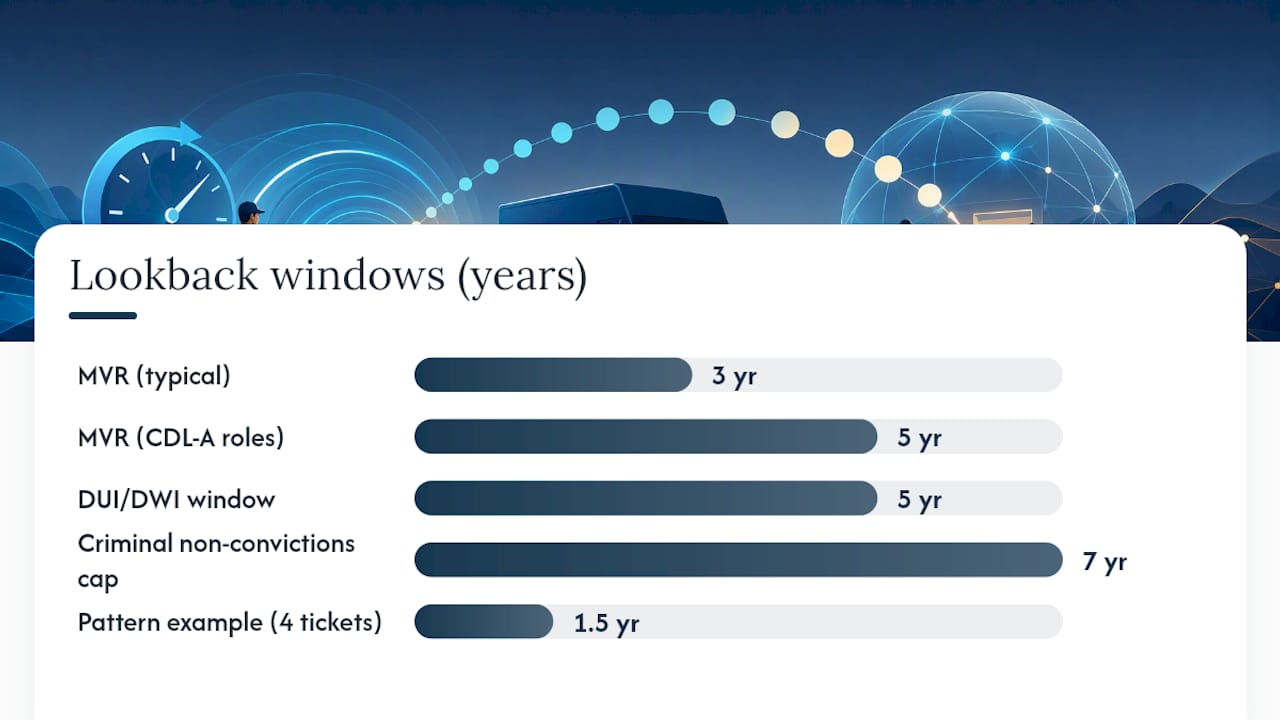
- MVR review: commonly 3 years, though some roles pull 5, especially for CDL-A positions.
- Criminal history: state laws vary, but many states cap reportable records at 7 years for non-conviction items; felony convictions can appear regardless of age in many jurisdictions.
- DUI/DWI convictions: frequently treated as disqualifying within a 5-year window under standards tied to FMCSA's commercial licensing regulations.
- Multiple moving violations: two or more serious violations within a short window (think reckless driving, following too close, or license suspensions) often trigger automatic disqualification even without a single major incident.
DUI lookbacks are commonly considered over a period of several years in the industry, and it applies whether the conviction happened in a personal vehicle or a commercial one. Serious accidents, especially those involving injury or a commercial vehicle, can weigh heavily even outside the standard lookback window because they speak directly to safety risk on the job.
Frequency matters as much as severity. A single speeding ticket from three years ago rarely sinks an application. Four tickets in eighteen months tells a different story, and it's the pattern, not any single violation, that most often costs a candidate the offer. Recruiters watching MVRs for FedEx-related roles report that a clean criminal record doesn't save an applicant who has been racking up moving violations, since driving-specific risk is exactly what the MVR check exists to catch.
How Long the FedEx Driver Screening Process Actually Takes
Turnaround time is one of the most common sources of anxiety for applicants, and it's also one of the easiest things to set realistic expectations around.
- Standard criminal and identity checks typically take several business days. This is the baseline for most non-DOT positions once the screening company has your consent and identifying information.
- DOT drug screen and physical: adds several days. Scheduling the clinic visit, waiting on lab results, and getting the medical examiner's certificate processed typically adds time on top of the standard check.
- Manual court record retrieval: the biggest wildcard. Some counties don't digitize records, which means a human has to physically request and review a file. This alone can stretch a timeline by a week or more.
- Full approval window: 7 to 21 days for most driving positions once every piece, MVR, criminal, drug screen, and employment verification, comes back clean and consistent.
Recruiters working with FedEx Service Providers often run a preliminary MVR pull before initiating the full background check. This lets them catch an obvious disqualifier, like a suspended license or a recent DUI, before paying for a comprehensive screen that was never going to result in a hire. If you're wondering why a recruiter asked for your license number before formally starting the process, that's usually why.
Why Background Check Reports Come Back Wrong
Report errors are more common than most applicants expect, and most of them trace back to a handful of predictable causes.
- Identity mismatches. A common last name, a maiden name still on file, or a transposed digit in a Social Security number can pull someone else's criminal record onto your report.
- Court record mixups. Records get misfiled under similar names, or a dismissed charge never gets updated in the county database the vendor pulled from.
- Reporting lag. You paid off a fine and had a case dismissed two years ago, but the courthouse database still shows it as open.
- MVR-specific errors. Wrong license number, wrong state, wrong license class, or an expired medical card that's actually been renewed but hasn't updated in the system yet.
- Missing employment verification. A former employer with an outdated contact number can leave a verification unanswered, which then reads as a gap or a red flag rather than a simple administrative miss.
Pro Tip: Before you assume the worst, pull your own MVR from your state's DMV and check your DOT Clearinghouse status yourself. Comparing what you see against what the background check flagged often reveals the exact mismatch in minutes, saving you a week of back-and-forth with a screening company.
How to Dispute and Correct a FedEx Background Check Error
Finding an error is only half the job. Fixing it requires a specific sequence, and skipping a step usually means starting over.
- Identify the screening company. Check your consent form or applicant portal. If it's First Advantage, as it commonly is for FedEx-related roles, their consumer portal is where you request your full file.
- Request your consumer report directly. Under the Fair Credit Reporting Act, you have the right to see exactly what's on file, including the source of any negative item.
- File a formal dispute. Include your full legal name, date of birth, the specific item you're disputing, and any supporting documents, a certified court disposition, a corrected DMV record, or proof of identity. The screening company has to reinvestigate.
- Contact the court clerk for record errors. If a criminal record is simply wrong or outdated at the source, the screening company can't fix the courthouse database. You need the clerk's office to issue a corrected disposition, which the vendor then reflects.
- Escalate if needed. If the screening company doesn't respond within a reasonable window or the dispute goes nowhere, the FTC's consumer guidance outlines your next options, including state consumer protection agencies.
Background-check errors happen often enough that consumer attorneys sometimes step in to help applicants correct records or pursue damages when a vendor's negligent reporting cost someone a job offer.
Keep your recruiter or Service Provider in the loop while a dispute is pending. Provide documentation showing the dispute is active, since a stalled report often reads as "no response" rather than "actively being corrected," and that distinction affects how a quals team handles your file in the meantime.
What to Have Ready Before You Apply
Recruiters working FedEx-related driving roles will tell you the same thing: most delays are not disqualifiers, they're paperwork. A blurry photo of a medical card or a mistyped license number can hold up an otherwise clean file for a week.
- A clear photo of your driver's license, both sides, with all four corners visible and no glare.
- Proof of your Social Security number that matches the name on your application exactly.
- Current contact information for former employers, especially anyone who can verify recent driving experience.
- An unexpired DOT medical card, or documentation showing your recertification date if it's pending.
- Your own recent MVR pull, so you know what a recruiter will see before they see it.
Pulling your own MVR and checking your Clearinghouse status before you apply isn't just due diligence, it's often the single fastest way to catch a problem while there's still time to address it. UCEP's driving opportunity requirements checklist and interview preparation guide walk through exactly what recruiters expect at each stage, and UCEP's job listings connect you directly to recruiters at vetted Service Providers rather than a generic application queue.
What Happens After Approval or Deactivation
Passing the screen unlocks the next phase: orientation, terminal access, and training on the specific equipment or route type you're hired for. A deactivation, on the other hand, cuts off access entirely and usually comes with a formal appeals path through the quals team rather than an informal conversation.
- Approval typically means scheduled orientation, terminal badge access, and assignment to a training route or team.
- Deactivation for a background-check issue usually includes a stated reason and, in many cases, a reapplication window.
- Reapplication timelines vary by violation, commonly ranging from 1 to 5 years depending on severity, with DUI-related deactivations often sitting at the longer end.
- Documented remediation helps. A corrected court record, a completed defensive driving course, or a clean MVR pulled well after the incident can strengthen a reconsideration case.
If you're reapplying after a correction, bring the paperwork. A quals team reviewing a second application wants to see the specific fix, not just a promise that things have changed.
Where to Verify the Rules Yourself
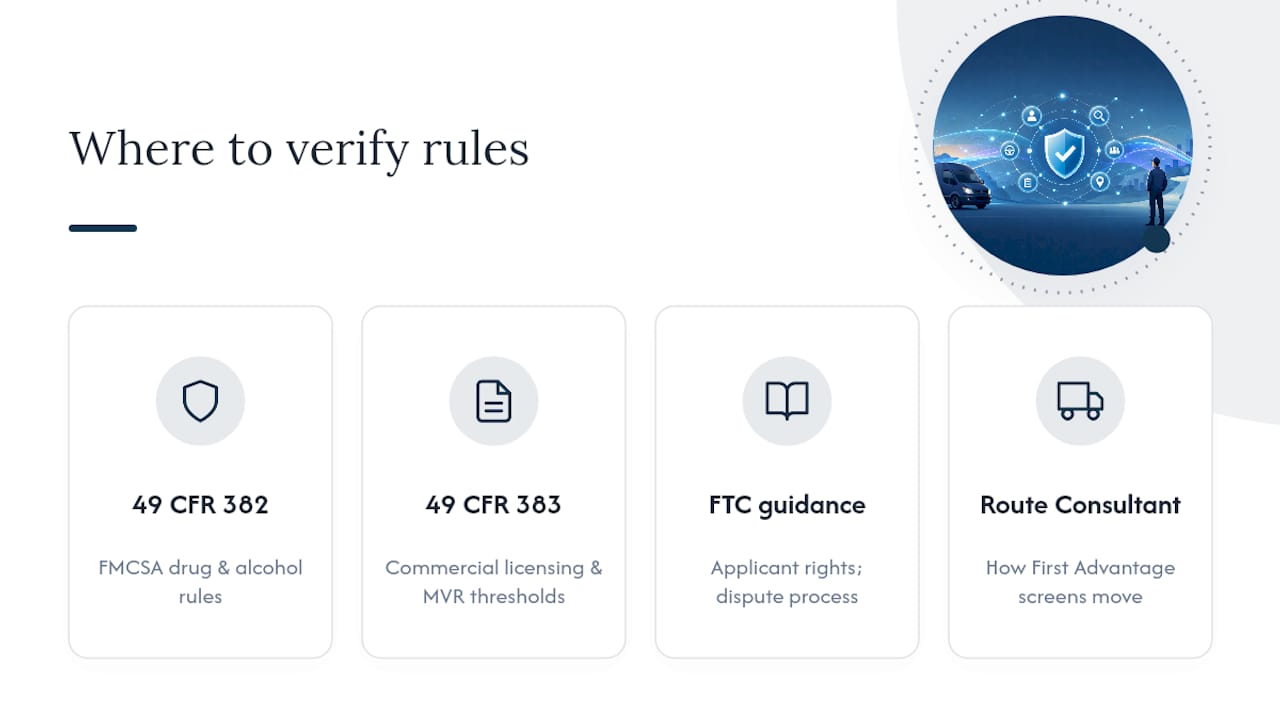
Don't take secondhand summaries as the final word on federal requirements. 49 CFR Part 382 governs DOT drug and alcohol testing rules directly from FMCSA. 49 CFR Part 383 covers commercial licensing standards, including the violation thresholds that drive most MVR disqualifications. For your rights as an applicant, the FTC's background check guidance explains the dispute process in plain language. And for the practical, contractor-side view of how First Advantage screens typically move through the system, Route Consultant's breakdown is worth reading before you apply.
A Recruiter's Take on the One Thing Applicants Should Do First
If there's one action that saves the most time, it's pulling your own MVR and checking your Clearinghouse status before a recruiter ever sees your name. Most delays trace back to something fixable, a wrong license number, an unrenewed medical card, a mismatched employer contact, and applicants who catch these early move through qualification faster than applicants who wait for the screening company to find them. Keep communication with the quals team simple and factual: state what you found, what you're doing to fix it, and when you expect resolution. Vague reassurances slow things down. Specific timelines don't.
— Aaron
Ready to Apply to a FedEx-Related Driving Role?
Once your background check documentation is in order, the next bottleneck is usually finding a Service Provider that's actually hiring and responsive. There are job boards where verified FedEx Service Providers post CDL-A team, CDL-A solo, linehaul, and pickup and delivery openings in one place, instead of scattered across general job boards that don't understand contractor-specific hiring.
Some platforms let you filter listings by role type and location, review employer profiles built from driver and Service Provider feedback, and reach recruiters directly rather than submitting into a black hole. If you've already pulled your MVR and gathered your documents, you're ahead of most applicants, so put that preparation to work. Browse companies currently hiring drivers or check listings from recruiting partners like Four Leaf Recruiting and Revolution Recruiting to see openings that match your qualifications right now.
Sources
- Fair Credit Reporting Act — Federal Trade Commission
- Employer background checks and your rights — Consumer FTC
- Navigating First Advantage for FedEx Contractors — Route Consultant