
On job boards, the fastest way to boost candidate volume, quality, and trust is pay transparency paired with a consistent, evidence-backed employer profile and real employee voice. Employers that list a salary range, mirror that language across their career page, and add a genuine driver or employee quote see more applicants and better-fit applicants. Niche boards can outperform general boards for specialized roles like commercial driving, where audience fit matters more than raw traffic.
TL;DR:
- Listing a specific pay range on job boards increases application volume by about 70% and improves candidate quality, according to SHRM research.
- Candidates are more likely to trust and apply when the job listing's language and benefits match the employer profile and career page precisely.
- Including real photos, authentic employee quotes, and clear role details in job ads significantly boosts applicant engagement and perceived credibility.
- Niche job boards outperform general boards for specialized roles by providing targeted, qualified candidates who already seek that specific work.
- Regularly measuring key metrics like apply rate, qualified candidate rate, and time-to-fill helps optimize employer branding strategies effectively.
Table of Contents
- Why Employer Brand on Job Boards Moves the Needle
- Job-Board Tactics: Craft Job Ads That Show, Don't Tell, Your Brand
- Align Your Employer Profile and Career Page With the Job Ad
- Use Employee Voices to Build Credibility on Job Boards
- Measure and Optimize Your Job-Board Branding
- When Niche Job Boards Beat General Boards
- A Recruiter's Checklist for Job-Board Branding
- Put Your Employer Brand in Front of Drivers Who Are Already Looking
- Sources
- FAQ
Why Employer Brand on Job Boards Moves the Needle
Job boards are not passive listing pages. They are the first place a candidate forms an opinion about whether your company is worth the application, and that opinion forms in seconds. SHRM's pay-transparency research found that 70% of organizations that listed pay ranges saw more applications, and 66% saw higher candidate quality. Even more telling: 82% of workers said they were more likely to apply when pay information appeared upfront, and 73% reported more trust in employers who disclosed it.
Quick Stat: Employers who publish pay ranges on job listings report 70% more applications and 66% higher candidate quality, according to SHRM.
Pay is only half the story. A 2026 study in the International Journal of Selection and Assessment found that process attributes, meaning how distinctive and consistent your employer brand feels across a candidate's search, predict job pursuit and word-of-mouth intentions beyond the content of the listing itself. Consistency mattered even more for applicants who researched thoroughly before applying, which describes most CDL and linehaul drivers comparing multiple carriers.
That combination explains why job-board branding carries outsized weight. Candidates scan listings for a few seconds before deciding whether to click "apply" or scroll past. If your headline, pay language, and profile don't align with what they find on your career site a minute later, you lose the trust you just built.

Job-Board Tactics: Craft Job Ads That Show, Don't Tell, Your Brand
A strong job ad on a board does not describe your culture in adjectives. It proves it in specifics. Here's a working structure recruiters can adapt today:
- Write a branded headline with your value proposition built in. Instead of "CDL-A Driver Needed," try "CDL-A Solo Linehaul Driver – Home Weekly, $1,400+/Week Average." The headline should answer "what's in it for me" before the candidate even clicks.
- State pay ranges explicitly, not vaguely. "Up to $80,000" reads as a ceiling nobody hits. "$68,000 to $80,000 based on route and experience" reads as a real range tied to a real reason.
- Add 3 to 5 "day-in-the-life" bullets. Cover shift length, freight type, hometime frequency, and equipment. Specificity here does the work generic culture statements can't.
- Include a benefits snapshot. Health coverage start date, PTO accrual, and sign-on bonus terms belong near the top, not buried in a paragraph.
- Use real photos and short video, not stock imagery. For driver and logistics roles, actual fleet photos, terminal shots, and real driver footage reduce the perceived risk of an unfamiliar employer more effectively than polished stock photography, based on UCEP's review of driver recruiting patterns.
- Simplify the apply flow. Mobile-first application forms, a resume-less "quick apply" option, and a one- or two-click call-to-action cut drop-off significantly among drivers applying from a phone between stops.
Pro Tip: Write your headline and pay range first, then build the rest of the ad around defending that number. If a bullet doesn't support why the pay range is fair, cut it.
Align Your Employer Profile and Career Page With the Job Ad
A job ad that promises one thing and a career page that shows another creates friction that costs you the applicant. Consistency across every touchpoint is what the process-attribute research above ties directly to stronger candidate attraction and referral behavior.
Build your employer profile and career page around the same core elements:
- A clear employer value proposition headline that matches the tone of your job ad, not a separate corporate mission statement.
- A benefit snapshot using the same numbers and language as the listing (don't say "competitive pay" on the profile if the ad names a specific range).
- Culture visuals that reflect actual operations: terminals, trucks, dispatch teams, safety gear.
- Operational notes specific to logistics roles: DOT compliance expectations, safety record, and equipment age or type.
- A staffed response process so profile visitors who reach out get an answer within hours, not days.
Run a quick audit: read your job ad and your career page back to back. If the pay, tone, or benefits described don't match word for word, a candidate researching both will notice, and that mismatch undoes the trust pay transparency just built.
Use Employee Voices to Build Credibility on Job Boards
A one-line quote from a real driver does more for credibility than another paragraph of company description. Candidates trust peers over marketing copy, and job boards give you space to show that trust cheaply.
- Place one short employee quote (15 to 25 words) directly on the job listing, ideally near the benefits section.
- Add a second, longer micro-testimonial on your employer profile page covering a specific detail, like hometime or dispatcher support.
- Surface star ratings or review counts from driver and service-provider review sites where they're strong, and address them honestly where they're not.
- Rotate quotes quarterly so the profile doesn't feel static or stale to repeat visitors.
Response speed itself functions as a reputation signal. Employers with stronger review ratings tend to respond to applicants faster, and that speed reinforces the same trustworthy image the quotes are building, according to SHRM's Executive Network research.
Pro Tip: Only use quotes you can attribute to a real person who consented to it. A vague "our drivers love it here" line without a name attached reads as filler, not proof.
Measure and Optimize Your Job-Board Branding
Branding changes only earn their place in your strategy if they move numbers. Track these four KPIs on every job-board listing:
- Apply rate — clicks-to-application ratio, tells you if the ad copy and headline are working.
- Qualified-candidate rate — the share of applicants who meet baseline requirements, tells you if the ad is attracting the right audience, not just more volume.
- Source-to-hire ratio — which boards actually convert to hires, not just applications, a metric UCEP's recruiting data flags as essential for driver roles specifically.
- Time-to-fill — how branding changes affect how fast open positions close.
Run small A/B tests to isolate what's driving results: test a headline with pay range against one without it, test a real driver photo against a stock fleet image, and test a one-click apply button against a longer form. Review results every two to four weeks, and scale a change only after it holds across at least two posting cycles, not one lucky week.
When Niche Job Boards Beat General Boards
General job boards win on raw traffic. Niche boards win on signal. When you're hiring for a specialized role like CDL-A linehaul or pickup and delivery driving, a smaller audience that's already qualified beats a massive audience you have to filter through manually.
Audience fit changes the math entirely. A general board sends you volume and makes you sort candidates who never had the right endorsements or route experience. A niche board built around FedEx-contracted driving work sends you people who already searched for exactly that job, which cuts screening time and raises the ratio of qualified applicants per posting.
UCEP was built on that premise: a job board focused exclusively on Service Providers contracted with FedEx and the drivers who want that work, rather than a general marketplace trying to serve every industry at once. The ROI case for niche boards holds up especially well for roles where specific endorsements, route familiarity, or contractor relationships narrow the real candidate pool. The practical rule: use a niche board as your primary channel for role-specific hiring, then layer a general board only when you need additional reach for high-volume openings.
A Recruiter's Checklist for Job-Board Branding

Three moves to make this week: publish your pay range if you haven't already, add one real employee quote to your top listing, and align your career page language with your job ad word for word. Small mismatches between the two are where trust quietly leaks out of the funnel.
The pattern shows up constantly: a listing gets rewritten with a specific pay range and a real photo, and application quality improves within days, not months. Branding on job boards rewards specificity over polish. Iterate weekly, measure honestly, and don't assume a tactic worked until the data across two cycles agrees with you.
— Aaron
Put Your Employer Brand in Front of Drivers Who Are Already Looking
UCEP is the alternative to competing for attention on a crowded general job board. Every listing reaches drivers actively searching for FedEx-related linehaul, CDL-A team, CDL-A solo, and pickup and delivery work, so your employer brand lands with an audience that already fits the role.
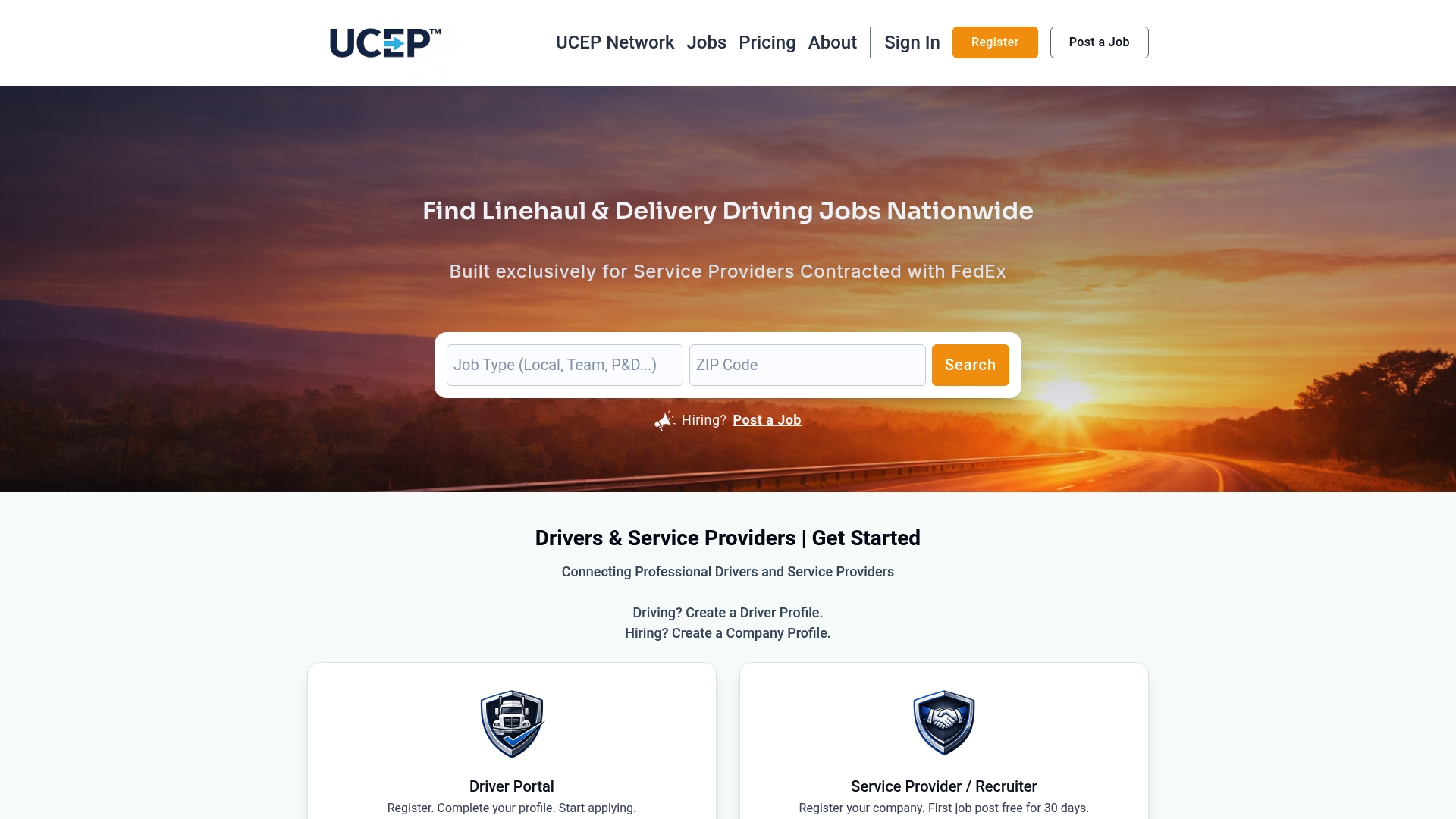
The platform gives Service Providers an employer directory, terminal directory, built-in applicant tracking, and driver reviews, so the consistency this article recommends between your job ad and your profile is easier to maintain in one place instead of scattered across five tools. Service Providers can start with a Complimentary Trial Listing or move straight to the Standard Monthly Plan. Browse current driver job listings to see how other Service Providers structure their pay ranges and benefits snapshots, then post your own with the same clarity. If you're weighing operational readiness alongside recruiting, a logistics industry partner can offer useful context on linehaul acquisition trends while you build out your posting.
Sources
- New SHRM research shows pay transparency makes organizations more competitive, leads to increase in qualified applicants
- What draws potential applicants towards an organization? The importance of employer brand process attributes and applicants' job search metacognitive activities
FAQ
What Is an Example of a Strong Employer Brand on a Job Board?
A strong example combines a headline stating the role and pay range, a "day-in-the-life" bullet list, and a short quote from a real employee. Listings that pair a specific pay range with authentic photos, rather than generic stock imagery, consistently draw more applications and higher candidate quality.
What Are the Core Elements of Employer Branding on Job Boards?
Job-board employer branding rests on four elements: a branded headline and value proposition, transparent pay information, a realistic job preview, and consistent messaging between the ad and the career profile. Some frameworks also reference audience, positioning, differentiation, and consistency as core building blocks, though exact terminology varies by source.
What Does Employer Branding Mean in a Recruiting Context?
Employer branding is how a company presents itself as a place to work, covering everything from job ad language to employee reviews to career page design. On job boards specifically, it means the impression a candidate forms in the seconds between reading your headline and deciding to click apply.
What Makes Some Employer Brands More Effective Than Others?
The strongest employer brands are distinctive and consistent, meaning they stand out from competitors and deliver the same message across every touchpoint a candidate encounters. Research on employer brand process attributes found distinctiveness and consistency predict job pursuit and word-of-mouth referrals beyond pay or job features alone.
Why Do Niche Job Boards Work Better for Driver Recruiting?
Niche job boards concentrate an audience already searching for a specific type of work, which reduces screening time and raises the share of qualified applicants per posting. UCEP applies this model to FedEx-contracted driving roles, connecting Service Providers directly with drivers seeking linehaul, CDL-A, and pickup and delivery positions.