
Detention pay is the hourly compensation a carrier bills when a driver is forced to wait at a shipper or receiver beyond the agreed free time, but collecting it requires written terms and immediate documentation. Most contracts allow a free time period of about two hours before detention charges begin, with rates varying depending on freight type. If you want to see that money, put detention terms in your rate confirmation before you haul the load, and start logging arrival timestamps the moment your wheels stop.
TL;DR:
- Detention pay is typically billed in 15 to 30 minute increments at rates ranging from $50 to $125 per hour, with a common free time window of two hours.
- Documentation must include timestamped photos, GPS/ELD data, signed bill of lading, and precise timestamps to successfully claim detention pay.
- Low detention rates and unpaid invoices often result from vague contract language, missing documentation, or delays in submitting claims within designated windows.
- Acceptable detention clauses should specify clear start triggers, rates, caps, and submission processes; vague wording or approval requirements usually lead to denied claims.
- Reducing detention exposure involves choosing facilities with faster turnaround, favoring drop-and-hook loads, and standardizing documentation procedures for faster claim submission.
Table of Contents
- What Counts as Detention Pay in Trucking
- How Detention Time Gets Calculated, Step By Step
- What Detention Actually Pays, by Freight Type and Driver Type
- Who Actually Pays Detention, and Why So Many Invoices Go Unpaid
- How to Document and Submit a Detention Claim
- Contract Language to Insist On, and Red Flags to Walk Away From
- Cutting Down Wait Time and Raising Your Collection Rate
- What Detention Pay Really Costs Drivers, and Where UCEP Fits In
- Sources
What Counts as Detention Pay in Trucking
Detention pay compensates for time spent waiting at a shipper or receiver beyond the free time window written into the contract or rate confirmation. It is not the same thing as layover pay, which covers time between loads when you are held overnight or waiting for a new dispatch with no freight on your trailer. It is also not demurrage, a separate fee that applies to shipping containers or trailers sitting at a port or rail terminal, not to a driver waiting at a dock.
These terms get mixed up constantly, and that confusion costs drivers money when they bill the wrong accessorial or when a broker uses the mix-up to deny a valid claim. If you regularly haul intermodal freight, understanding the split between over-the-road detention and container-based demurrage matters even more, since the difference between drayage and standard trucking changes who you invoice and under what rules.
Detention almost always traces back to a handful of recurring triggers:
- Warehouse or distribution center backlogs that leave trucks stacked in a yard queue
- No open dock door assigned at your scheduled appointment time
- Receiver staff shortages that slow unloading, especially on Mondays and after holidays
- Paperwork delays where the bill of lading or seal number does not match the system
- Live-load or live-unload appointments where the facility simply runs behind schedule
Detention applies at the shipper or receiver. Layover applies between dispatches. Demurrage applies to equipment sitting at a terminal. Knowing which one you are actually owed determines which accessorial code goes on your invoice.
How Detention Time Gets Calculated, Step By Step
The clock starts from whichever timestamp your contract names, and that single word choice decides whether you get paid for the first hour of your wait. Some rate confirmations start the clock at your scheduled appointment time. Others start it at actual arrival or check-in at the guard shack. A clause that reads "scheduled appointment" instead of "actual arrival" can shave real money off your invoice if you arrive early and the facility runs late, so push for "actual arrival or check-in" language every time you negotiate.
Once the clock starts, here is the typical structure you're working with:
- Free time window: Usually two hours before detention charges begin accruing.
- Billing increment: Most carriers bill in 15 or 30 minute blocks once free time expires.
- Hourly rate: Commonly $50 to $125 per hour depending on freight type and equipment.
- Daily cap: Many contracts cap total detention billed per stop, often between $250 and $500.
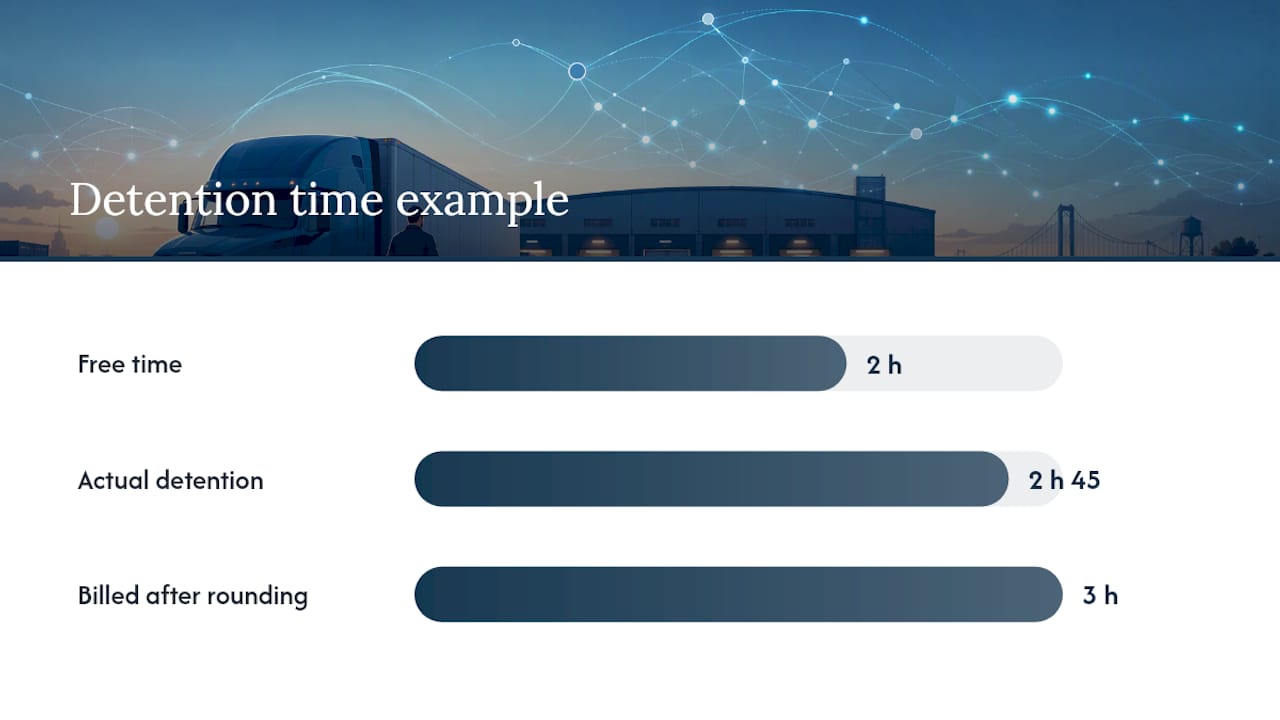
Worked example: Your appointment is 8:00 AM. You check in at 7:50 AM and get a signed release at 12:35 PM. Free time covers 7:50 AM to 9:50 AM. Detention runs from 9:50 AM to 12:35 PM, which is 2 hours and 45 minutes. Rounded to the next 15 minute increment, that's 3 hours billed at $75 per hour, for a $225 line item.
On the invoice itself, list the stop number, facility name, check-in and release timestamps, total detention hours after rounding, your contracted rate, and the total dollar amount. Attach your supporting documents directly to that line item rather than emailing them separately, since detention charges get calculated from those exact timestamps and any gap invites a dispute.
What Detention Actually Pays, by Freight Type and Driver Type
Rate ranges shift more by freight and equipment type than most new drivers expect, and knowing the band for your specific trailer type gives you real leverage when you push back on a lowball offer.
- Dry van: Typically $50 to $75 per hour, the most common and most negotiated category.
- Reefer: Typically $60 to $90 per hour, reflecting the added risk of temperature-sensitive freight sitting idle.
- Flatbed: Typically $65 to $100 per hour, often tied to strapping and tarping delays as much as dock waits.
- Specialized/heavy haul: Can run up to $125 per hour given the equipment and permitting involved.
Company drivers, owner-operators, and team drivers all face the same wait, but the financial impact lands differently. A company driver on hourly or mileage pay loses earning time regardless of whether detention gets billed. An owner-operator eats the fuel, insurance, and equipment cost of a parked truck whether or not the invoice ever gets paid, which is why negotiating the rate matters more for owner-operators than anyone else in the chain.
The scale of the problem is bigger than most single-truck operators realize. ATRI's 2024 analysis puts the industry-wide cost at $15.1 billion a year, with detention occurring at roughly 39.3% of stops and accounting for about 135 million lost driver hours annually. That means detention hits a driver at nearly two out of every five stops, not as some rare exception worth shrugging off.
Who Actually Pays Detention, and Why So Many Invoices Go Unpaid
Detention money almost never comes directly from the party who caused the delay. The typical flow runs from carrier to broker, then from broker to shipper or receiver, and each additional link in that chain is another place where a claim can stall or get quietly dropped.
Brokers are often reluctant to push shippers on detention because the shipper is their paying customer relationship, not the carrier. That structural conflict is a major reason detention invoices sit unpaid for weeks or get rejected outright over a technicality. Federal rule 49 CFR 371.3 gives carriers the right to request the broker's transaction records, including what the broker actually charged the shipper for the load. That right helps you verify whether detention was billed upstream at all, though it does not force the broker to pay you faster or force the shipper to approve the charge.
Small carriers fail to collect detention for reasons that have nothing to do with whether the claim is valid:
- No dedicated back-office staff to chase down unpaid accessorials
- Missing or incomplete documentation submitted after the deadline
- Rate confirmations that never named detention terms in the first place
- Owner-operators who prioritize the next load over a two-week-old invoice dispute
The gap between detention owed and detention actually collected is one of the more consistently cited pain points in the industry, and it traces almost entirely back to paperwork and follow-through rather than legitimate disputes over whether the wait happened.
How to Document and Submit a Detention Claim
Collecting detention pay is mostly a documentation problem, not a persuasion problem. Brokers and shippers respond to timestamped evidence, not phone calls describing how long you sat in a yard.
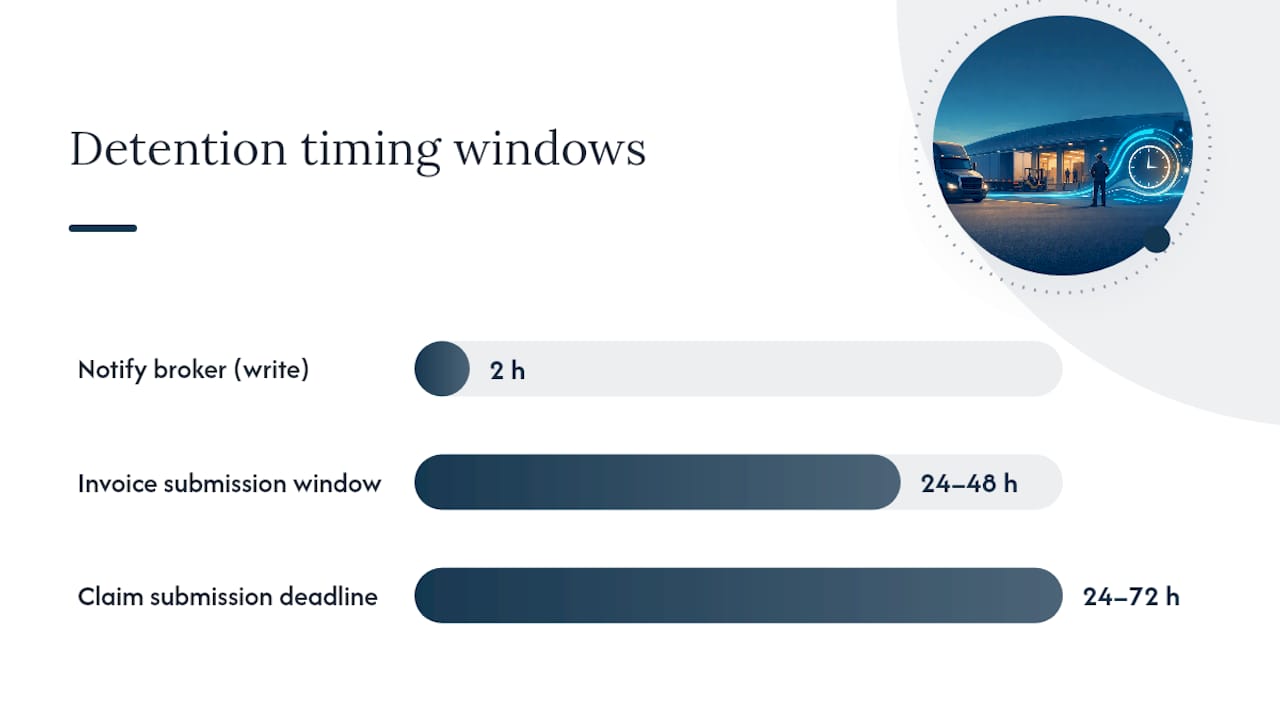
- At the two-hour mark, notify the broker in writing. A text or email with a timestamp starts a paper trail that forces the broker to engage the shipper earlier rather than later.
- Photograph the gate log or check-in slip showing your actual arrival time, plus a photo of the dock or yard showing your trailer still loaded or unloaded.
- Pull your ELD or GPS data for the stop, showing engine-off time and duration on-site as an independent record separate from anything the facility controls.
- Get the bill of lading signed with a release timestamp the moment you're cleared, since that closes out your detention window cleanly.
- Assemble the invoice within 24 to 48 hours, attaching the ELD extract, gate photo, signed BOL, and a reference to the specific detention clause in your rate confirmation.
- Follow up on a fixed cadence, typically every 3 to 5 business days, rather than waiting for the broker to circle back on their own schedule.
Submission deadlines matter more than most drivers assume. Many rate confirmations specify a window of 24 to 72 hours to submit a detention claim, and missing that window is grounds for automatic denial regardless of how solid your documentation is.
Pro Tip: Save a detention invoice template with pre-built fields for stop number, timestamps, rate, and increment math. Filling in a template at the truck stop takes five minutes; building one from scratch after a long day makes it far more likely you miss the submission deadline entirely.
Contract Language to Insist On, and Red Flags to Walk Away From
Your leverage over detention exists almost entirely at the moment you accept the load, not after you're already sitting in the yard. Once you sign a rate confirmation with no detention clause, you have no contractual basis to bill for the wait.
Before accepting a load, confirm the rate confirmation spells out:
- A clear definition of free time, stated in hours, not vague language like "reasonable time"
- The exact start trigger, specified as actual arrival or check-in, not scheduled appointment
- The hourly detention rate in dollars, not "to be negotiated" or "market rate"
- The billing increment, either 15 or 30 minutes
- Any daily cap on total detention billable per stop
- The submission window and the exact process, including who to email and what to attach
- A commitment that the facility will provide a timestamp or signature on request
Watch for language that quietly guts your ability to collect. A clause requiring "shipper approval before detention is billed" with no named contact or process is a near-guaranteed denial machine, since vague approval wording gives the shipper an easy out with no accountability. Submission windows longer than 72 hours, requirements for proof that's impossible to obtain at a rural facility, or any clause that omits a dollar rate entirely should all trigger a renegotiation before you accept the load.
Pro Tip: If a broker won't put a detention rate in writing, treat that itself as information. Build the detention risk into your all-in rate instead of hoping the wait doesn't happen.
Cutting Down Wait Time and Raising Your Collection Rate
Reducing detention exposure is partly about which loads you take and partly about how consistently you document the ones you accept.
On the operational side: track which facilities detain you repeatedly and factor that history into whether you accept future loads there. Push for scheduling windows instead of hard appointment times when a facility has a pattern of running behind. Favor drop-and-hook freight over live loads whenever the lane allows it, since drop-and-hook removes the wait entirely rather than just billing for it.
On the paperwork side: standardize your invoice template so every claim looks identical and professional. Set up automatic ELD timestamp extraction if your device supports it, so you're not manually screenshotting logs under time pressure. Notify the broker the moment you hit the two-hour mark instead of waiting until you're released, since immediate notification forces the broker to start working the shipper while you're still sitting there rather than after the fact.
If a broker has a documented history of denying detention or a facility detains you on more than half your visits, that's your signal to either refuse the load or demand a higher all-in rate that already prices in the expected wait.
What Detention Pay Really Costs Drivers, and Where UCEP Fits In
Detention doesn't just cost carriers money. It costs drivers hours they could spend running paid miles, and it's a quiet driver of turnover at carriers who never fix the pattern. Ucep exists to help drivers find FedEx-contracted Service Provider roles with clearer pay practices, and browsing service provider reviews before you sign on is one of the simplest ways to spot carriers who handle detention fairly versus ones who don't.
— Aaron
Sources
- What are detention charges and how are they calculated?
- Understanding detention pay clauses
- DOT Office of Inspector General materials on detention impacts