
The fastest way to find FedEx-related emergency management jobs — meaning CDL-A linehaul, team, solo, and pickup & delivery roles with FedEx Ground-contracted ISPs — is through Ucep, where FMCSA-compliant ISP listings are filtered by role type and location. Two actions get you moving immediately:
- Create or update your Ucep profile and set job alerts for CDL-A linehaul or P&D openings in your target region.
- Gather your core documents now: CDL-A license, valid DOT medical card (MedCard), current DMV printout, SSN/I-9 documents, and background check consent forms.
Key Takeaways
FedEx-related driving roles are filled by ISPs, not FedEx directly — and Ucep is the fastest channel to find and apply for verified openings.
| Point | Details |
|---|---|
| Use Ucep first | Ucep lists verified FedEx ISP openings filtered by role type and location nationwide. |
| Prepare documents before applying | CDL-A, DOT MedCard, DMV printout, and I-9 documents uploaded upfront cut hiring time significantly. |
| ISPs are your employer | You are a W-2 employee of the ISP; the ISP handles payroll, workers' comp, and discipline. |
| Pay varies by role type | P&D typically pays per stop; linehaul pays per mile — compare total weekly earnings, not just rates. |
| Respond fast to ISP outreach | Same-day responsiveness is one of the strongest predictors of a fast hire. |
Table of Contents
- Where can you find legitimate FedEx-related driving openings?
- What roles count as FedEx emergency-management driving positions?
- What qualifications and documents do you need ready?
- What does pay look like for FedEx ISP drivers?
- What does the hiring process look like from start to first shift?
- How does the ISP–FedEx relationship affect your employment?
- How do you apply for roles using Ucep?
- What questions should you ask, and what are the red flags?
- What should you focus on in your first 30 days?
- What actually gets drivers hired faster?
- Ucep puts FedEx ISP hiring in one place for you
- Sources
Where can you find legitimate FedEx-related driving openings?
Knowing where to look saves time and keeps you away from third-party scams. Four channels are worth your attention.
| Channel | Who posts | Reliability | Speed to apply |
|---|---|---|---|
| Ucep | FedEx-contracted ISPs | High — ISP-verified listings | Fast — direct profile match |
| ISP direct websites | Individual ISPs | Moderate — varies by ISP | Moderate |
| FedEx terminal boards | Local terminal hiring staff | High — terminal-sourced | Varies by terminal |
| General job boards | Mixed employers | Low — unverified ISP status | Slow — manual vetting needed |
Ucep is purpose-built for this market. General job boards mix ISP postings with unrelated logistics roles, making it hard to confirm the employer is actually a FedEx-contracted Service Provider.
Pro Tip: To verify a posting is a genuine ISP position, check that the employer name appears in the Ucep employer directory or that the job description references FedEx Ground service standards, ISP ownership, and W-2 employment. Any posting that asks you to pay a fee or supply equipment upfront is a red flag.
What roles count as FedEx emergency-management driving positions?
In this context, "emergency management jobs" refers to the driving and logistics roles that keep FedEx Ground service running, especially during peak demand. P&D routes are generally easier to enter and use box trucks or step vans, while linehaul requires a CDL-A and covers long distances with different schedule expectations.
| Role | Typical vehicle | CDL required | Home time | Public contact |
|---|---|---|---|---|
| Pickup & Delivery (P&D) | Step van, box truck | No CDL required (varies by ISP/weight) | Daily | High — residential and business stops |
| CDL-A Solo Linehaul | Tractor-trailer | CDL-A required | Mostly home weekly | Terminal-only |
| CDL-A Team Linehaul | Tractor-trailer | CDL-A required (both drivers) | Less frequent | Terminal-only |
For team driving specifics, this guide on succeeding as a team driver covers the coordination and schedule demands in detail. P&D drivers interact with customers at every stop; linehaul drivers move freight between terminals with minimal public contact.

What qualifications and documents do you need ready?
ISPs screen quickly. Having every document ready before you apply shortens your hiring timeline by days.
- CDL-A license (required for linehaul; confirm weight class with ISP for P&D)
- Valid DOT medical card (MedCard) — must be current, not expired
- Current DMV driving record printout — most ISPs require the last 3–5 years
- SSN verification and I-9 documents (passport or driver's license + Social Security card)
- Background check consent form — ISPs run criminal and employment history checks
- Drug screen paperwork — pre-employment drug test is standard; linehaul roles require a background check and drug screening as part of the process
- Form W-4 — you are a W-2 employee of the ISP, not an independent contractor
- Workers' comp acknowledgment — ISPs carry workers' comp per state law; confirm coverage before your first shift
For a full qualification checklist, see the FedEx driving opportunity requirements list. State-specific rules on payroll deductions and workers' comp vary; confirm your state's requirements with the ISP's HR contact during onboarding.
What does pay look like for FedEx ISP drivers?
FedEx Ground ISPs use a mix of per-stop or per-package fees for P&D and per-mile rates for linehaul; ISP net margins commonly range roughly 10–15%, though individual operations vary. That margin directly shapes what ISPs can pay drivers.
Worked example: A solo linehaul driver running 2,500 miles per week at $0.60/mile earns $1,500 gross weekly. A P&D driver completing 120 stops per day at $2.00/stop earns $1,200 for a five-day week. The per-stop model rewards efficiency; the per-mile model rewards consistent mileage.
ISPs may also offer peak-season differentials (November through January), sign-on bonuses, and limited health benefits. Always ask what is included in writing. ISPs staff up significantly more drivers during peak season, so openings increase sharply in Q4.
What does the hiring process look like from start to first shift?
| Step | Typical duration | Common delay |
|---|---|---|
| Application submission | Same day | Incomplete profile or missing docs |
| Phone screen | 1–3 days | Slow applicant response |
| Background and DMV check | 2–5 days | Unresolved violations or gaps |
| DOT physical and drug screen | 1–3 days | Scheduling delays |
| Orientation and road check | 1–2 days | ISP scheduling |
| First dispatched route | Day after orientation | Paperwork not finalized |
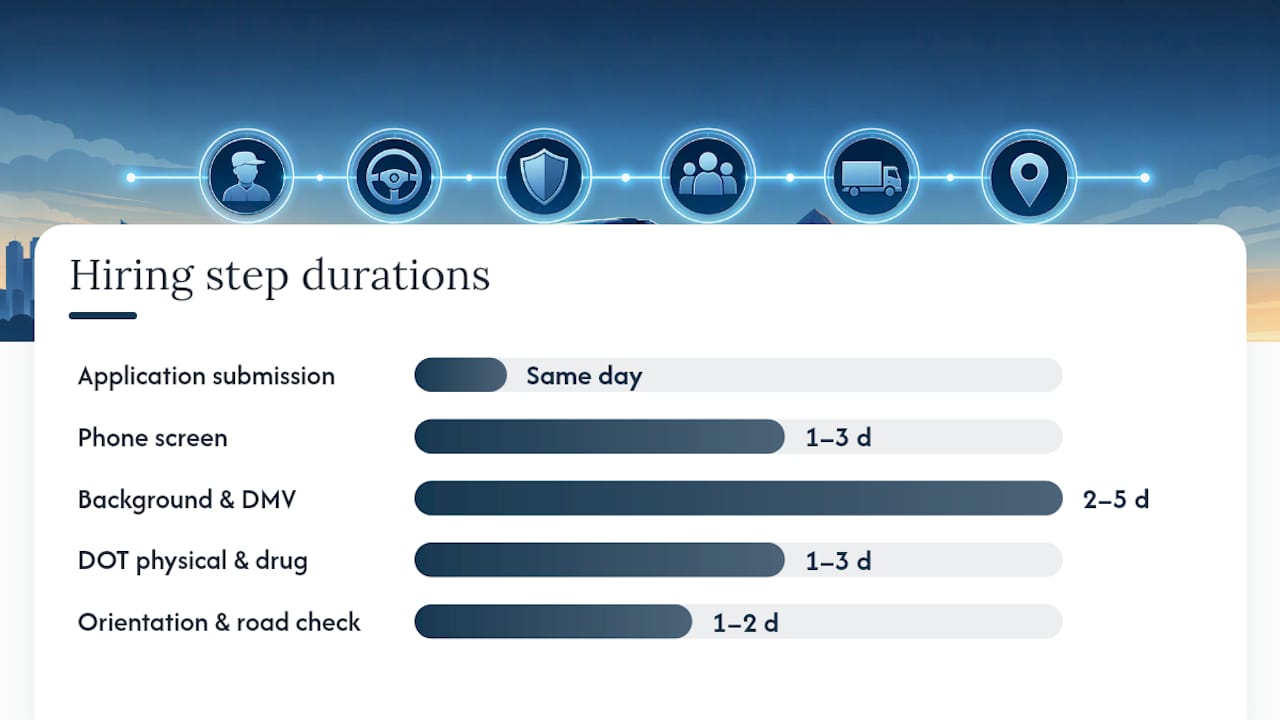
Total time from application to first shift typically runs 7–14 days when documents are complete upfront. For a detailed look at hiring linehaul drivers fast, the biggest bottleneck is almost always the DOT physical.
Pro Tip: Schedule your DOT physical the same day you submit your application. Pre-upload your DMV printout and background check consent to Ucep before applying so ISPs can start screening immediately. A clean record with no gaps moves you to orientation within a week.
How does the ISP–FedEx relationship affect your employment?
This distinction matters for your paycheck, your benefits, and who you report to.
ISPs are independent contractors to FedEx Ground. They make all hiring, firing, and employment decisions for their drivers. FedEx sets service standards and vehicle requirements, but your employer is the ISP — a separate small business. Legal analysis from Buchalter confirms that ISPs must maintain this separation and bear full responsibility for overtime, recordkeeping, and payroll compliance.
Practical implications for drivers:
- Payroll taxes are withheld by the ISP; you receive a W-2 at year end, not a 1099
- Workers' compensation is the ISP's responsibility under state law
- Discipline and scheduling come from the ISP, not from FedEx
- Uniform and vehicle standards are set by FedEx but enforced by the ISP
Per FleetWage's contractor compliance guide, ISPs must also carry FedEx-required insurance minimums and meet vehicle maintenance standards. The common myth that FedEx drivers are independent contractors is incorrect for ISP-employed drivers. You are a W-2 employee of the ISP.
How do you apply for roles using Ucep?
Ucep is built specifically for this market. Here is how to use it efficiently:
- Create your profile. Add your CDL class, endorsements, years of experience, and preferred role type (linehaul, P&D, team, solo).
- Upload your documents. Attach your CDL-A, MedCard, and DMV printout directly to your profile so ISPs can verify credentials before the interview.
- Set job alerts. Filter by role type and state to receive notifications when new ISP openings match your criteria.
- Use the employer directory. Browse the Ucep network to research ISPs before applying — check terminal locations, fleet size, and posted reviews.
- Research ISP reviews. Read service provider reviews from other drivers to evaluate pay practices and management before you commit.
- Apply directly. Submit your application through Ucep's applicant tracking system so the ISP receives a complete, verified profile.
Pro Tip: Use Ucep's role-type filters to narrow results to CDL-A linehaul or P&D only. ISPs with complete company profiles and active review histories tend to be more organized employers — prioritize those listings when you have multiple options.
What questions should you ask, and what are the red flags?
| Your question | Red-flag answer |
|---|---|
| "How often is payroll processed?" | "We pay when routes settle" — no fixed schedule |
| "Do you carry workers' comp?" | "You're covered under FedEx's policy" — incorrect; ISP must carry it |
| "Who owns and maintains the vehicle?" | "You'll need to cover repairs" — cost-shifting to drivers |
| "Is this a W-2 position?" | "You'll be a contractor" — misclassification risk |
| "What is the background check provider?" | No clear answer or vague response |
For more examples of driver recruiting red flags, pause any application where the ISP cannot confirm workers' comp coverage or payroll frequency in writing. Verify insurance by asking for the certificate of insurance before orientation. Uniform and vehicle cost deductions from your paycheck require written authorization under federal wage law.
What should you focus on in your first 30 days?
- Complete all onboarding paperwork on day one. Missing a W-4 or I-9 document delays your first paycheck.
- Perform a full pre-trip vehicle inspection every shift. Document any existing damage in writing before you drive.
- Complete any required driver-safety training assigned by the ISP during orientation.
- Learn your top five routes before week two. Ask dispatch for route maps and delivery windows.
- Log all scan exceptions immediately. Missed scans affect ISP performance metrics with FedEx.
- Report any vehicle incident or workplace injury the same day. Notify your ISP supervisor and document the incident in writing to protect your workers' comp rights.
- Confirm your payroll schedule and direct deposit setup before your first pay date.
For a full CDL driver onboarding checklist, the first week is mostly paperwork and route familiarization. Week two is where performance expectations become real.
What actually gets drivers hired faster?
Three factors predict a fast hire more reliably than anything else: a clean DMV record, a complete document upload before the first interview, and same-day responsiveness to ISP calls or messages.
ISPs move quickly when they have an opening. A driver who takes 48 hours to return a call often loses the slot to someone who responded in two hours. Your profile on Ucep functions as your first impression — a blank or incomplete profile signals low readiness to a hiring manager reviewing 20 applications at once.
The timeline expectation worth setting: if your record is clean and your documents are ready, 7–10 days from application to first shift is realistic. If you need to schedule a DOT physical or resolve a DMV issue, add 5–7 days. Plan accordingly, especially if you are targeting a peak-season start.
Ucep puts FedEx ISP hiring in one place for you
Searching general job boards for FedEx-related driving roles wastes time on unverified postings. Ucep is built for exactly this: a focused platform where FedEx-contracted ISPs post CDL-A linehaul, team, solo, and P&D openings, and where you can research employers before you apply.
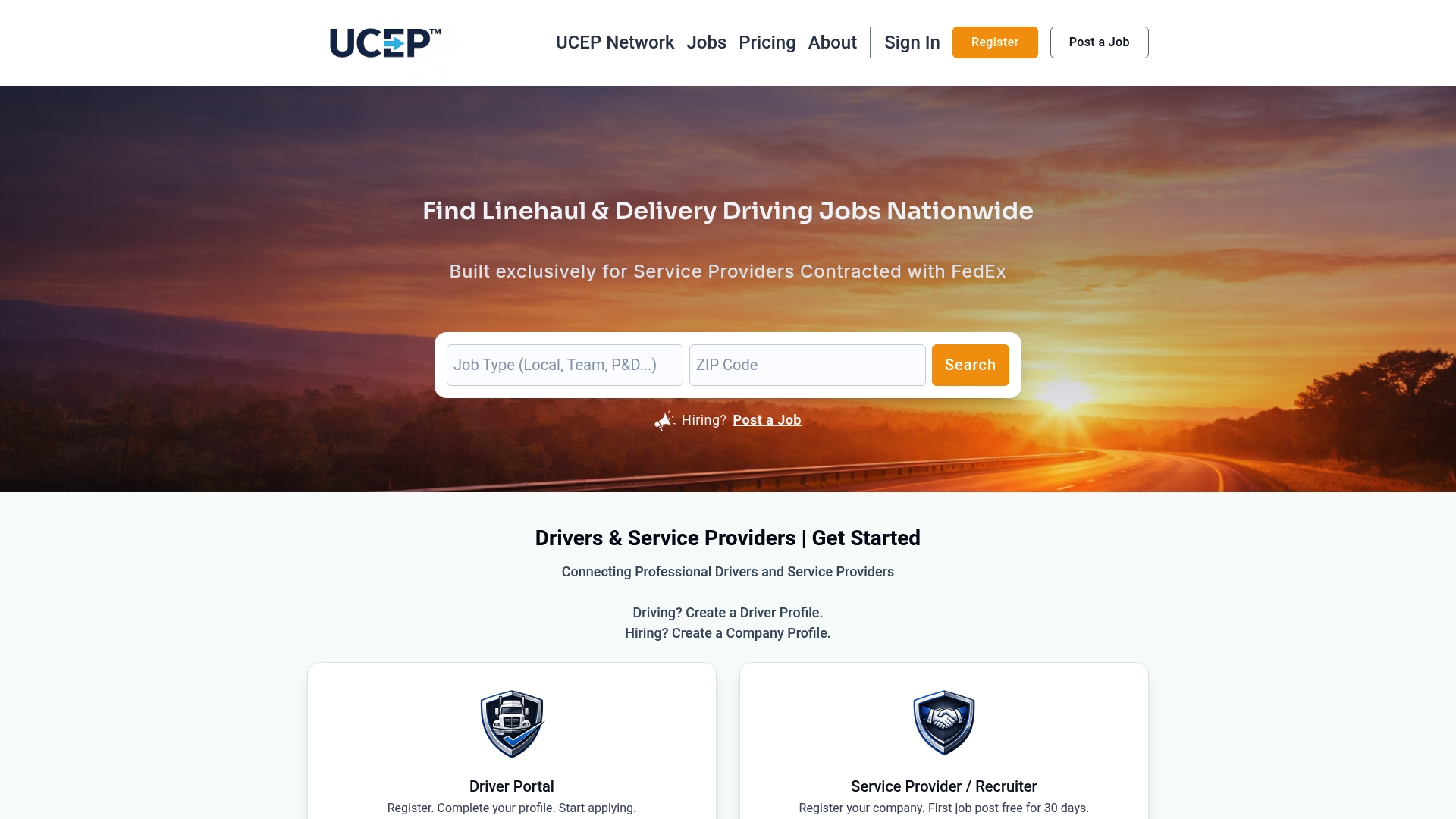
Ucep gives you filtered job listings by role and state, an employer directory with terminal locations, driver-submitted ISP reviews, and a profile system that lets ISPs verify your credentials before the phone screen. Free for job seekers. Browse active ISP openings and set your first job alert today.
Sources
- Gensoli and Eppich v. FedEx Ground: Overtime and recordkeeping risks in contractor-based delivery systems — Buchalter
- FedEx Contractor Compliance Guide — Labor Laws & Regulations | FleetWage
- What Is a FedEx Ground Contractor? Routes, Pay, and Costs - LegalClarity
- Pickup and Delivery vs. Linehaul FedEx Ground Routes — RouteAdvisors