
Team driving is defined as two CDL-qualified drivers sharing a single truck to keep it moving nearly around the clock, making it the most efficient method for covering long-haul distances quickly. Under this arrangement, one driver operates the truck while the other rests in the sleeper berth, then the two swap roles at regular intervals. The FMCSA hours-of-service rules allow each driver up to 11 hours of driving per duty period. That means a team truck can stay in motion 20–22 hours per day, far beyond what any solo driver can legally manage. For professional drivers weighing long-haul opportunities and for logistics operators evaluating freight options, understanding why team driving suits long hauls comes down to three factors: operational efficiency, financial potential, and driver well-being.
Why team driving suits long hauls: efficiency and earnings
The core advantage of team driving is simple. A solo driver legally covers roughly 2,000–2,800 miles per week. A team covers 4,500–5,500 miles per week. That gap directly translates to faster deliveries and higher gross pay potential.

Carriers recognize this productivity. They often assign team drivers newer equipment and prioritize them for premium freight loads, including expedited and time-sensitive shipments. Expedited freight paying $3.00–$4.50 per mile favors team driving because solo drivers cannot cover those distances within required delivery windows. Teams can.
Carriers also offer bonus incentives ranging from $5,000 to $15,000 to attract team drivers. That reflects how much carriers value the higher asset utilization that teams provide.
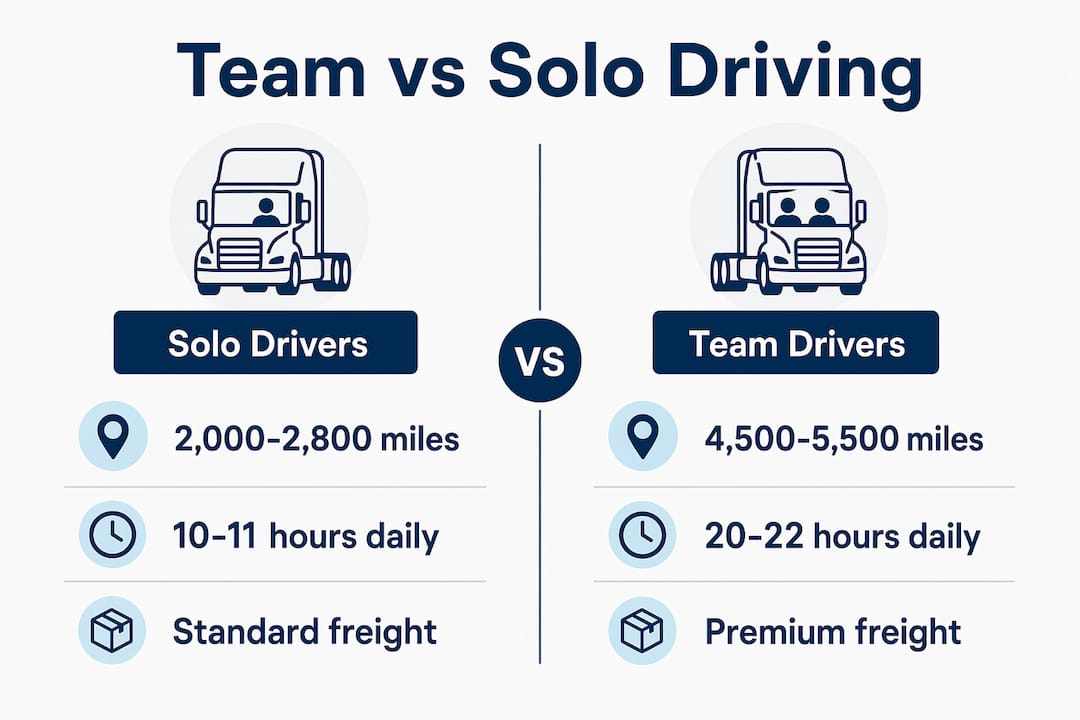
| Metric | Solo driver | Team drivers |
|---|---|---|
| Weekly miles | 2,000–2,800 | 4,500–5,500 |
| Daily operating hours | 10–11 hours | 20–22 hours |
| Freight access | Standard loads | Standard + expedited |
| Carrier incentives | Standard | Bonus $5,000–$15,000 |
Pro Tip: Coordinate shift handoffs at fuel stops or truck stops rather than mid-highway. Clean transitions reduce idle time and keep your weekly mileage at the top of the range.
What psychological and safety advantages do team drivers gain?
Long-haul solo driving is isolating. Weeks away from home with no one to talk to creates real mental fatigue. Team driving directly addresses this. Compatible partners provide social support that reduces emotional stress and helps both drivers stay mentally sharp over long haul periods.
The safety benefits are equally concrete:
- Reduced fatigue risk. One driver always rests while the other drives, preventing the cumulative exhaustion that builds over solo multi-day runs.
- Second set of eyes. Your partner can assist with tight docking maneuvers, back-of-truck checks, and navigating unfamiliar terminals.
- Shared problem solving. Mechanical issues, weather decisions, and route changes benefit from two experienced perspectives.
- Operational backup. When one driver is sick or injured, the other can absorb more driving within legal limits to keep the load on schedule.
"Team driving's greatest advantage beyond pay is psychological resilience from companionship, reducing isolation and mental fatigue in long-haul trucking." — USA Trucker Choice
Sleeping in a moving truck does present a real challenge. Motion and road noise disrupt rest, and some drivers never fully adapt. Poor sleep quality increases fatigue risk and affects performance. Teams that manage this well establish consistent sleep schedules and invest in quality blackout curtains, earplugs, and mattress toppers for the sleeper berth.
What are the challenges and compatibility considerations in team driving?
Team driving places two people in roughly 70 square feet of shared living space for days or weeks at a time. That reality makes personality compatibility more important than almost any other factor. Many partnerships dissolve within months, and the cause is rarely financial. It is almost always personal conflict.
Common friction points include:
- Temperature preferences. One driver runs hot, the other cold. The sleeper thermostat becomes a daily negotiation.
- Cleanliness standards. Differing habits around food, trash, and personal items create tension fast in a small cab.
- Communication styles. Some drivers want to debrief every decision; others prefer silence. Mismatched styles wear on both parties.
- Sleep and wake schedules. Noisy pre-trip routines or phone use during the other driver's rest period are frequent complaints.
- Driving habits. Aggressive braking or hard acceleration wakes a sleeping partner and creates safety concerns.
Unresolved conflict is the chief cause of early team failure. Addressing these issues before the first load, not after the third argument, is what separates successful teams from short-lived ones.
Pro Tip: Before committing to a long-term team arrangement, do a short trial run of two to three days with your prospective partner. You will learn more about compatibility in 48 hours on the road than in any interview.
How do the economics of team driving compare to solo driving?
Team driving doubles gross revenue potential. It also roughly doubles vehicle operating costs. Net income depends on the specific freight contract and how costs are shared between drivers.
Maintenance, tire wear, fuel consumption, and depreciation all increase with mileage. A team truck running 5,000 miles per week burns through tires and engine hours faster than a solo truck running 2,500. Owner-operators absorb these costs directly. Company drivers do not, which changes the math significantly.
The clearest financial advantage for teams appears in expedited freight. Net income depends on freight contracts and team arrangements, but teams running $3.00–$4.50 per mile expedited loads consistently outperform solo drivers on gross pay. Couple teams often have lower friction over cost sharing than carrier-matched strangers, which also affects net outcomes.
| Scenario | Gross revenue potential | Key cost factor | Net income outlook |
|---|---|---|---|
| Company team drivers | High | Minimal personal costs | Strong, especially with bonuses |
| Owner-operator team | Very high | Fuel, tires, maintenance | Depends on freight rate |
| Couple team | High | Shared personal costs | Often favorable |
| Carrier-matched team | Moderate to high | Potential conflict costs | Variable |
Pro Tip: Before accepting a team position as an owner-operator, calculate your cost-per-mile at the expected weekly mileage. A $0.10 increase in cost-per-mile at 5,000 miles per week adds up to $500 per week in additional expenses.
What best practices help team drivers succeed on long-haul routes?
Success in team driving comes from discipline and clear agreements, not just miles. The drivers who last longest in team arrangements treat the partnership like a professional relationship with defined rules from day one.
- Set ground rules before the first load. Agree on temperature, cleanliness, phone use during rest, and driving habits before you leave the terminal. Written notes help.
- Stick to a consistent sleep schedule. Your body adapts to sleeping in a moving truck faster when the schedule is predictable. Irregular handoffs destroy sleep quality for both drivers.
- Divide duties clearly. Assign one driver to handle pre-trip inspections on odd days and the other on even days. Rotate fueling and log management. Clear ownership prevents tasks from falling through the cracks.
- Prioritize nutrition and movement. Eating well and getting brief walks at fuel stops reduces fatigue and improves mood. The trucker's guide to healthy eating covers practical meal strategies for drivers on long runs.
- Plan routes together. Both drivers should review the route, known construction zones, and rest stop locations before departure. Shared route knowledge prevents confusion during handoffs.
- Communicate problems early. Small irritations become major conflicts if left unaddressed. A direct, calm conversation at a truck stop beats a blowup at mile 800.
For drivers working with FedEx Service Providers, Ucep has published a detailed resource on succeeding as a team driver that covers role-specific expectations and performance standards.
Key takeaways
Team driving suits long hauls because it keeps trucks moving up to 22 hours daily, unlocks premium freight access, and provides psychological support that solo driving cannot match.
| Point | Details |
|---|---|
| Operational hours advantage | Teams run trucks 20–22 hours daily versus 10–11 for solo drivers. |
| Miles and earnings gap | Team drivers cover 4,500–5,500 miles weekly compared to 2,000–2,800 for solo drivers. |
| Premium freight access | Expedited loads at $3.00–$4.50 per mile favor teams due to tight delivery windows. |
| Compatibility is critical | Personality conflicts, not financial issues, cause most team partnerships to fail early. |
| Cost structure matters | Gross revenue doubles, but so do operating costs; net income depends on freight type and cost sharing. |
Why compatibility matters more than the math
After reviewing the operational data and financial comparisons, the factor that stands out most to me is not the mileage numbers. It is compatibility.
The economics of team driving are genuinely compelling. Running 5,000 miles a week on expedited freight at premium rates is a strong income model. But I have seen drivers walk away from those earnings because they could not stand spending 70 hours a week in a cab with the wrong person. The financial case for team driving is easy to make. The human case is harder.
What I find underappreciated is how much the psychological benefit depends on the quality of the partnership. A good partner does not just reduce isolation. They actively make you a safer, more alert driver because you are not grinding through fatigue alone. That is a real safety outcome, not just a soft benefit.
My honest take: if you are considering team driving, spend as much time evaluating your potential partner as you do evaluating the freight contract. Trial runs matter. Honest conversations about habits matter. The drivers who thrive in team arrangements treat compatibility as a non-negotiable, not an afterthought.
The long-haul partnership benefits are real, but they require the right foundation to hold up over thousands of miles.
— Aaron
Team driving opportunities with Ucep
Ucep is a job board and recruiting platform built exclusively for Service Providers contracted with FedEx. If you are a driver looking for CDL-A team positions or a Service Provider searching for qualified team drivers, Ucep connects both sides in one focused place.
Ucep lists linehaul, CDL-A team, CDL-A solo, and pickup and delivery roles nationwide. You can browse team driver listings to find current openings that match your experience and preferred routes. Service Providers can post roles and reach a pool of drivers who already understand the FedEx contractor environment. Whether you are ready to start a team arrangement or still evaluating your options, Ucep gives you the tools to move forward with accurate, current information.
FAQ
What is team driving in trucking?
Team driving is an arrangement where two CDL-qualified drivers share a single truck, alternating driving and rest periods to keep the vehicle moving nearly continuously. FMCSA rules allow each driver up to 11 hours of driving per duty period.
How many miles can team drivers cover per week?
Team drivers typically cover 4,500–5,500 miles per week. Solo drivers average 2,000–2,800 miles per week under the same FMCSA hours-of-service rules.
Does team driving pay more than solo driving?
Gross pay potential is higher for team drivers due to more miles and access to expedited freight paying $3.00–$4.50 per mile. Net income depends on operating costs, freight type, and how expenses are shared between drivers.
What is the biggest challenge in team driving?
Personality and lifestyle compatibility is the most common cause of team failure. Differences in cleanliness, temperature preferences, sleep habits, and communication styles create conflict in the shared sleeper cab space.
Is team driving a good fit for new CDL drivers?
Team driving can benefit newer drivers by pairing them with experienced partners, but the close quarters and demanding schedule require maturity and strong communication skills. Many carriers require a minimum of one year of CDL experience before placing drivers in team positions.
Recommended
- What It Takes to Succeed as a Team Driver for Service Providers Contracted with FedEx | UCEP Meta description - United Contractor Employment Portal
- Safe Delivery Driving Summer 2026 | Reduce Delivery Risk - United Contractor Employment Portal
- Healthy Eating on the Road: A Trucker’s Guide - United Contractor Employment Portal