
CDL-A drivers earn more than other commercial drivers because their license unlocks long-haul routes, specialized freight, and premium pay structures that lower-class licenses cannot access. The Class A commercial driver's license (CDL-A) is the industry's highest-tier credential, authorizing drivers to operate combination vehicles over 26,001 pounds. That distinction translates directly into higher wages, broader job access, and stronger negotiating power. Understanding why CDL-A drivers earn more starts with three factors: the compensation models carriers use, the freight types only CDL-A holders can haul, and a labor market that consistently pays a premium for qualified long-haul drivers.
What compensation models drive higher CDL-A driver salaries?
Pay structure is the single biggest reason CDL-A earnings outpace other commercial driving roles. Most CDL-A positions use a cents-per-mile (CPM) model, where OTR CPM rates range from $0.58 to $0.72 per mile. A driver running 120,000 miles annually at $0.65 CPM earns $78,000 before accessorials. That figure climbs fast once you add the extras.
Accessorial pay covers the time and work that CPM does not. Detention, layover, and stop pay can add $2,000 to $5,000 annually to a CDL-A driver's total compensation. Detention pay typically runs $25 to $35 per hour after a two-hour grace period, and layover pay ranges from $75 to $125 per day. These amounts are not trivial. A driver sitting at a shipper dock for six hours twice a week accumulates real money over a year.
The driver category also shapes total pay:
- Company drivers receive a fixed CPM rate plus benefits, with predictable income and no equipment costs.
- Owner-operators gross more per mile but absorb fuel, maintenance, insurance, and truck payments. Net income varies widely.
- Team drivers split miles but run nearly twice the annual mileage of solo drivers, producing higher combined earnings per truck. If you are weighing the team model, Ucep covers what team driving requires in detail.
Local and regional CDL-A roles use hourly pay instead of CPM. Hourly rates for these positions run $28.50 to $34.00, which suits drivers who prefer home time over maximum mileage.
Pro Tip: When evaluating a CDL-A job offer, calculate total compensation by adding base CPM earnings, estimated accessorials, and benefits value. A lower CPM offer with strong detention pay and full health coverage often beats a higher CPM offer with no accessorials.
How do private fleet and for-hire fleet pay scales compare for CDL-A drivers?
The CDL-A driver salary comparison between private fleets and for-hire carriers reveals one of the most significant pay gaps in trucking. Private-fleet OTR dry van drivers earn roughly 27% more at median pay than their for-hire counterparts. Regional dry van haulers in private fleets earn approximately 30% more. That gap exists because private fleets operate as a separate labor market segment with structured pay escalations designed to hold onto experienced drivers.
| Factor | Private fleet | For-hire carrier |
|---|---|---|
| Median pay premium | 27–30% above for-hire | Baseline reference |
| Route predictability | Fixed, scheduled routes | Spot market dependent |
| Equipment quality | Newer trucks, lower breakdown risk | Varies by carrier size |
| Driver turnover | Significantly lower | Industry average 90%+ annually |
| Pay exposure to freight market | Minimal | High during downturns |
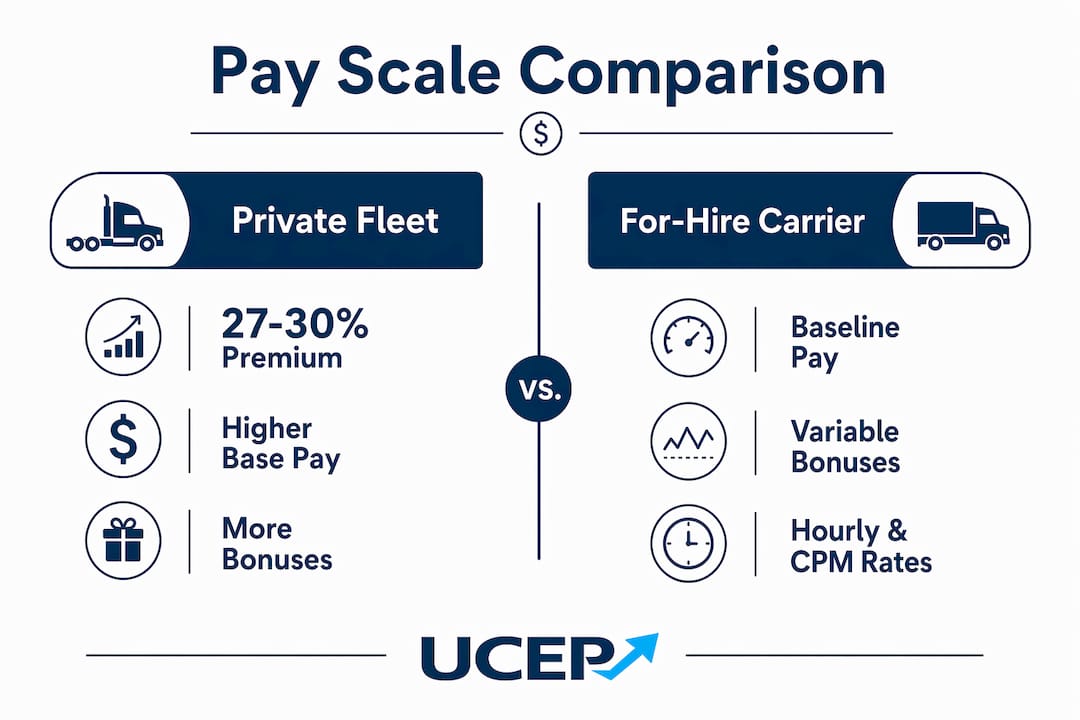
Private fleets serving large retailers such as Walmart pay CDL-A drivers between $110,000 and $125,000 annually. That figure reflects structured pay escalation, consistent miles, and benefits packages that for-hire carriers rarely match. For-hire carriers, by contrast, tie driver income more closely to freight volumes. When spot rates drop, so does driver pay.
The practical advantages of private fleets extend beyond the paycheck:
- Predictable schedules reduce fatigue and improve home time.
- Newer equipment means fewer breakdowns and less unpaid downtime.
- Lower turnover signals better working conditions, which compounds over a career.
- Pay raises follow structured timelines rather than market negotiations.
For job seekers, targeting private fleet roles is one of the most direct ways to access higher pay for truck drivers without adding endorsements or switching freight types.
What role do endorsements and specialized freight play in increasing CDL-A earnings?
Endorsements are the fastest way to move from average CDL-A pay to the top of the earnings range. The combined Hazmat and Tanker endorsement, known in the industry as the X endorsement, places drivers in the top 15% of earners nationally. That result comes from a simple supply-and-demand dynamic. Fewer drivers hold the X endorsement, so carriers pay more to secure them.
Specialized freight types each carry their own CPM premium over standard dry van:
- Tanker freight commands higher CPM due to liquid load management requirements and the Tanker endorsement prerequisite.
- Flatbed freight pays a premium because drivers must secure loads with chains, straps, and tarps, adding skill and physical labor.
- Refrigerated (reefer) freight adds a temperature-monitoring responsibility that carriers compensate with higher base rates.
- Hazmat freight requires background checks, TSA clearance, and specialized handling knowledge, all of which narrow the driver pool and push pay upward.
Drivers interested in the Hazmat and Tanker path can review what those endorsements involve before committing to the certification process. The testing and clearance steps take time, but the pay return is measurable.
Pro Tip: Pursue the Tanker endorsement before Hazmat. Tanker testing is straightforward, and many carriers will pay for your Hazmat endorsement once you are already on their roster with a Tanker credential.
The key insight here is that specialized freight demands skills that shrink the available driver pool. A smaller pool means carriers compete harder for qualified drivers, and that competition shows up in CPM rates and sign-on bonuses.
How does the current labor market shortage impact CDL-A driver salaries?
The driver shortage is a direct wage driver. The American Trucking Associations (ATA) estimates a shortage of 60,000 to 82,000 drivers in 2026, with projections pointing toward 175,000 by 2028. That number represents unfilled CDL-A seats, not a general commercial driving gap. The shortage concentrates in long-haul and specialized freight, which are exactly the segments where CDL-A licenses are required.
When supply of qualified drivers falls short of demand, carriers respond with pay increases and retention incentives. Current examples include:
- Guaranteed minimum weekly pay of $1,200 to $1,500 for long-haul routes.
- Referral bonuses of $500 to $1,000 for drivers who bring in qualified candidates.
- Sign-on bonuses that can reach $5,000 or more at carriers with acute staffing needs.
- Accelerated pay raises tied to tenure rather than annual reviews.
The median annual earnings for wage-and-salary truck drivers range from $47,680 to $62,000 depending on experience and role. CDL-A drivers in long-haul and specialized freight consistently land above that range. The shortage is the structural reason why. Carriers cannot afford to underpay when the alternative is leaving freight sitting at a dock.
Focusing on sectors with concentrated shortages and premium pay models, like OTR long-haul freight, is the most direct strategy for maximizing CDL-A earnings in 2026. The shortage is not evenly distributed, and neither is the pay response.
How can aspiring CDL-A drivers maximize their earning potential in 2026?
Knowing why CDL-A drivers earn more is useful. Knowing how to position yourself to capture that pay is what matters. The factors affecting CDL-A earnings are within your control more than most job seekers realize.
-
Gain endorsements selectively. Start with Tanker, then add Hazmat. Both together unlock the X endorsement and place you in the highest-paying freight categories. Do not pursue endorsements you will not use. Doubles/Triples and Passenger endorsements add credentials without adding meaningful pay in most markets.
-
Target private fleets with structured pay scales. Research carriers known for private fleet operations in your target region. Look for published pay scales, not just advertised starting rates. Structured escalation over two to three years matters more than a high starting CPM.
-
Evaluate regional pay differences before accepting an offer. CDL-A jobs with the best pay cluster around freight hubs in the Midwest, Southeast, and Texas corridor. Drivers based near major distribution centers often access more consistent miles and better accessorial opportunities.
-
Avoid carriers with poor pay transparency. If a carrier cannot clearly explain how detention pay is calculated or what triggers layover pay, that is a signal. Unpaid downtime costs drivers real income, and carriers who obscure pay structures tend to underperform on total compensation.
-
Use targeted job boards to find premium employers. General job sites surface every driving role equally. Niche platforms focused on CDL-A roles help you filter by pay model, freight type, and fleet type faster. Ucep explains why niche job boards consistently deliver better matches for both drivers and employers.
Pro Tip: Ask every prospective carrier for their average driver's annual W-2, not just the advertised CPM rate. A carrier offering $0.70 CPM with poor load consistency may produce lower annual earnings than one offering $0.63 CPM with guaranteed miles.
Key takeaways
CDL-A drivers earn more because their license, endorsements, and freight specialization place them in the highest-demand, highest-pay segments of commercial trucking.
| Point | Details |
|---|---|
| CPM and accessorial pay drive base earnings | OTR CPM rates of $0.58 to $0.72 per mile, plus $2,000 to $5,000 in annual accessorials, form the CDL-A pay foundation. |
| Private fleets pay 27 to 30% more at median | Private fleet drivers earn significantly more than for-hire counterparts due to structured pay escalation and route stability. |
| X endorsement reaches top 15% of earners | Combining Hazmat and Tanker endorsements places CDL-A drivers in the top 15% of national earners. |
| Driver shortage supports wage growth | An ATA-estimated shortage of 60,000 to 82,000 drivers in 2026 keeps upward pressure on CDL-A wages and retention bonuses. |
| Employer type and freight type determine actual pay | Location, fleet type, and freight specialization cause CDL-A earnings to range from under $70,000 to over $125,000 annually. |
What I have learned about CDL-A pay after years of watching the market
The most common mistake I see aspiring CDL-A drivers make is treating all CDL-A jobs as roughly equivalent. They compare advertised CPM rates and pick the highest number. That approach consistently produces disappointment.
The real differentiator is not the license class. It is the combination of freight type, fleet structure, and pay model. A driver hauling dry van for a for-hire carrier at $0.70 CPM with inconsistent loads and no detention pay will often earn less annually than a driver at a private fleet running $0.62 CPM with guaranteed miles and full accessorials.
Private fleet opportunities represent the clearest path to both income stability and career satisfaction in CDL-A trucking. The structured pay escalation, predictable schedules, and lower turnover create conditions where drivers can actually build a career rather than constantly chasing the next sign-on bonus.
My honest view is that the driver shortage is a genuine opportunity for anyone entering CDL-A trucking right now. Carriers are competing for qualified drivers in ways they were not five years ago. That competition shows up in guaranteed minimums, referral bonuses, and accelerated raises. Drivers who enter the market with an endorsement or two and a clear preference for private fleet roles are positioned to capture the best of that competition.
The long-term play is specialization. Drivers who invest in Hazmat and Tanker endorsements early, then target freight types with narrow driver pools, consistently outperform peers who stay in standard dry van. The pay gap between a general CDL-A driver and a specialized one widens every year the shortage persists.
— Aaron
Find CDL-A jobs that match your earning goals with Ucep
Ucep is a job board and recruiting platform built exclusively for Service Providers contracted with FedEx. If you hold a CDL-A license and want access to linehaul, team, solo, and pickup and delivery roles with competitive pay structures, Ucep connects you directly to employers in the FedEx network.
You can browse companies hiring CDL-A drivers through Ucep's employer directory, which lists Service Providers with active openings nationwide. Each listing reflects real roles with real pay structures, not placeholder postings. If you want to evaluate specific employers before applying, the service provider reviews section gives you driver feedback on pay, conditions, and management. Ucep keeps the search focused so you spend less time filtering and more time driving.
FAQ
What is the average salary for a CDL-A driver in 2026?
The median annual earnings for truck drivers range from $47,680 to $62,000, but CDL-A drivers in long-haul and specialized freight regularly earn $78,000 to $125,000 depending on employer type, endorsements, and freight category.
Why do CDL-A drivers earn more than CDL-B drivers?
CDL-A licenses authorize combination vehicles and long-haul routes that CDL-B licenses do not cover. That access unlocks higher CPM rates, specialized freight premiums, and private fleet roles that consistently pay above CDL-B positions.
How much do endorsements increase CDL-A pay?
The combined Hazmat and Tanker (X) endorsement places drivers in the top 15% of national earners. Specialized freight types like tanker and flatbed each carry CPM premiums above standard dry van rates.
Do private fleets really pay that much more than for-hire carriers?
Private-fleet OTR dry van drivers earn approximately 27% more at median pay than for-hire drivers, with regional dry van haulers earning around 30% more. Carriers like Walmart pay CDL-A drivers between $110,000 and $125,000 annually.
How does the driver shortage affect CDL-A wages?
The ATA estimates a shortage of 60,000 to 82,000 CDL drivers in 2026. That gap pushes carriers to offer guaranteed weekly minimums of $1,200 to $1,500, referral bonuses, and accelerated raises to attract and retain qualified CDL-A drivers.