
Many CDL-A drivers assume contract work is simply a way to earn more money. That assumption leads to both good and bad decisions. The real reasons why CDL-A drivers choose contract work go deeper than a pay bump. Autonomy, schedule control, and the appeal of running your own operation all play a role. So do financial risk, self-funded benefits, and business management responsibilities you did not have as a company driver. This article breaks down both sides clearly so you can make an informed decision before you sign anything.
Table of Contents
- Key takeaways
- What contract driving actually means for CDL-A drivers
- Why CDL-A drivers choose contract work
- Risks and challenges of contract driving
- Steps to take before you start contract work
- My take on why drivers really choose contract work
- How Ucep helps CDL-A drivers explore contract opportunities
- FAQ
Key takeaways
| Point | Details |
|---|---|
| Contract work means business ownership | As an independent contractor, you operate as a business with all the tax, insurance, and compliance responsibilities that come with it. |
| Financial upside is real but conditional | Earnings can increase 20% to 50% after 3 to 5 years, but only after covering truck costs, taxes, and benefits out of pocket. |
| Company benefits have real dollar value | Company drivers receive $15,000 to $25,000 in annual benefits that contractors must self-fund, including health insurance and retirement contributions. |
| Preparation is the biggest success factor | Drivers with 2 to 4 years of company experience and $50,000 or more in savings have the best odds of a successful transition. |
| Classification is more complex than a label | Your contract can call you an independent contractor, but the IRS and DOL look at how you actually work to determine your legal status. |
What contract driving actually means for CDL-A drivers
Before you weigh the pros and cons, you need to understand what contract driving actually involves. The term gets used loosely in trucking, and it covers several different arrangements.
Company driver vs. independent contractor
A company driver is a W-2 employee. You drive the carrier's truck, follow their dispatch, and receive a paycheck with taxes already withheld. You also receive benefits like health insurance, paid time off, and often a 401(k) match.
An independent contractor operates as a separate business entity. You are responsible for your own taxes, insurance, equipment costs, and compliance. The carrier pays you a contracted rate, and you handle everything else.
Common contract models in trucking
- Lease-on: You use your own truck (or lease one through the carrier) and operate under the carrier's authority. You are paid per mile or per load.
- Owner-operator with own authority: You obtain your own motor carrier authority, set your own rates, and work with freight brokers or direct shippers.
- Lease-purchase programs: The carrier provides a truck and deducts weekly payments from your settlements. These programs carry high risk. Lease-purchase failure rates are significant, with down payments of $3,000 to $8,000 and weekly payments of $600 to $1,100. Many drivers lose payments and the truck if the contract is terminated.
How pay structure and taxes change
As a company driver, your employer withholds federal and state income taxes and pays half of your Social Security and Medicare taxes. As an independent contractor, you pay self-employment taxes that add 7.65% more burden compared to W-2 employment. On $75,000 in net income, that equals roughly $5,737 more per year in taxes alone.
You also take on quarterly estimated tax payments, expense tracking, and potentially hiring an accountant.
Pro Tip: Before you sign a contract, have a tax professional calculate your full projected tax burden as a contractor, including self-employment tax and quarterly payments. Many drivers are surprised by the first-year bill.
Classification is not just a label
One common misconception is that your contract determines your classification. It does not. A signed contract alone does not guarantee independent contractor status. The IRS and Department of Labor examine actual working conditions: how much supervision you receive, how economically dependent you are on one carrier, and how integrated you are into their business operations. Additionally, state ABC tests like California's impose stricter standards that can limit contract driving arrangements entirely, regardless of what your agreement says.
Why CDL-A drivers choose contract work
Understanding the appeal is straightforward once you look at what experienced drivers actually value. The motivations vary, but several stand out consistently.
Autonomy and load selection
Company drivers typically operate under forced dispatch. You take the load assigned to you or risk disciplinary action. Contract drivers can decline loads that do not meet their standards for rate, distance, or destination. That control over your own schedule is the single most commonly cited reason drivers make the switch. If avoiding forced dispatch is a priority for you, contract work addresses that directly.
Financial upside after the transition period
The income potential is real, but timing matters. Independent contractors can increase earnings by 20% to 50% after reaching maturity, typically within 3 to 5 years. That growth comes from building broker relationships, learning rate negotiation, and reducing deadhead miles over time.

However, owner-operator net take-home often ends up between $50,000 and $90,000 after expenses. Company drivers net a more stable $55,000 with significantly less financial risk. The upside is real, but it is not automatic.
Other reasons CDL-A drivers make the move
- Home time flexibility: You control which lanes and runs you accept, giving you more ability to plan time at home around your life.
- Route and schedule control: You are not locked into a carrier's preferred corridors. You can specialize in lanes that pay better or fit your lifestyle.
- Business ownership appeal: Some drivers want to build something. Running your own operation, even a single truck, satisfies the entrepreneurial drive that company employment does not.
- Avoidance of employer controls: No random equipment assignments, no mandatory orientation programs, and no dispatcher pressure to accept marginal freight.
Pro Tip: Track your current per-mile earnings and total weekly hours as a company driver. Use that baseline to model what your contract income would need to be to clear the same take-home pay after expenses. Most drivers underestimate the gap by $15,000 to $20,000 in year one.
Risks and challenges of contract driving
The benefits listed above are genuine. So are the risks. Informed decision-making requires looking at both sides with equal honesty.
Comparing financial realities
| Cost Category | Company Driver | Independent Contractor |
|---|---|---|
| Health insurance | Employer-subsidized | $9,600 to $18,000 per year out of pocket |
| Retirement savings | Employer 401(k) match available | Self-funded only |
| Truck maintenance | Carrier covers repairs | Your responsibility entirely |
| Self-employment tax | Employer pays half | You pay full 15.3% |
| Total benefits value | $15,000 to $25,000 per year | Must be self-funded |
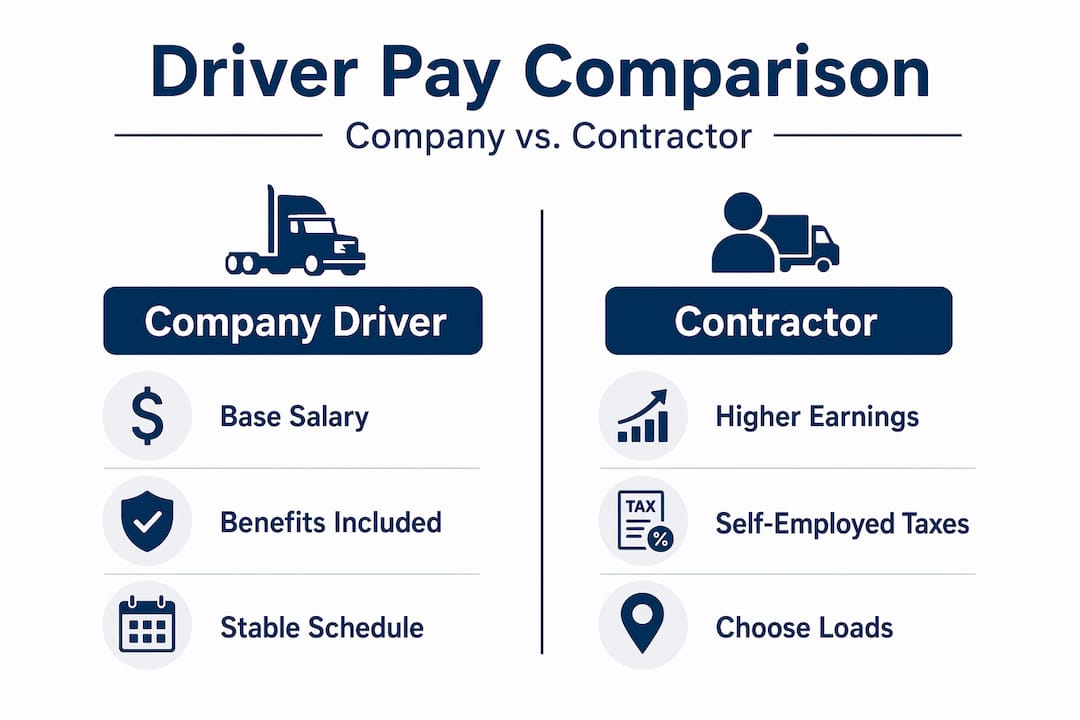
Company drivers receive a total compensation package worth $15,000 to $25,000 annually that contractors must fund themselves. Health insurance alone runs $9,600 to $18,000 per year for a contractor paying full premiums.
Business management responsibilities
Contract driving is not just driving. You take on the full role of a small business operator. That includes load negotiation, invoice tracking, fuel expense reporting, equipment maintenance scheduling, DOT compliance, and quarterly tax filings. Drivers who underestimate this burden often find themselves spending 10 to 15 hours per week on administrative tasks in addition to their driving hours.
Successful owner-operators must balance load negotiation, cost tracking, vehicle maintenance, tax planning, and insurance management to sustain long-term income. Those who struggle usually lack systems, not effort.
Financial risk is ongoing
Unlike a company driver who receives a consistent paycheck, contractors face income variability. Slow freight markets, truck breakdowns, or unexpected downtime directly reduce your earnings with no safety net. A single major repair can cost $10,000 to $30,000. If you do not have reserves, that repair can put you out of business.
Pro Tip: Set up a separate business checking account before you start contracting. Route all income and expenses through it from day one. This makes tax filing easier and forces a clearer picture of actual profitability.
Steps to take before you start contract work
Preparation separates drivers who succeed in contract work from those who return to company employment within the first year.
-
Build financial reserves first. You need three to six months of operating expenses saved before you transition. Successful owner-operators typically have $50,000 or more saved before making the move. This is not optional. It is the single biggest predictor of survival in year one.
-
Get 2 to 4 years of company driving experience. Route knowledge, equipment familiarity, shipper relationships, and load planning skills all develop during company employment. Drivers who transition too early face a steeper learning curve while managing new financial pressures simultaneously.
-
Learn the financial side before you need it. Take a basic accounting course or work with a trucking-focused bookkeeper. Understand how to track mileage for deductions, categorize expenses, and calculate your actual cost per mile.
-
Read every contract clause carefully. Pay attention to pay calculation methods, deduction schedules, termination clauses, and non-compete terms. If you do not understand something, ask a lawyer before you sign. This applies especially to lease-purchase agreements, which carry significant risks if the contract ends early.
-
Understand your insurance requirements. As a contractor, you need occupational accident coverage, non-trucking liability, and potentially bobtail insurance depending on your operating model. Get quotes before you decide.
-
Build dispatcher and broker relationships early. Your ability to find good freight consistently is what sustains contract income. Start networking with freight brokers and learning self-dispatch tools while you are still employed as a company driver.
My take on why drivers really choose contract work
I have seen drivers jump into contract work for the right reasons and the wrong ones. The appeal of control is real. Nobody likes being forced onto a bad load at 11 p.m. with no say in the matter. That frustration is legitimate, and contract work genuinely solves it.
What surprises most drivers is the weight of the daily decisions. When you run your own operation, every load decision is a business decision. You are calculating fuel costs, tolls, deadhead miles, and time simultaneously, while also managing equipment maintenance and paperwork. Some drivers thrive on that. Others find it exhausting after six months.
The financial picture is also more nuanced than it first appears. I have watched drivers project owner-operator earnings based on gross revenue numbers without factoring in self-employment tax, full health insurance premiums, truck depreciation, and downtime. The math looks very different once those numbers go in.
My honest take is this: contract work rewards drivers who are disciplined, detail-oriented, and genuinely motivated by business ownership. It is not the right path for someone primarily trying to escape a bad dispatcher or chase a short-term pay increase. The classification complexity alone, particularly the gap between what your contract says and what the IRS determines, catches too many drivers off guard.
If you are considering the move, give yourself a real planning period. Talk to active owner-operators, not just those who are selling the idea.
— Aaron
How Ucep helps CDL-A drivers explore contract opportunities
If you are researching contract driving, finding the right opportunity is as important as the preparation work. Ucep is a job board built exclusively for Service Providers contracted with FedEx, connecting CDL-A drivers with linehaul, solo, team, and pickup and delivery roles nationwide.
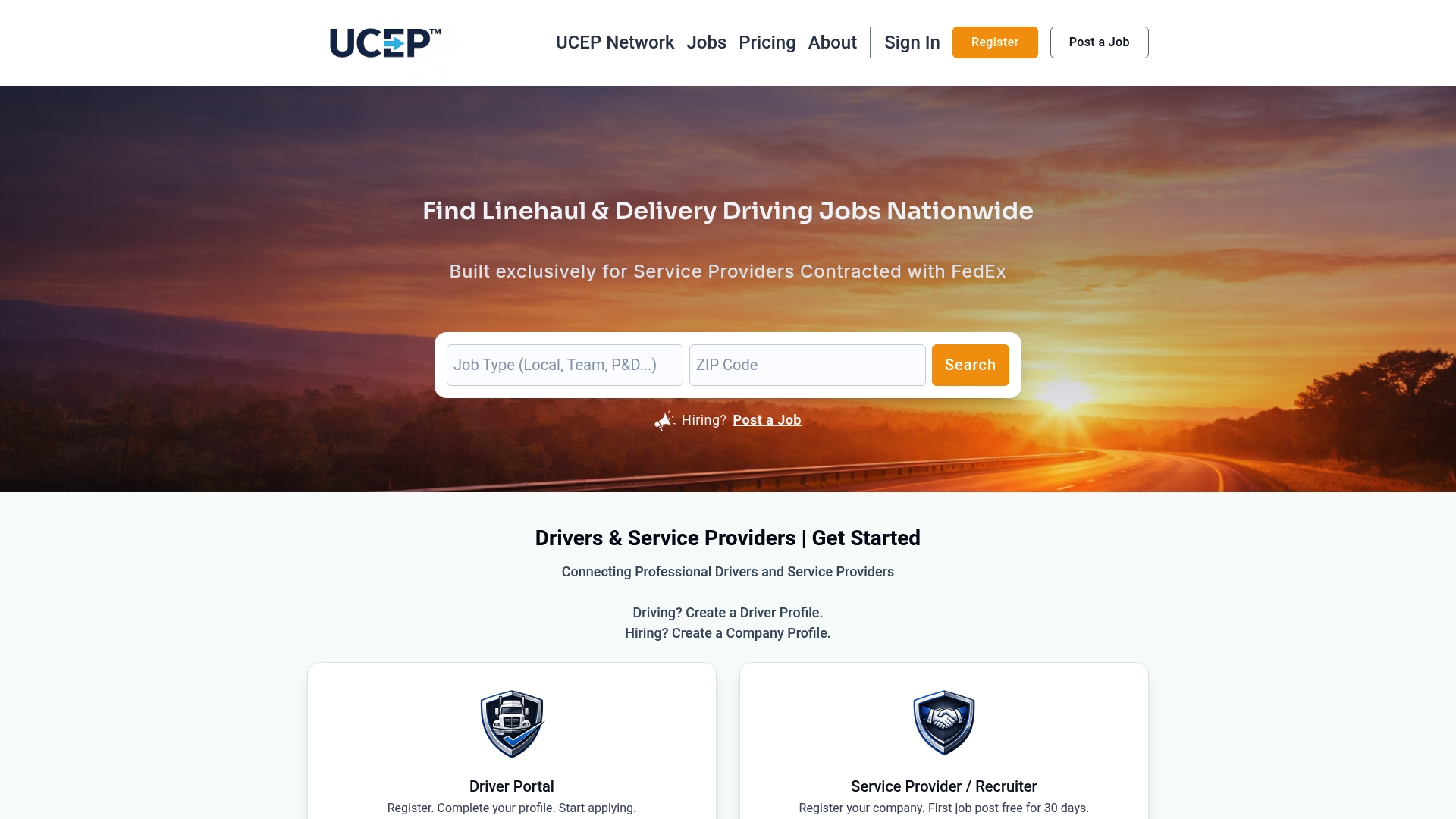
You can browse CDL-A contract opportunities in one focused place without sifting through general job boards that mix unrelated postings. Every listing on Ucep is connected to the FedEx service provider network, so you get relevant, verified opportunities that match your license class and experience level.
If you want a clearer picture of what contract driving looks like within this specific network, Ucep also provides resources to help you understand driver expectations and route structures before you apply. Start by browsing available roles and comparing what is available in your region.
FAQ
What does contract work mean for a CDL-A driver?
Contract work means you operate as an independent contractor rather than a company employee. You are responsible for your own taxes, insurance, and equipment costs while controlling your own load selection and schedule.
Do independent contractors earn more than company drivers?
They can, but not always. Owner-operators can earn 20% to 50% more after reaching maturity, but net take-home is often similar to company drivers once expenses are deducted. The financial gap narrows significantly after accounting for self-funded benefits, taxes, and truck costs.
What are the biggest financial risks of contract trucking?
The main risks are no employer-provided benefits, self-employment taxes that add roughly $5,737 per year on $75,000 net income, full health insurance costs of $9,600 to $18,000 annually, and income variability due to equipment downtime or slow freight markets.
How long should I drive for a company before going contract?
Most successful owner-operators have 2 to 4 years of company experience and at least $50,000 in savings before transitioning. Rushing the move significantly increases the risk of financial failure in the first year.
Does my contract determine my classification as an independent contractor?
No. A signed contract does not guarantee contractor status. The IRS and DOL examine actual working conditions, including economic dependence and level of supervision, to determine your legal classification.