
An independent contractor driver is a self-employed individual who hauls freight or provides delivery services under a business-to-business contract rather than an employment agreement. Unlike a W-2 employee, this driver receives payment via 1099 forms, typically per mile, per load, or as a percentage of the load rate. No employer withholds payroll taxes, and no company provides health insurance, paid time off, or retirement benefits. The IRS and the Department of Labor each apply specific classification tests to determine whether a driver truly qualifies as a contractor. Understanding those tests, the financial responsibilities involved, and the practical steps to get started is what this guide covers.
What is an independent contractor driver under U.S. law?
An independent contractor driver is legally defined by control, not by the label on a contract. The IRS applies its common-law classification test, which examines three factors: behavioral control (does the company direct how work is done?), financial control (does the driver invest in their own tools and work for multiple clients?), and the type of relationship (are there employee-type benefits or a permanent arrangement?).
The Department of Labor uses a separate standard called the "economic reality" test. This test asks whether the driver is economically dependent on one company or genuinely operating an independent business. A driver who works exclusively for one carrier, uses that carrier's equipment, and follows their dispatch schedule may be classified as an employee under this standard, regardless of what the contract says.
Several states go further with the ABC test, which presumes a worker is an employee unless the hiring company can prove all three conditions: the worker is free from control, performs work outside the company's usual business, and is independently established in that trade.
- Behavioral control: Does the carrier dictate routes, hours, and methods?
- Financial control: Does the driver own their truck and work for multiple clients?
- Relationship type: Are there written contracts, benefits, or long-term exclusivity?
- Economic dependence: Is the driver's income tied to a single company?
Misclassification carries real consequences. Companies face back taxes, penalties, and benefit liability. Drivers can lose access to unemployment insurance and workers' compensation they may have assumed they had.
Pro Tip: If you work exclusively for one carrier, review your state's ABC test criteria. Working for multiple clients is one of the strongest defenses against reclassification as an employee.
The contract label alone does not determine your status. Economic reality and actual working conditions define it.
What are the financial and operational responsibilities?
Running as an independent contractor driver means running a business. The driving is only part of the job. You are also responsible for every cost that an employer would otherwise cover.
Here is what that looks like in practice:
- Truck and equipment: You own or lease your vehicle. Maintenance, tires, and repairs come out of your pocket.
- Fuel costs: Fuel is your largest variable expense. Fuel cards and route planning tools help manage this.
- Insurance: You must carry commercial auto liability, cargo insurance, and physical damage coverage at minimum.
- Permits and registrations: FMCSA operating authority costs approximately $300 to register, but ongoing compliance filings add to that.
- Taxes: You pay both the employer and employee portions of FICA taxes, totaling 15.3% of net earnings. Quarterly estimated tax payments to the IRS are required.
- Record-keeping: You track income, expenses, mileage, and maintenance logs for tax purposes and DOT audits.
The financial gap between leasing on to a carrier and running your own authority is significant. Leasing on means you operate under the carrier's DOT and MC numbers. The carrier handles some compliance filings, and the arrangement is simpler to manage. Running your own authority means you hold your own MC number, manage your own BMC-91 insurance filings, and handle DOT safety audits independently. The tradeoff is full control over rates and clients versus reduced administrative burden.
| Expense Category | Estimated Annual Cost |
|---|---|
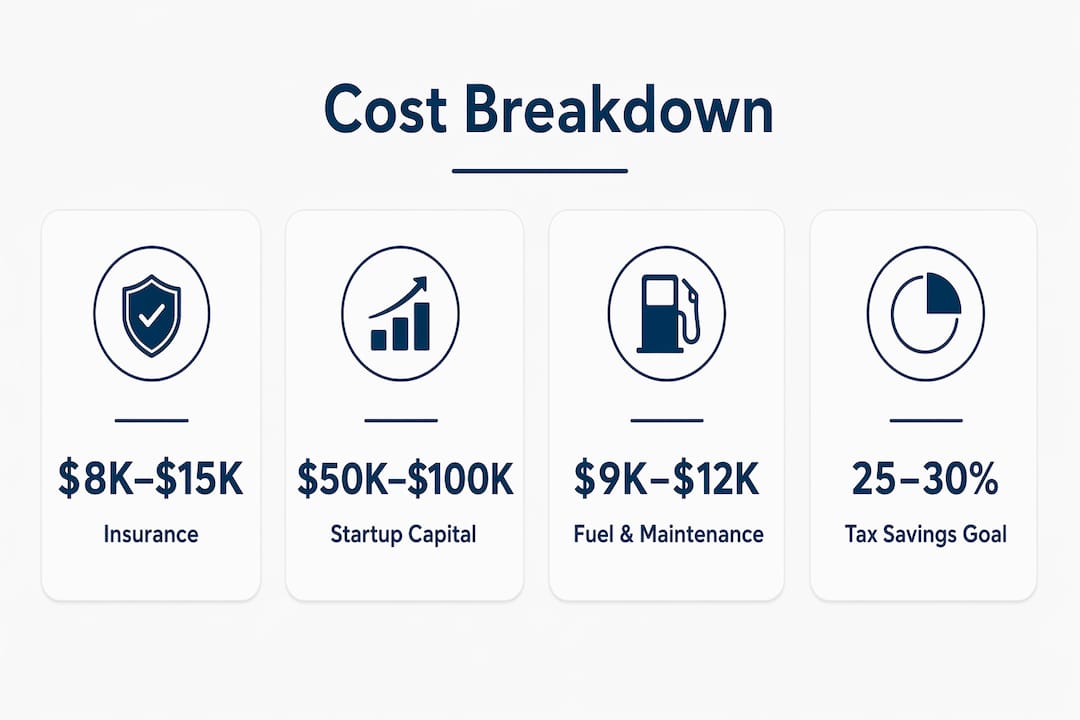
| Commercial insurance premiums | $8,000–$15,000 |
| Fuel (varies by mileage) | $40,000–$70,000 |
| Truck maintenance and repairs | $10,000–$20,000 |
| Permits, registrations, filings | $1,500–$3,000 |
| Taxes (self-employment) | 15.3% of net profit |

Startup capital requirements are substantial. Most new independent drivers need $50,000–$100,000 to cover the vehicle, two to three months of operating expenses, insurance down payments, and an emergency reserve. That reserve is not optional. Cash flow gaps between load completion and payment are common, and a single major repair can end an underfunded operation.
What are the benefits and challenges of contractor driving?
The benefits of working as an independent contractor driver are real, but they come with equally real trade-offs. Understanding both sides helps you make an informed decision.
Benefits:
- Schedule flexibility: You choose which loads to accept and when to work. This is a meaningful advantage over company driver roles with fixed dispatch.
- Earning potential: Pay is directly tied to the loads you haul and the rates you negotiate. Skilled operators who manage costs well can earn significantly more than salaried drivers.
- Business ownership: You build equity in your equipment and your client relationships. That has long-term value a W-2 position does not offer.
- Route control: You can prioritize lanes and regions that work for your life, rather than being assigned runs by a dispatcher.
Challenges:
- No employer benefits: There is no health insurance, no paid sick leave, and no retirement match. You fund all of it yourself.
- Insurance costs: Occupational accident coverage is the contractor's substitute for workers' compensation. Premiums are higher, deductibles are larger, and coverage is less comprehensive than employer-provided plans.
- Administrative load: Invoicing, tax filings, compliance paperwork, and maintenance logs take real time every week.
- Payment delays: Factoring companies exist for a reason. Net-30 or Net-45 payment terms are common, and cash flow management is a constant discipline.
Pro Tip: Set aside 25–30% of every payment for taxes before spending anything else. Quarterly estimated payments to the IRS are due in April, June, September, and January. Missing them triggers penalties.
The independent contractor vs employee comparison ultimately comes down to risk tolerance and business readiness. The contractor model rewards preparation and penalizes those who treat it like a job rather than a business.
How to become a contractor driver: steps and requirements
Becoming an independent contractor driver requires more than a commercial driver's license. Here is the practical path from start to operating status.
-
Build your driving experience. Most carriers and shippers require 3–5 years of commercial driving experience before they will work with an independent operator. A clean MVR and a strong safety record are non-negotiable.
-
Obtain your CDL. A Class A CDL is required for most linehaul and over-the-road freight work. Endorsements for hazmat, tanker, or doubles/triples expand your load options.
-
Secure your operating authority. Apply for an MC number and DOT number through the FMCSA. The filing fee is approximately $300. Processing takes several weeks, so plan ahead.
-
Get your insurance in place. You need commercial auto liability (minimum $750,000 for most freight), cargo insurance, and physical damage coverage. Work with a broker who specializes in trucking.
-
Choose your business structure. A sole proprietorship is the simplest starting point, but an LLC provides liability protection and can offer tax advantages. Consult a CPA familiar with trucking before you decide.
-
Decide: lease-on or own authority. Leasing on to an established carrier is the lower-risk entry point. You operate under their authority while building your financial reserves and client relationships. Running your own authority gives you full control but demands compliance management from day one.
-
Build your financial reserve. Target $50,000–$100,000 before your first load. This covers startup costs, operating expenses for the first few months, and a buffer for unexpected repairs or slow payment periods.
-
Diversify your clients. Working for a single carrier long-term creates misclassification risk. Multiple client relationships also protect your income if one client reduces volume or terminates the contract.
For drivers specifically interested in FedEx-related routes, Ucep lists linehaul, CDL-A team, CDL-A solo, and pickup and delivery opportunities with Service Providers nationwide. It is a direct path to finding contracted work without sorting through unrelated postings.
Key Takeaways
An independent contractor driver operates as a self-employed business owner, responsible for taxes, insurance, compliance, and client relationships that a W-2 employee never manages directly.
| Point | Details |
|---|---|
| Legal classification is based on control | The IRS, Department of Labor, and state ABC tests all look at economic reality, not contract labels. |
| Startup costs are significant | Plan for $50,000–$100,000 to cover equipment, insurance, permits, and a cash reserve. |
| Insurance is your responsibility | Occupational accident coverage replaces workers' comp, but at higher cost and with less protection. |
| Client diversification protects your status | Working for multiple clients strengthens your contractor classification and protects your income. |
| Leasing on is the lower-risk entry point | Operating under a carrier's authority reduces compliance burden while you build experience and reserves. |
The part most guides skip over
I have reviewed a lot of content aimed at drivers considering the contractor path, and most of it undersells the business management side. The driving is the easy part. What trips people up is the administrative reality that starts on day one.
Tax planning is the clearest example. Most new contractors know they owe self-employment taxes. Fewer realize that the IRS expects quarterly estimated payments, and that missing even one can trigger a penalty on top of the balance owed. A CPA who works with owner-operators is not a luxury. It is a cost of doing business.
The misclassification risk is another area that gets glossed over. I have seen drivers sign contracts that call them independent contractors, then spend 100% of their time working for a single carrier under that carrier's dispatch. Under the Department of Labor's economic reality test and many state ABC tests, that arrangement looks like employment. The driver ends up with contractor tax obligations but without the legal protections of an employee. That is the worst of both situations.
The drivers who succeed long-term are the ones who treat this like a business from the start. They track every expense, maintain separate business accounts, work with multiple clients, and build reserves before they need them. The business management skills matter as much as the miles.
— Aaron
Find contractor driving opportunities with Ucep

Ucep is a job board and recruiting platform built exclusively for Service Providers contracted with FedEx. If you are a professional driver looking for linehaul, CDL-A team, CDL-A solo, or pickup and delivery roles, Ucep puts relevant opportunities in one place without the noise of general job boards. Service Providers use Ucep to find qualified drivers who understand the contractor model and are ready to work. Browse current openings, read driver reviews, and connect directly with Service Providers hiring in your area. Visit Ucep to get started.
FAQ
What does an independent contractor driver do?
An independent contractor driver hauls freight or provides delivery services under a business contract, managing their own truck, insurance, taxes, and compliance rather than working as a company employee.
How is a contractor driver different from an employee driver?
A contractor driver is self-employed, pays their own taxes, and receives no employer benefits. An employee driver has taxes withheld by the employer and is entitled to benefits like workers' compensation and unemployment insurance.
What are the tax implications for contractor drivers?
Contractor drivers pay self-employment tax at 15.3% of net earnings and must submit quarterly estimated payments to the IRS. No employer withholds taxes on their behalf.
How much does it cost to become an independent contractor driver?
Startup costs typically range from $50,000 to $100,000, covering the vehicle, insurance down payments, FMCSA registration, and two to three months of operating reserves.
Can a contractor driver work for just one company?
Working exclusively for one company creates misclassification risk under the Department of Labor's economic reality test and many state ABC tests. Maintaining multiple client relationships is the stronger legal and financial position.