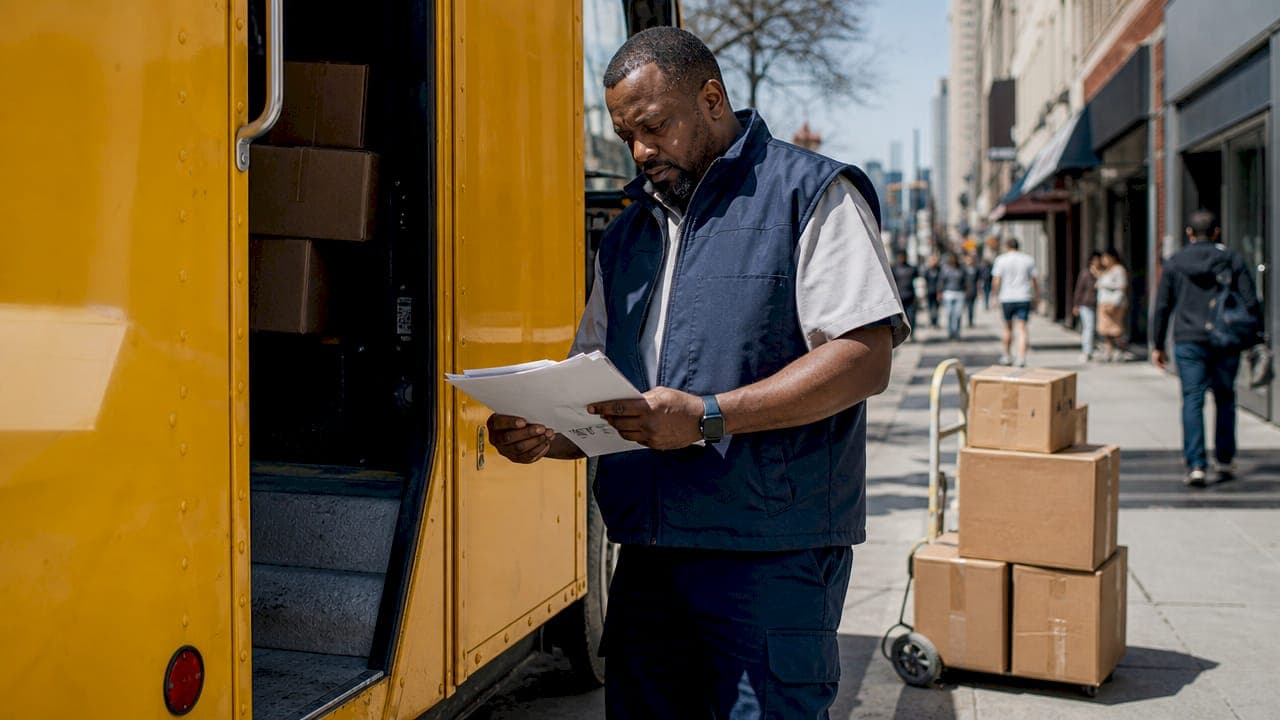
A P&D driver role is defined as a commercial driving position focused on local pickup and delivery of freight between terminals, warehouses, and customer locations. P&D stands for Pickup and Delivery, and it is the industry-standard term used by carriers, logistics companies, and FedEx Service Providers nationwide. Drivers in this role manage 6 to 12 stops per shift, operating commercial vehicles on local or regional routes rather than cross-country hauls. If you are exploring driving careers and want daily home time, consistent schedules, and hands-on freight work, the P&D driver job description fits that profile directly.
What is a P&D driver role, and what does it involve daily?
A P&D driver operates a commercial vehicle on a local route, moving freight from a terminal or warehouse to businesses and residential customers. The role is not simply driving. It combines vehicle operation, freight handling, customer interaction, and regulatory compliance into a single shift.
Core daily responsibilities include vehicle inspections, loading and unloading freight, maintaining electronic logs, and following all traffic laws and safety protocols. Each of those tasks carries accountability. A missed pre-trip inspection or an incomplete log entry creates compliance risk for the driver and the company.
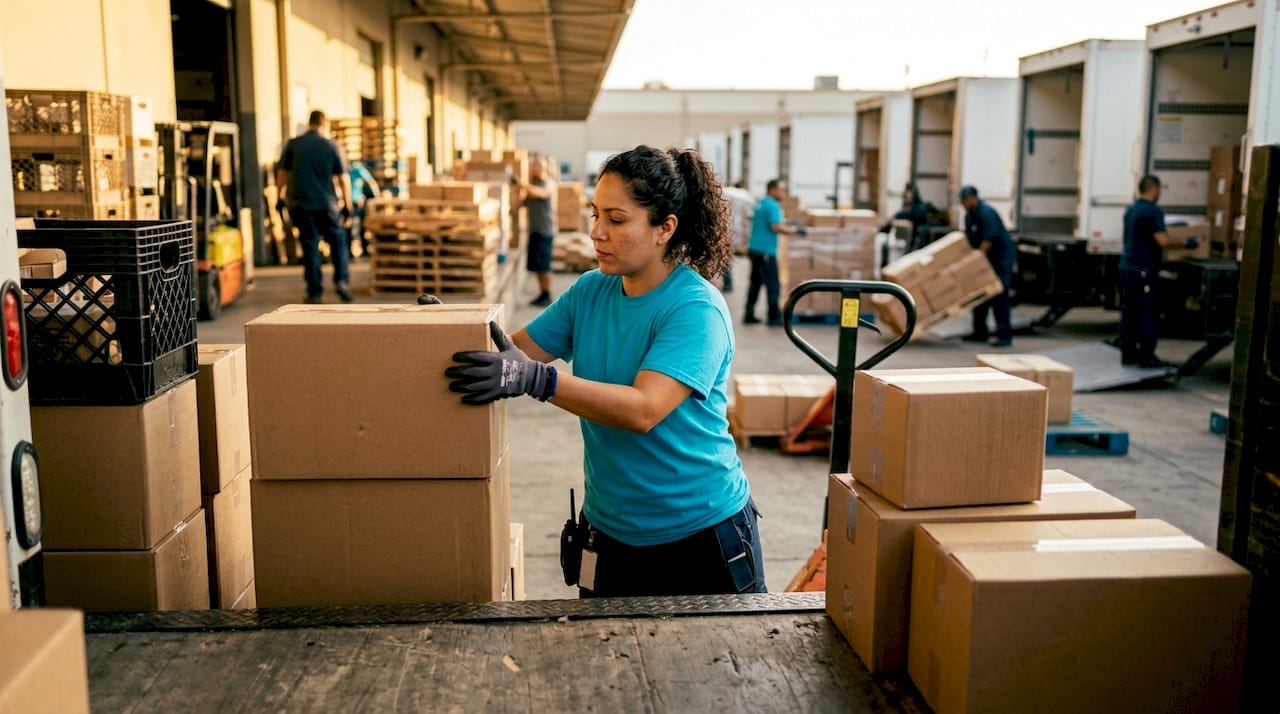
Most shifts begin early in the morning. Drivers report to a terminal, complete a pre-trip inspection, load their freight, and then execute a planned route. By the end of the shift, they return to the terminal, complete a post-trip inspection, and submit their paperwork. That cycle repeats five or more days per week.
The P&D driving role sits within the broader Less-Than-Truckload (LTL) freight model, where multiple customers share trailer space. That structure is what creates the multi-stop format. Each stop is a separate customer, a separate delivery, and often a separate set of freight-handling requirements.
What are the main responsibilities of a P&D driver?
P&D driver responsibilities cover a wider range than most people expect before entering the field. The job blends driving, physical labor, documentation, and customer service into every shift.
Core responsibilities include:
- Driving commercial vehicles locally, often with straight trucks, day cabs, or various trailer combinations
- Performing pre-trip and post-trip vehicle inspections to confirm mechanical safety before and after every shift
- Loading and unloading freight using equipment like pallet jacks, hand trucks, or forklifts
- Maintaining electronic logs and cargo documentation to comply with federal and company regulations
- Following all federal, state, and company safety rules on every route
- Communicating professionally with customers at each stop as a direct representative of the company
Pro Tip: Treat every customer stop as a customer service interaction, not just a freight drop. Drivers who communicate clearly and act professionally at the door protect the company's reputation and often receive better route assignments over time.
Professionalism and customer interaction define a P&D driver's success beyond safe driving alone. Customers judge the carrier by the driver they see at the door. That means appearance, communication, and attitude matter as much as on-time delivery.
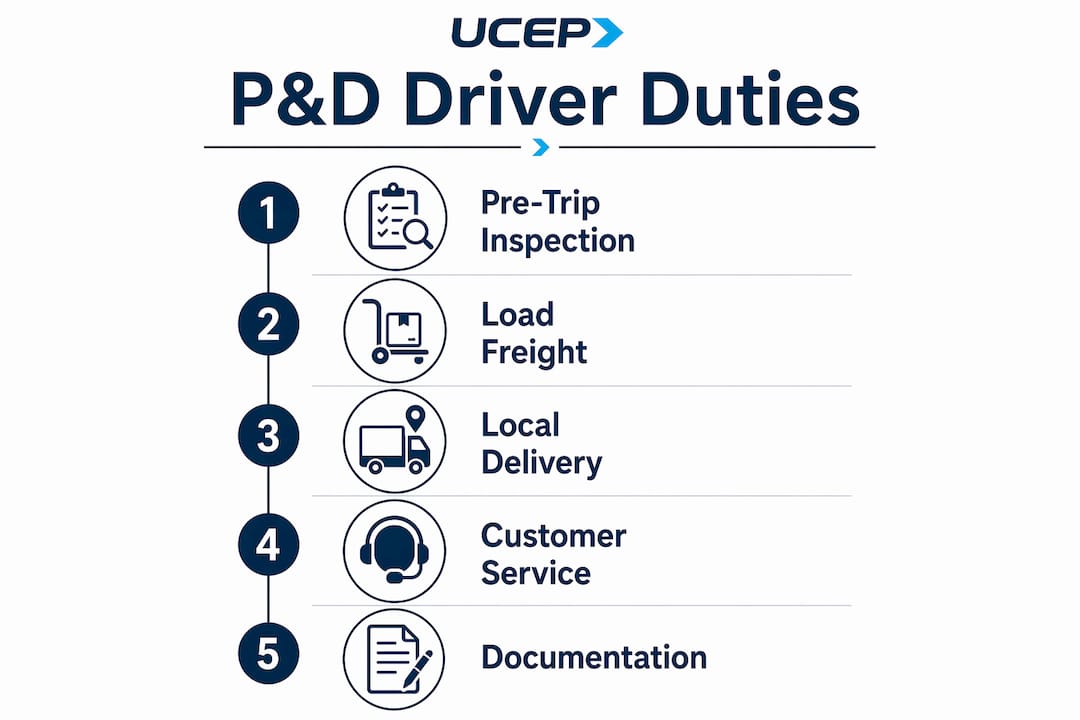
Accurate documentation is equally non-negotiable. Electronic logs track hours of service, and cargo paperwork confirms chain of custody for every shipment. Errors in either area create compliance problems under federal regulations.
What qualifications and skills are needed for a P&D driver?
Most P&D driver job descriptions require a Commercial Driver's License (CDL), typically Class A. A Class A CDL authorizes you to operate combination vehicles, which covers the tractor-trailer configurations common in LTL freight. Some positions accept a Class B CDL for straight truck routes, but Class A opens more opportunities.
Job listings specify a clean driving record, a valid DOT medical card, no recent DUIs, and the physical ability to perform demanding freight tasks. These are not optional preferences. They are minimum requirements that carriers verify before hiring.
The core qualifications for a P&D driving role are:
- CDL Class A license with a clean motor vehicle record
- Valid DOT medical card confirming physical fitness to operate a commercial vehicle
- Physical capability to stand, walk, climb, bend, push, and handle freight using pallet jacks or forklifts
- Knowledge of traffic laws and safe driving practices in urban and suburban environments
- Time management skills to complete 6 to 12 stops efficiently within a shift window
- Customer service ability to communicate clearly and professionally at every delivery point
- Basic mechanical awareness to identify vehicle issues during pre-trip and post-trip inspections
Pro Tip: If you are still working toward your CDL, focus your training on backing maneuvers and urban driving. P&D routes run through tight city streets and loading docks far more often than open highways.
Physical demands include standing, walking, climbing, bending, pushing, and freight handling throughout the shift. This is moderate to heavy physical labor. Drivers who underestimate the physical side of the job often struggle in their first weeks.
How does the P&D driver role differ from other driving positions?
The clearest distinction between P&D driving roles and other commercial driving jobs is route structure. P&D drivers work local routes and return home every night. Over-the-road (OTR) drivers run cross-country hauls that keep them away from home for days or weeks at a time.
P&D drivers return home nightly with predictable schedules, while long-haul drivers trade home time for higher per-mile pay. That trade-off is real, and it shapes which role fits your life.
The table below compares P&D driving to two other common commercial driving positions:
| Feature | P&D driver | Linehaul driver | OTR driver |
|---|---|---|---|
| Route type | Local, multi-stop | Terminal to terminal | Cross-country |
| Daily stops | 6–12 per shift | 1–2 per run | 1–3 per trip |
| Home time | Daily | Most nights | Weekly or less |
| Customer contact | High | Low | Low |
| Freight handling | Heavy, hands-on | Moderate | Moderate |
| Schedule consistency | High | Moderate | Variable |
Linehaul drivers move freight between terminals on fixed runs, typically overnight. They have fewer stops and less customer contact than P&D drivers, but they also spend more nights away from home than a local P&D driver does.
OTR drivers earn more per mile in many cases, but the lifestyle cost is significant. P&D driving offers a more structured schedule, which makes it a strong fit for drivers who prioritize consistency and work-life balance.
What does a typical day look like for a P&D driver?
A standard P&D shift follows a predictable structure, though no two days are identical. Urban traffic, customer availability, and freight volume all create variation within that structure.
A typical P&D driver day looks like this:
- 5:00–6:00 AM: Arrive at the terminal, complete a pre-trip vehicle inspection, and confirm the freight manifest
- 6:00–7:00 AM: Load freight onto the truck in stop sequence, using pallet jacks or hand trucks as needed
- 7:00 AM–2:00 PM: Execute the route, completing 6 to 12 stops with freight delivery and pickup at each location
- Throughout the route: Update electronic logs, communicate with dispatch, and handle any customer questions at the door
- 2:00–3:00 PM: Return to the terminal, complete a post-trip inspection, and submit all paperwork and logs
High-performing drivers anticipate traffic and delivery issues before they occur rather than reacting to them mid-route. That means checking traffic conditions before departure, sequencing stops to avoid backtracking, and flagging address discrepancies with dispatch early.
Common challenges include incorrect delivery addresses, customers who are unavailable to receive freight, and urban congestion during peak hours. Each of those situations requires a quick decision. Do you reattempt the stop, leave a notice, or contact dispatch? Knowing your company's protocol before the situation arises saves time and prevents errors.
Mastering freight handling equipment like pallet jacks and understanding urban traffic patterns directly determines how efficiently you complete your route. Drivers who struggle with equipment slow down at every stop. Drivers who know their tools move faster and finish their routes with less physical strain.
A typical P&D day balances tight delivery schedules with physical demands and safety inspections. That balance requires strong multitasking and problem-solving skills, not just the ability to drive a truck.
Key Takeaways
A P&D driver role is a local commercial driving position that combines freight handling, vehicle safety, customer interaction, and regulatory compliance into every shift.
| Point | Details |
|---|---|
| Role definition | P&D drivers operate commercial vehicles locally, completing 6–12 freight stops per shift. |
| Core requirements | A CDL Class A license, DOT medical card, and clean driving record are standard minimums. |
| Physical demands | Expect daily freight handling using pallet jacks, hand trucks, and forklifts at every stop. |
| Work-life balance | P&D drivers return home nightly, making this role more consistent than OTR or linehaul positions. |
| Customer impact | Professionalism at each stop directly shapes the company's reputation with every customer. |
The part of P&D driving most job descriptions leave out
Most P&D driver job descriptions list the technical requirements clearly. CDL Class A, clean record, DOT medical card. What they rarely communicate is how much the mental side of the job matters.
You are making decisions constantly. Traffic reroutes, missed customers, freight discrepancies, and tight time windows all demand quick judgment. The drivers who thrive in P&D roles are not just good behind the wheel. They are organized, calm under pressure, and consistent in how they handle the unexpected.
The work-life balance advantage is real, but it comes with a trade-off that does not get discussed enough. You are home every night, but your mornings start early and your body absorbs real physical wear. Freight handling across 10 stops a day adds up over a week. Drivers who build good habits around stretching, hydration, and pacing themselves last longer and stay healthier in the role.
The customer interaction piece is also underestimated. You are the face of the carrier at every door. A professional, communicative driver builds goodwill that protects the company's contracts. A careless interaction at a customer's dock can cost a service provider a business account. That weight is real, and the best P&D drivers carry it seriously.
For anyone considering this career path, I would say this: the role rewards people who are organized, physically capable, and genuinely good with people. If you check all three, P&D driving offers stability, daily home time, and a clear career path in commercial freight.
— Aaron
Finding P&D driving opportunities through Ucep
Ucep is a job board and recruiting platform built exclusively for FedEx Service Providers and the drivers who work with them. If you are ready to move from researching the P&D driver job description to actually applying, Ucep connects you directly with Service Providers hiring for local pickup and delivery roles nationwide.
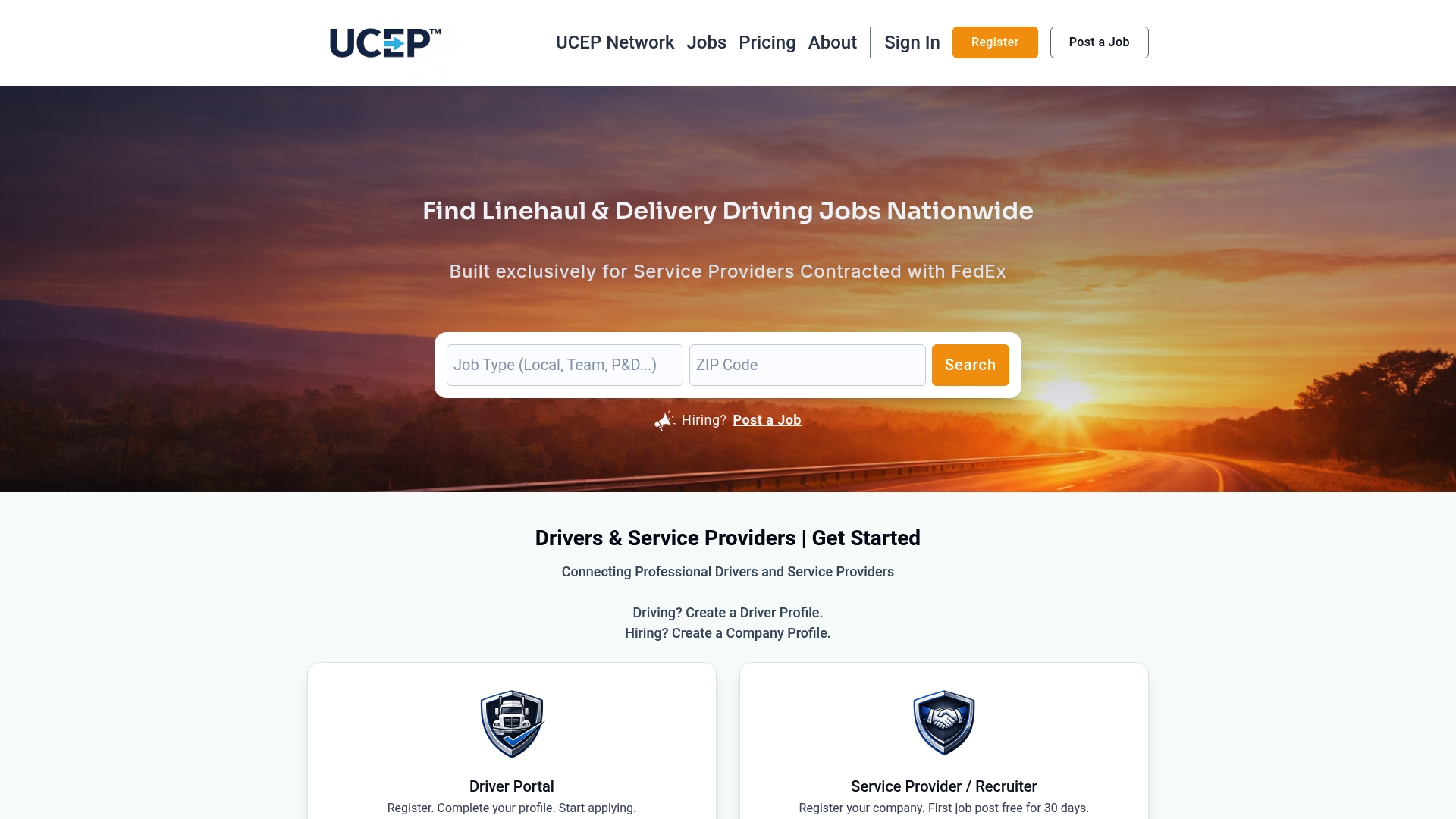
You can browse companies hiring drivers right now on the Ucep platform, with listings filtered for P&D, linehaul, CDL-A team, and CDL-A solo positions. Before you apply, check service provider reviews to see what drivers say about working with specific companies. That information helps you make a better decision before you commit to a position.
FAQ
What does P&D stand for in trucking?
P&D stands for Pickup and Delivery. It describes a commercial driving role focused on local freight transportation between terminals, warehouses, and customer locations.
Do P&D drivers need a CDL?
Most P&D driver positions require a CDL Class A license, a valid DOT medical card, and a clean driving record. Some straight-truck routes accept a Class B CDL, but Class A is the standard requirement.
How many stops does a P&D driver make per day?
P&D drivers typically complete 6 to 12 stops per shift, depending on route density and freight volume. Each stop involves freight delivery, pickup, or both.
Is a P&D driver role good for work-life balance?
P&D drivers return home nightly and follow consistent schedules, making the role a strong fit for drivers who want predictable home time compared to OTR or linehaul positions.
What physical demands should P&D drivers expect?
P&D drivers perform daily freight handling that includes standing, walking, climbing, bending, and pushing freight using pallet jacks, hand trucks, and forklifts throughout every shift.