
A dedicated job board is a niche online recruitment platform that connects employers and job seekers within a specific industry, profession, or role type. Unlike general platforms, these boards focus exclusively on one sector, filtering out unqualified applicants before they ever reach your inbox. Platforms like Ucep operate in this model, serving FedEx Service Providers who need qualified CDL-A drivers for linehaul, solo, and pickup and delivery roles. The result is faster hiring, less screening time, and candidates who already understand the work. This guide explains how dedicated job boards work, what they cost, and how to use one effectively.
What is a dedicated job board and how does it work?
A dedicated job board is a specialized website where employers post openings and candidates search for roles within a defined industry or professional niche. The industry term for this model is a niche job board, and it operates on a simple principle: narrow the audience to improve the match.
General platforms like Indeed or LinkedIn accept postings from every industry imaginable. A niche board accepts only postings that fit its defined scope. A transportation board only lists driving roles. A healthcare board only lists clinical positions. That focus changes everything about how employers and candidates interact with the platform.

The core functions of any dedicated board include job posting management, candidate search tools, application tracking, and employer branding features. Most platforms also offer resume databases so employers can reach out to qualified candidates who have not yet applied. Dedicated boards act as top-of-funnel sourcing channels, meaning they distribute your openings to the right audience but do not replace an Applicant Tracking System (ATS) for managing the full hiring workflow.
Pro Tip: Treat your dedicated job board as a sourcing channel, not a complete hiring solution. Pair it with an ATS to manage applications, track candidates, and measure time-to-fill.
What are the main benefits for businesses and employers?
The primary benefit of a dedicated job board is a higher-quality candidate pool with less noise. When every applicant on the platform has opted into a specific industry, you spend less time filtering and more time interviewing.
Here are the core advantages for employers:
- Reduced screening time. Niche boards reduce recruitment noise by filtering out non-relevant candidates before they apply. A Service Provider posting a CDL-A linehaul role on Ucep reaches only drivers with relevant experience, not general job seekers clicking through listings.
- Access to passive candidates. Dedicated boards connect employers with both active and passive candidates, giving access to hard-to-find talent not reachable on large generalist platforms. Passive candidates are professionals who are not actively searching but will respond to a relevant, well-targeted opportunity.
- Employer credibility. Posting on a recognized niche platform signals industry knowledge. Candidates trust that employers on a specialized board are serious about the role and the sector.
- Revenue potential for organizations. If your organization hosts a dedicated board, it can become a top-three revenue driver by meeting employer demand for niche candidates and cutting staff screening time. Associations and industry groups frequently discover this faster than expected.
- Premium promotional reach. Employers pay premiums for exclusive distribution via email blasts and promoted posts targeting passive industry professionals. These channels consistently yield better candidate quality than mass job sites.
The ROI case for dedicated boards is straightforward. Fewer irrelevant applications means less recruiter time wasted. Better candidate quality means faster time-to-fill. For high-volume roles like commercial driving, that speed directly affects operations. You can review the niche board ROI case for transportation and logistics hiring specifically.
Dedicated vs. general job boards: what is the difference?
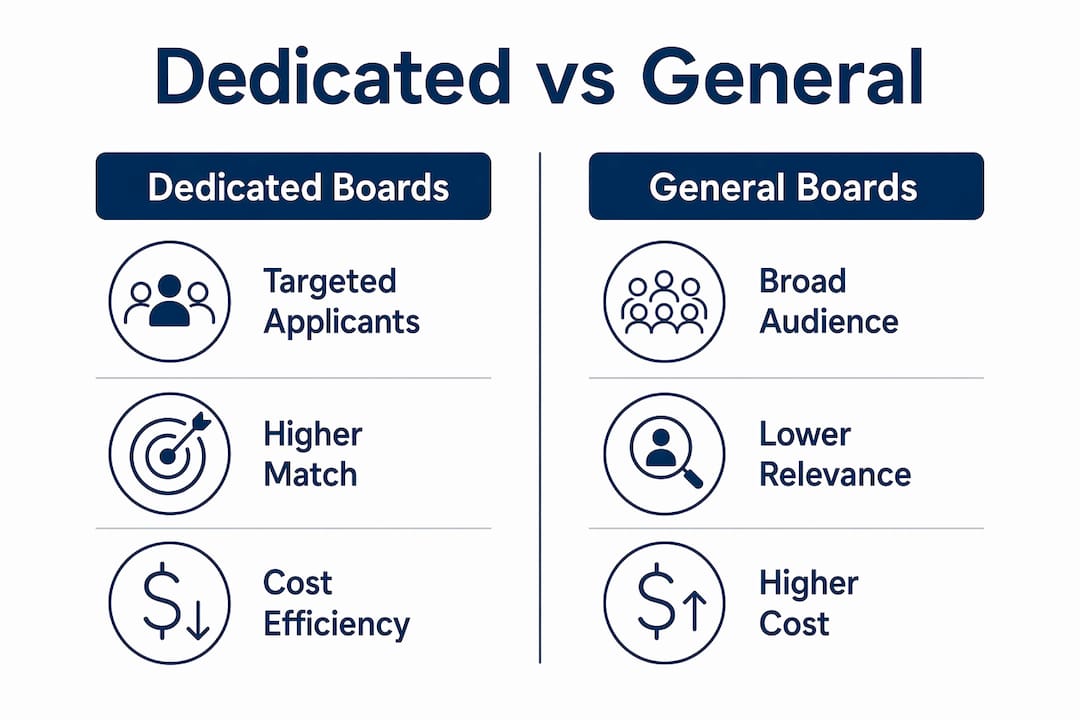
The difference between dedicated and general job boards comes down to audience targeting, match quality, and cost efficiency.
General job boards like Indeed and LinkedIn are broad by design. They serve every industry, every role type, and every experience level. That breadth creates volume, but volume is not the same as quality. A CDL-A job posting on a general platform will attract applications from people without a commercial license, people in the wrong state, and people who applied to 50 jobs that morning without reading the description.
Dedicated boards solve this by design. The audience self-selects. A driver visiting a transportation-specific board is already in the right industry. An employer posting there knows the platform's entire user base is relevant.
| Attribute | Dedicated Job Board | General Job Board |
|---|---|---|
| Candidate pool | Industry-specific, pre-filtered | All industries, unfiltered |
| Application quality | High relevance, lower volume | High volume, mixed relevance |
| Employer branding | Niche credibility, industry trust | Broad visibility, less differentiation |
| Pricing model | Per-post, subscription, or bundled | Pay-per-click or flat-fee posting |
| Passive candidate reach | Targeted email blasts, niche networks | General job alerts, broad email lists |
| Time-to-fill | Typically faster for specialized roles | Slower due to screening overhead |
The pricing difference is also worth noting. General boards often charge per click or per application, which can get expensive fast when you are attracting unqualified traffic. Dedicated boards typically use flat-fee posting, subscriptions, or bundled packages, giving you predictable costs and better budget control. For high-volume specialized hiring, the cost-per-qualified-applicant on a niche board is almost always lower.
What features and pricing models do dedicated job boards offer?
Dedicated job boards in 2026 offer a consistent set of features, with pricing structured to serve both employers and candidates.
Core employer features
Most dedicated boards include job posting management, application tracking, and employer profile pages. Many also offer resume database access, which lets you search for and contact candidates who have not applied to your specific posting. This is particularly valuable for hard-to-fill roles where active applicants are scarce.
Employer branding tools, such as company pages, logo placement, and featured listings, help your postings stand out. Promoted posts and sponsored email blasts extend your reach to passive candidates who visit the board infrequently.
Pricing structures
Pricing models for dedicated job boards in 2026 include per-post fees, subscriptions, bundles, and premium employer access to resume databases. Each model serves a different hiring volume and budget.
| Pricing Model | Best For | Typical Features Included |
|---|---|---|
| Per-post fee | Occasional hiring, small teams | Single listing, standard visibility |
| Monthly subscription | Ongoing or high-volume hiring | Unlimited or bulk postings, analytics |
| Bundled packages | Mid-size employers | Multiple posts, featured placement, branding |
| Premium access | Enterprise or agency hiring | Resume database, email blasts, priority support |
Flexible pricing matters because it balances the needs of both sides of the marketplace. Employers need predictable costs. Candidates need free or low-cost access to keep the talent pool large. Most dedicated boards keep candidate access free and charge employers, which is the model Ucep uses. You can review current posting packages to see how this structure works in practice.
Pro Tip: Advanced analytics on dedicated boards help you track which postings attract the most qualified applicants. Use that data to refine your job titles, descriptions, and posting frequency before your next hiring cycle.
How can organizations effectively use or launch a dedicated job board?
Whether you are posting jobs on an existing niche board or considering launching one for your industry association, the process follows a clear sequence.
Using an existing dedicated board
- Identify the right platform. Match the board's niche to your role type. A CDL-A linehaul posting belongs on a transportation-specific board, not a general platform.
- Write a precise job description. Include license requirements, route type, home time, and pay structure. Niche candidates read descriptions carefully. Vague postings underperform.
- Select the right posting tier. If you are hiring multiple drivers, a subscription or bundle is more cost-effective than individual per-post fees.
- Use resume database access. Do not wait for applications. Search the candidate database and reach out directly to qualified drivers or professionals who match your criteria.
- Track your results. Monitor application volume, time-to-fill, and candidate quality by posting. Use that data to adjust your approach each cycle.
Launching your own dedicated board
If your organization is considering hosting a board for your industry, the operational steps are equally straightforward. Dedicated job boards typically launch quickly with built-in SEO, payment processing, and easy maintenance handled by specialized platforms. That speed to launch translates directly to speed to revenue.
Key steps for launching include:
- Choose a platform that handles technical infrastructure so your team focuses on employer relationships, not software maintenance.
- Build employer relationships proactively. Proactive employer engagement through member-only coupon codes and corporate outreach drives revenue faster than waiting for organic job post volume.
- Invest in SEO from day one. A board that ranks for industry-specific search terms attracts both employers and candidates without paid advertising.
- Integrate with ATS platforms your employer clients already use. Friction in the application workflow reduces posting volume.
- Measure ROI by tracking job post revenue, employer retention rates, and candidate placement rates quarterly.
The most common mistake organizations make is treating the board as a passive listing service. Dedicated boards serve as key non-dues revenue drivers only when the organization actively manages employer relationships and candidate engagement.
Key takeaways
A dedicated job board delivers measurably better hiring outcomes than general platforms by matching employers with pre-filtered, industry-specific candidates at predictable costs.
| Point | Details |
|---|---|
| Definition and purpose | A dedicated job board is a niche platform connecting employers and candidates within one specific industry or role type. |
| Candidate quality advantage | Niche boards filter irrelevant applicants by design, reducing screening time and improving time-to-fill for specialized roles. |
| Pricing flexibility | Models include per-post fees, subscriptions, and bundles, giving employers predictable costs regardless of hiring volume. |
| Revenue potential | Organizations that host dedicated boards can make them a top-three revenue driver through proactive employer engagement. |
| Effective use requires action | Passive listing alone underperforms. Use resume databases, analytics, and direct employer outreach to maximize results. |
Why niche boards outperform general platforms in practice
I have spent years watching organizations post specialized roles on general job boards and then wonder why their screening queues are full of unqualified applicants. The answer is always the same. General platforms optimize for volume. Niche boards optimize for fit.
The organizations that get the most out of dedicated boards are the ones that treat them as active recruitment tools, not passive listing services. They use resume databases. They run sponsored email blasts. They track which job titles generate the best applicant quality and adjust their language accordingly. That level of engagement is simply not possible on a platform where your posting competes with listings from every other industry.
The other thing most organizations underestimate is how quickly a well-managed dedicated board becomes a revenue asset rather than a cost center. When you own the niche, employers come to you because you have the candidates they cannot find elsewhere. That is a durable competitive position. General platforms cannot replicate it because their value proposition is breadth, not depth.
For Service Providers hiring CDL-A drivers, the math is clear. Every day a route goes unfilled is a day of lost revenue. A niche board that puts your posting in front of qualified drivers in the right region, with the right license class, in the right role type, pays for itself in the first hire.
— Aaron
Find qualified drivers faster with Ucep
Ucep is a dedicated job board built exclusively for FedEx Service Providers. If you are hiring for CDL-A linehaul, CDL-A team, CDL-A solo, or pickup and delivery roles, Ucep puts your posting in front of drivers who are already looking for FedEx-contracted opportunities nationwide.
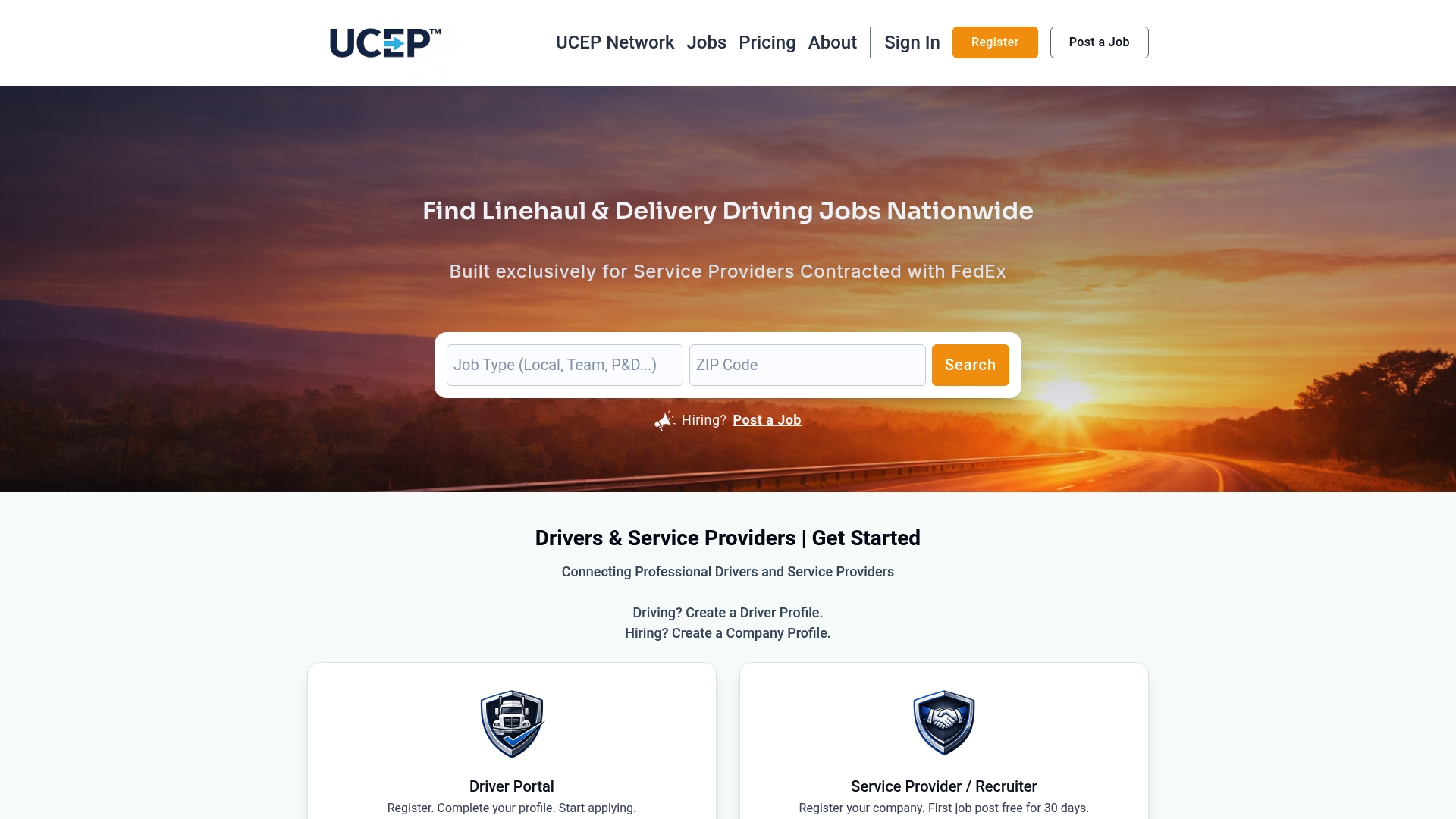
Ucep offers flexible posting packages designed for Service Providers at every hiring volume, from single-route operators to large contractors managing multiple terminals. You get access to a focused candidate pool, employer branding tools, and direct application tracking in one place. General platforms scatter your posting across every industry. Ucep delivers it directly to the drivers you need. Post a job on Ucep today and start receiving qualified applications from CDL-A drivers actively seeking FedEx-related roles.
FAQ
What is a dedicated job board?
A dedicated job board is a niche online platform where employers post job openings and candidates search for roles within a specific industry or profession. It differs from general job boards by filtering the audience to one sector, improving candidate relevance and reducing screening time.
How do dedicated job boards differ from general job boards?
General job boards like Indeed accept postings from every industry, creating high application volume but low relevance for specialized roles. Dedicated boards restrict postings to one niche, so every applicant already has relevant industry experience.
What pricing models do dedicated job boards use?
Most dedicated job boards offer per-post fees, monthly subscriptions, bundled packages, and premium resume database access. Subscriptions and bundles are the most cost-effective options for employers with ongoing or high-volume hiring needs.
Can a dedicated job board become a revenue source for my organization?
Yes. A well-managed dedicated job board can become a top-three revenue driver for industry associations and organizations by charging employers for postings, premium placements, and sponsored email blasts targeting passive candidates.
Do dedicated job boards replace an ATS?
No. Dedicated job boards function as top-of-funnel sourcing channels that distribute your openings to qualified candidates. An Applicant Tracking System manages the full hiring workflow after candidates apply and is a separate, complementary tool.