
A dedicated fleet driver is defined as a commercial driver who operates fixed routes exclusively for a single customer under a long-term carrier contract. This role sits within the broader dedicated contract carriage model, where a for-hire carrier supplies drivers, equipment, and management to serve one client's freight needs. The arrangement gives drivers predictable pay and home time that OTR roles rarely match. If you are evaluating commercial driving careers, understanding what a dedicated fleet driver does, how the pay works, and what the lifestyle looks like will help you decide if this path fits your goals.
What is a dedicated fleet driver and what do they do daily?
A dedicated fleet driver runs the same lanes repeatedly for one customer, acting as an extension of that customer's logistics operation. The industry term for this arrangement is dedicated contract carriage, or DCC. You drive the same origin-to-destination corridor on a fixed schedule, often weekly or daily, rather than chasing loads across the country.
Daily duties go well beyond steering a truck. Here is what the role typically includes:
- Fixed route execution. You drive the same lanes on a set timetable, which means you learn every stop, dock, and access point quickly.
- Cargo handling and verification. You confirm load counts, check seals, and follow any temperature or handling protocols specific to the freight.
- Dock compliance. You arrive within tight appointment windows and follow the customer's dock procedures, which vary by facility.
- Customer interaction. You represent the carrier at the customer's facilities, which means your conduct directly affects the client relationship.
- Performance reporting. Carriers track on-time delivery rates, fuel usage, and safety scores. Clients often add their own KPIs on top.
Dedicated drivers must adhere to the customer's dock schedules and KPIs, functioning as brand ambassadors whose performance is closely monitored. That means your job is part driver and part account representative.
Pro Tip: Before accepting a dedicated position, ask the carrier for the client's specific dock requirements and KPI targets. Knowing the on-time delivery threshold and any detention policies upfront prevents surprises once you are on the account.

Route familiarity is one of the underrated advantages here. After a few weeks, you know exactly where to fuel, where to park, and how long each stop takes. That knowledge reduces stress and makes your day more predictable than a load board ever could.
How does dedicated fleet driving differ from OTR and other trucking types?
The clearest way to understand dedicated fleet operations is to compare them directly to over-the-road driving and regional roles. The differences affect your paycheck, your home life, and your long-term career trajectory.
| Factor | Dedicated fleet | OTR |
|---|---|---|
| Route structure | Fixed, repeated lanes | Variable, load-board driven |
| Home time | Predictable, often daily or weekly | Irregular, sometimes weeks away |
| Deadhead rate | Typically 5–8% | Typically 15–25% |
| Pay consistency | Steady weekly earnings | Fluctuates 30–50% week to week |
| Per-mile rate | 5–15% below spot market peak | Higher during peak spot cycles |
| Stress level | Lower due to routine | Higher due to unpredictability |
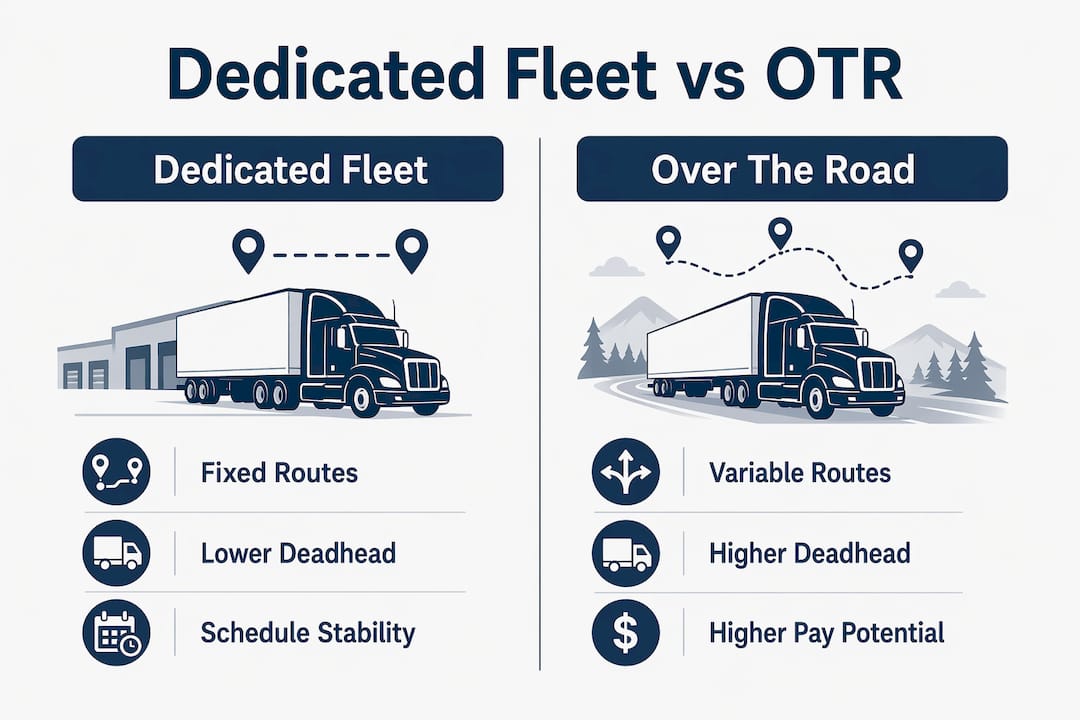
Deadhead rates for dedicated drivers run 5–8% versus 15–25% for OTR drivers. Lower deadhead means more of your miles are paid miles, which directly affects your weekly gross.
The pay trade-off is real. Dedicated driver pay runs 5–15% below peak spot market OTR rates. You give up the ceiling in exchange for a floor. During slow freight markets, that floor is worth a great deal. During hot markets, OTR drivers can out-earn you significantly.
Regional driving sits between the two. Regional drivers cover a multi-state territory with more variety than dedicated but more home time than long-haul OTR. If you want variety without the extreme unpredictability of OTR, regional is a middle path. Dedicated fleet driving suits drivers who prioritize routine and home life over earnings peaks.
The lifestyle difference is significant. OTR drivers often spend three to four weeks on the road before returning home. Dedicated drivers typically run home daily or every few days. That predictability matters for family schedules, health routines, and mental well-being. The mental health impact of trucking is a real consideration that career seekers often overlook until they are already in the seat.
What are the benefits and challenges of dedicated fleet driving?
Dedicated trucking services offer a distinct set of advantages, but the role is not right for every driver. Knowing both sides helps you make a clear-eyed decision.
Benefits
- Schedule stability. You know your start time, your route, and your expected return. That predictability makes personal planning possible.
- Lower deadhead miles. Fewer empty miles means more consistent pay per week.
- Relationship building. You work with the same dispatchers, dock workers, and client contacts regularly. That familiarity reduces friction.
- Specialized freight experience. Dedicated fleets are common in food and beverage and other industries requiring temperature control or specialized handling. That specialization adds value to your resume.
- Reduced decision fatigue. You are not hunting loads, negotiating rates, or managing uncertainty every day.
Challenges
- Route monotony. The same 300-mile loop daily can become mentally demanding. Drivers who need variety often find dedicated work draining over time.
- Lower peak earnings. When freight rates spike, dedicated drivers do not benefit. Your rate is locked in by contract.
- Contract dependency. If the client's volume drops, your route can disappear. That is a real employment risk that OTR drivers do not face in the same way.
- Limited flexibility. Your schedule aligns with the customer's needs, not yours. Swapping days or adjusting routes requires carrier and client approval.
Pro Tip: Before signing on to a dedicated account, ask the carrier how long the client contract runs and whether there is a volume guarantee. A two-year contract with a minimum mileage commitment is far more secure than a month-to-month arrangement.
Drivers should proactively ask about contract length, volume guarantees, and client business stability. That due diligence protects your income before you commit to a single account.
How do dedicated fleet drivers fit into the logistics industry model?
Understanding the employment structure behind dedicated fleet operations clears up a common misconception. Many drivers assume they work for the customer whose freight they haul. They do not.
Here is how the model actually works:
- The carrier holds the contract. A for-hire trucking company signs a multi-year agreement with a shipper to provide dedicated capacity. The carrier owns the trucks and employs the drivers.
- The driver works for the carrier. Your paycheck, benefits, HR support, and compliance training all come from the carrier, not the client. Dedicated drivers are employed by the logistics provider, with carriers managing payroll, training, and regulatory compliance.
- The client sets the operational requirements. The shipper defines the routes, schedules, dock procedures, and performance standards. The carrier delivers drivers who meet those requirements.
- The shipper gains capacity without fleet ownership. The client gets reliable, branded freight service without managing trucks, drivers, or compliance. That is the core value of dedicated contract carriage for shippers.
- Volume guarantees protect both sides. Well-structured contracts include minimum volume commitments from the shipper and service-level commitments from the carrier. Both parties carry risk.
This structure matters for your career planning. If the client loses business or switches carriers, your employment is affected even though you never worked directly for that client. Evaluating the carrier's financial health and contract portfolio is just as important as evaluating the route itself. Ucep connects drivers with vetted service providers so you can assess the carrier before you commit.
Key Takeaways
A dedicated fleet driver trades peak earning potential for schedule stability, predictable home time, and lower deadhead miles under a carrier-managed contract with a single client.
| Point | Details |
|---|---|
| Role definition | A dedicated fleet driver runs fixed routes for one customer under a long-term carrier contract. |
| Pay trade-off | Dedicated rates run 5–15% below OTR spot market peaks but deliver steady weekly earnings. |
| Employment structure | The carrier employs the driver, not the client, managing payroll, compliance, and HR. |
| Key risk | Contract loss from client volume drops can eliminate a route without warning. |
| Best fit | Drivers who prioritize routine, home time, and income stability over peak earnings. |
Why dedicated driving rewards the right personality, not just the right license
I have spoken with enough drivers and recruiters to say this plainly: dedicated fleet driving is a personality fit before it is a skills fit. Most CDL-A holders can handle the physical demands. The harder question is whether you can run the same corridor for two years and stay mentally engaged.
The drivers who thrive in dedicated roles tend to value control over their schedule more than they value variety in their work. They find satisfaction in doing a job well repeatedly, building relationships at the same docks, and coming home on a predictable schedule. That is a legitimate and valuable way to build a career.
The drivers who struggle are often the ones who took the role for the stability but underestimated the monotony. Route repetition requires mental resilience that not everyone develops naturally. If you get restless after a few weeks on the same road, OTR or regional work will serve you better.
The contract risk piece is the part I think most career guides underplay. Your income depends on one client staying healthy. I have seen drivers lose solid dedicated accounts because a shipper restructured its supply chain or lost a major retail customer. That is not a reason to avoid dedicated driving. It is a reason to ask hard questions before you accept the position. Look at the client's industry, the contract length, and whether the carrier has backup accounts for displaced drivers.
Recruiters consistently advise drivers to choose dedicated when they value predictable income and home life over maximum earnings. That advice is sound. Just make sure you are choosing it with full information, not just because the schedule looks good on paper.
— Aaron
Finding dedicated fleet driving jobs through Ucep
Ucep is a job board and recruiting platform built exclusively for Service Providers contracted with FedEx. It connects drivers with linehaul, CDL-A team, CDL-A solo, and pickup and delivery roles across the country.
If you are ready to find a dedicated driving position, Ucep gives you one focused place to browse verified opportunities. You can read service provider reviews before you apply, so you know the carrier's reputation before you commit to an account. Browse companies hiring drivers on Ucep to find dedicated fleet roles matched to your license and location. The platform removes the guesswork from finding a reputable carrier and puts the information you need in one place.
FAQ
What is a dedicated fleet driver in simple terms?
A dedicated fleet driver is a commercial driver who runs fixed routes for a single customer under a contract between that customer and a carrier. The driver works for the carrier, not the customer.
What does a fleet driver do every day?
A dedicated fleet driver executes the same routes on a set schedule, manages dock check-ins, verifies cargo, and meets the client's on-time delivery KPIs. Customer interaction and performance reporting are also part of the role.
What are the main benefits of dedicated fleet driving?
The primary benefits are predictable home time, consistent weekly pay, lower deadhead miles, and reduced schedule uncertainty compared to OTR driving.
How do I become a dedicated fleet driver?
You need a valid CDL-A license and a clean driving record. Most carriers require at least one year of verifiable commercial driving experience before placing you on a dedicated account.
What is the biggest risk of dedicated fleet driving?
Contract loss is the primary risk. If the client reduces volume or switches carriers, your route can disappear. Asking about contract length and volume guarantees before accepting a position reduces this risk.