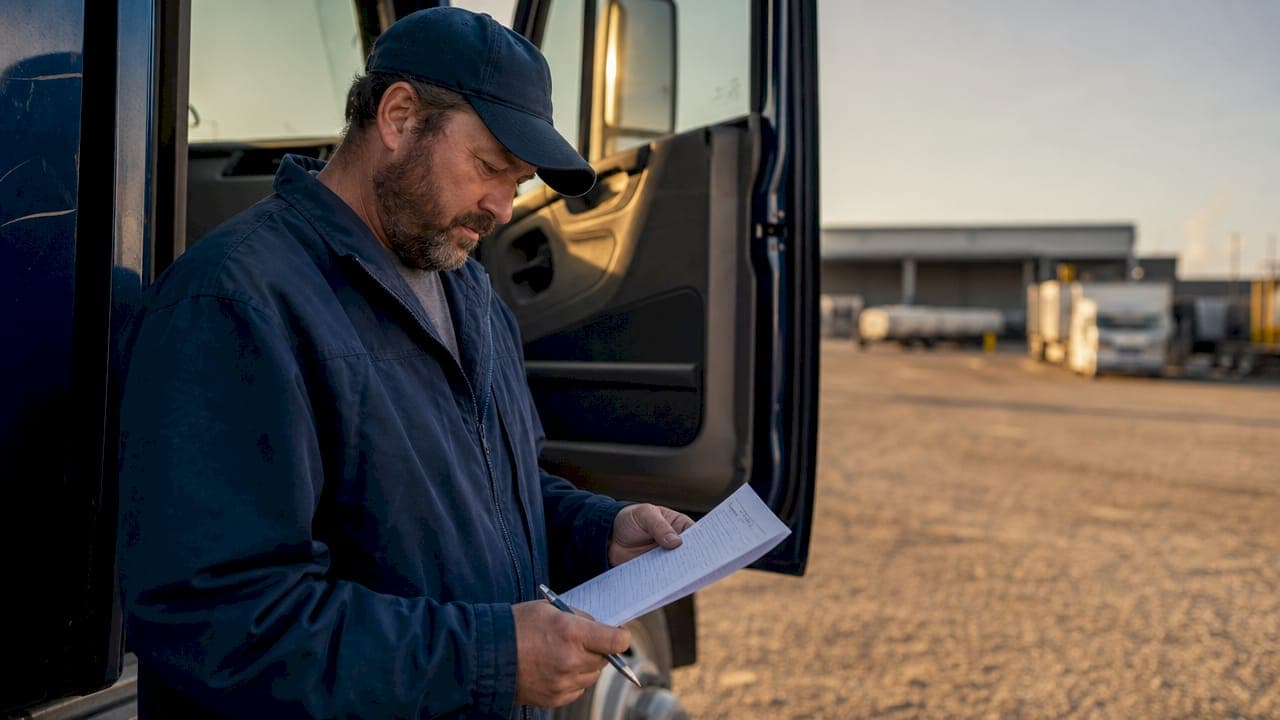
A bill of lading driver is the carrier or truck driver who receives, verifies, and signs the bill of lading (BOL) at shipment pickup, formally accepting legal responsibility for the freight. The BOL itself serves three legal functions simultaneously: it is a receipt of goods, a contract of carriage, and a document of title. The National Motor Freight Traffic Association (NMFTA) recognizes these three functions as the foundation of freight transport law in the United States. Understanding what a bill of lading driver does clarifies why this role sits at the center of every freight claim, delivery dispute, and carrier liability case.
What is a bill of lading driver responsible for at pickup?
A bill of lading driver carries out specific verification duties before the truck leaves the shipper's dock. These duties are not optional. They determine who bears financial responsibility if freight arrives damaged or short.
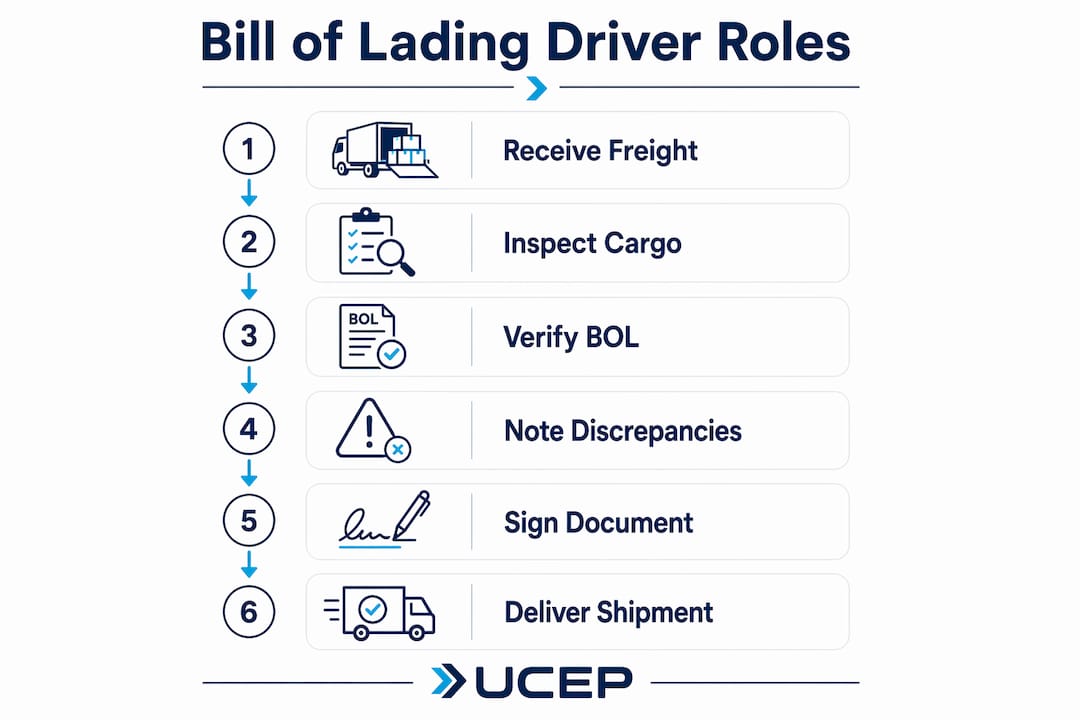
At pickup, the driver must check every detail on the BOL against the physical shipment. That includes:
- Piece count: Confirm the number of pallets, boxes, or units matches the BOL exactly.
- Weight: Verify the listed weight is consistent with what is being loaded.
- Commodity description: Confirm the goods described match what you see.
- Special handling instructions: Note any temperature requirements, fragile markings, or hazmat designations.
- Freight condition: Inspect packaging for visible damage before signing.
The most critical distinction a driver must make is between a clean BOL and a claused BOL. A clean BOL means the driver accepts the freight as undamaged and complete. A claused BOL includes written exceptions noting pre-existing damage or discrepancies. Ignoring this distinction is the most common reason drivers are held liable for damage they did not cause.
Improperly completed BOLs are one of the leading causes of freight claims and delivery delays in the U.S. trucking industry. That fact alone shows why thorough verification at pickup is not a formality. It is the first line of defense against a costly dispute.

Pro Tip: If you notice any damage or discrepancy at pickup, write it clearly on the BOL before you sign. Use specific language like "corner damage on pallet 3" rather than vague terms like "possible damage." Vague notations rarely hold up in a claim.
A driver's signature on the BOL is a legal certification of cargo condition and acceptance of liability. Signing without inspecting is the equivalent of signing a blank check. Once your signature is on that document, you have legally confirmed the freight was received in the condition described.
How does a bill of lading protect the driver and carrier?
The BOL creates legal protections, but only when it is completed correctly. Drivers who understand this use the document as a shield. Drivers who ignore it often find it used against them.
The primary federal law governing this area is the Carmack Amendment. Under the Carmack Amendment, a carrier is strictly liable for damage to goods from the moment it signs the BOL until delivery, with very limited exceptions. That liability window begins the instant the driver signs at pickup.
The BOL functions as an evidentiary document in any damage or loss claim. Courts and insurance adjusters treat it as the definitive record of the freight's condition at the time of pickup. A properly notated BOL with clear exceptions gives the driver and carrier a strong defense. A clean BOL with no exceptions gives the shipper a strong claim.
Four consequences follow from an unsigned or inaccurately completed BOL:
- The carrier loses its primary legal defense in a damage claim.
- The driver may be held personally responsible for pre-existing damage.
- The shipper can dispute the entire shipment, not just the damaged portion.
- Delivery may be refused or delayed, creating additional costs for the carrier.
Proper notation on the BOL at pickup is the single most effective action a driver can take to protect both their own financial interests and their carrier's legal standing. A few seconds of documentation can prevent months of dispute.
A BOL also requires two signatures to be legally complete: the shipper's at pickup and the carrier's acknowledgment. If either signature is missing, the document's legal validity is compromised. Drivers should never leave a pickup location without confirming both signatures are present on their copy.
What types of bills of lading might a driver encounter?
Not every BOL works the same way. The type of BOL on a shipment affects the driver's procedures at both pickup and delivery.
Three basic BOL types exist in domestic trucking: straight, order (negotiable), and electronic.
| BOL Type | Key Characteristic | Driver Implication |
|---|---|---|
| Straight (non-negotiable) | Names a specific consignee | Deliver only to the named party; most common type |
| Order (negotiable) | Represents ownership of goods | Requires endorsement; treat like a financial instrument |
| Electronic (eBOL) | Digital format, no paper copy | Verify through carrier's digital system at pickup and delivery |
The straight BOL is the standard in domestic freight. The vast majority of domestic truckload shipments use straight BOLs naming a specific consignee. That means most drivers will handle straight BOLs on a daily basis, making familiarity with this format the baseline requirement.
The order BOL is less common but carries higher stakes. Because it represents ownership of the goods, it can be transferred between parties by endorsement, similar to a check. A driver handling an order BOL must confirm the correct party is endorsing the document before releasing the freight. Releasing goods to the wrong party on a negotiable BOL creates serious legal exposure.
Electronic BOLs are growing in use across the industry. The procedures mirror paper BOLs, but verification happens through a carrier's digital platform rather than a physical document. Drivers working with eBOLs should confirm their carrier's specific system requirements before the first load.
How should drivers properly use the bill of lading?
Proper BOL handling follows a clear sequence from pickup through delivery. Skipping any step creates gaps that can be exploited in a dispute.
At pickup:
- Read the entire BOL before touching the freight.
- Count pieces and verify weight against the BOL.
- Inspect all packaging for visible damage.
- Note every discrepancy in writing on the BOL before signing.
- Retain your signed copy before leaving the dock.
During transit:
- Keep the BOL accessible in the cab at all times.
- Do not alter the BOL after signing. Any changes require a new document or a formal amendment.
- If a load is split or partially delivered, document it clearly on the BOL.
At delivery:
- Present the BOL to the consignee and have them inspect the freight before signing.
- Note any delivery discrepancies on the BOL before the consignee signs.
- Collect the consignee's signature as proof of delivery.
- Retain a copy of the signed delivery receipt for your records.
Pro Tip: Take photos of the freight at pickup and delivery. Photos with timestamps create independent evidence that supports your BOL notations if a claim is filed later. This practice costs nothing and has saved carriers significant money in disputed claims.
Mastering the BOL verification process is a skill that protects both the driver and the carrier financially. Drivers who follow a consistent process at every pickup build a reputation for reliability. That reputation directly affects the loads they are offered and the carriers willing to work with them. For drivers interested in succeeding as a team driver or in solo roles, BOL proficiency is a baseline expectation, not an advanced skill.
Compliance with company policies on BOL handling also matters. Many carriers have internal documentation requirements that go beyond the legal minimum. Drivers who follow those requirements consistently reduce their carrier's claims ratio, which is a measurable contribution to the business.
Key Takeaways
A bill of lading driver's signature is a legal act, not a formality. Every step from pickup verification to delivery confirmation determines who bears liability for the freight.
| Point | Details |
|---|---|
| BOL serves three legal functions | It is a receipt, a contract of carriage, and a document of title simultaneously. |
| Clean vs. claused BOL | Always note pre-existing damage before signing to avoid liability for damage you did not cause. |
| Carmack Amendment liability | Carrier liability begins the moment the driver signs the BOL at pickup. |
| BOL types differ in procedure | Straight BOLs are most common; order BOLs require endorsement and extra care at delivery. |
| Proper documentation protects you | Accurate notations and photos at pickup and delivery are your strongest defense in any claim. |
The detail most drivers overlook on every load
After years of watching freight disputes play out, one pattern stands out clearly. The drivers who avoid costly claims are not necessarily the most experienced. They are the most consistent. They read the BOL before they touch the freight, every single time.
The BOL verification process is treated as a career-defining skill by the best drivers in the industry. I have seen experienced drivers sign a clean BOL on visibly damaged freight because they were in a hurry or trusted the shipper's word. That decision cost their carrier thousands of dollars and cost them a working relationship.
The claused vs. clean BOL distinction is where most mistakes happen. Shippers sometimes pressure drivers to sign a clean BOL even when damage is visible. That pressure is not your problem to solve. Your signature is your legal statement. Protect it.
BOL expertise also signals something to carriers and service providers. Drivers who handle documentation accurately get assigned to higher-value loads. They get called back. They build the kind of track record that opens doors to better routes and better pay. The paperwork is not separate from the driving career. It is part of it.
— Aaron
Ucep connects drivers with carriers who value documentation skills
Carriers contracted with FedEx require drivers who understand freight documentation from day one. Ucep is the dedicated job board built exclusively for FedEx Service Providers and the drivers who work with them.
You can browse companies hiring drivers who need professionals with solid BOL knowledge and freight handling experience. Ucep also publishes service provider reviews so you can evaluate carriers before you commit to a role. Whether you are looking for linehaul, CDL-A team, CDL-A solo, or pickup and delivery positions, Ucep lists opportunities from vetted FedEx Service Providers nationwide. Visit Ucep to find your next role with a carrier that takes documentation seriously.
FAQ
What does a bill of lading driver do?
A bill of lading driver receives, inspects, and signs the BOL at freight pickup, legally accepting responsibility for the shipment. The driver then carries the BOL through transit and collects the consignee's signature at delivery.
What is the difference between a clean and claused BOL?
A clean BOL means the driver accepted freight with no visible damage or discrepancies. A claused BOL includes written exceptions noting pre-existing damage, which protects the driver from liability for that damage.
When does carrier liability begin under the Carmack Amendment?
Carrier liability begins the moment the driver signs the BOL at pickup and continues until the freight is delivered to the consignee.
What happens if a BOL is not signed correctly?
An unsigned or incorrectly completed BOL weakens the carrier's legal defense in any damage or loss claim and can result in the driver being held liable for damage they did not cause.
What is the most common type of BOL in domestic trucking?
The straight BOL is the most common type in domestic freight. It names a specific consignee and is non-negotiable, meaning it cannot be transferred to another party by endorsement.