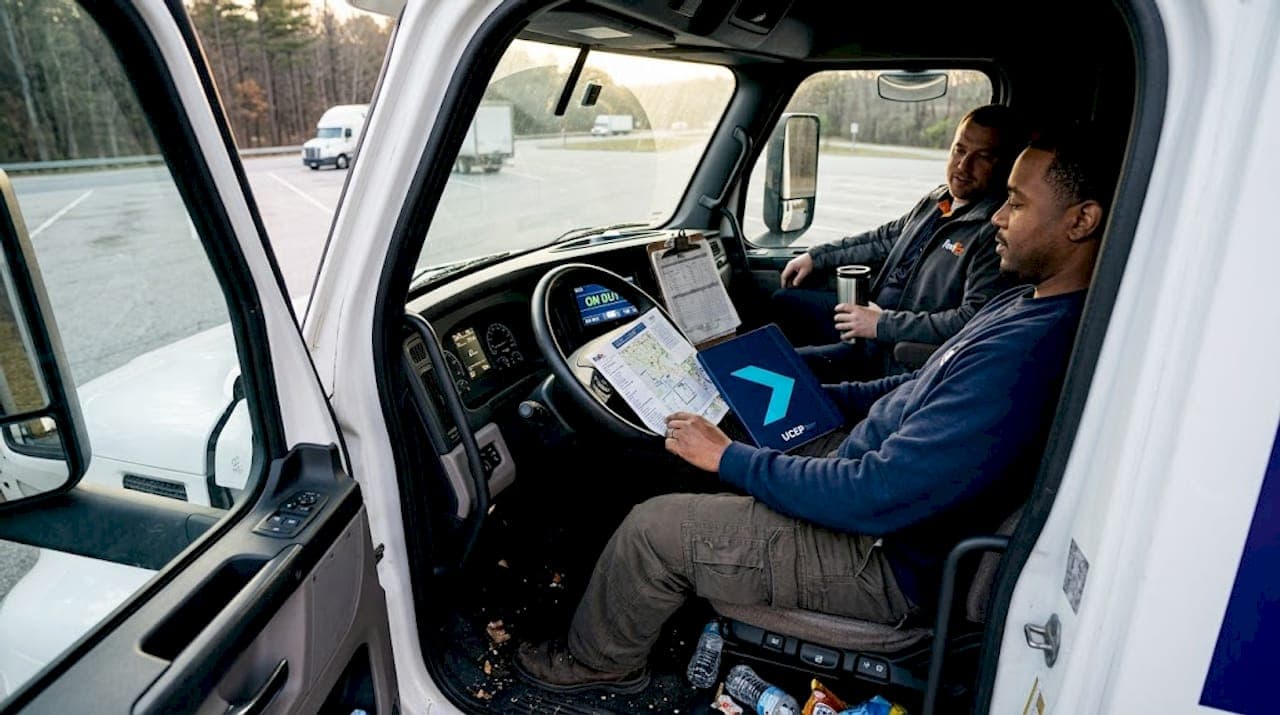
If you manage drivers for a FedEx contracted service provider, understanding what does team driving involve is not optional. It is the difference between winning time-sensitive hot loads and passing on them. Team driving means two CDL-A qualified drivers share one truck, alternating between driving and sleeping so the vehicle stays in motion almost around the clock. Done right, it can roughly double the miles your trucks cover each day. Done wrong, it produces compliance violations, burnt-out drivers, and failed deliveries. This guide covers the mechanics, the legal framework, and practical steps to recruit and train effective teams.
Table of Contents
- Understanding the basics of team driving
- Hours of Service rules and compliance in team driving
- Operational workflow and technology support in team driving
- When and why to use team driving: benefits and challenges
- Best practices for recruitment, training, and scheduling of team drivers
- Why typical views on team driving miss key operational truths
- Optimize your FedEx contracted team driving operations with UCEP
- Frequently asked questions
Key Takeaways
| Point | Details |
|---|---|
| Team driving basics | Two CDL drivers alternate driving and resting to keep a truck moving nearly nonstop, doubling typical solo mileage. |
| HOS compliance | Each driver follows individual Hours of Service rules using the sleeper berth provision for legal rest splits. |
| ELD technology | Electronic Logging Devices track each driver's duty status separately and manage role swaps for compliance. |
| Benefits and challenges | Team driving enables faster deliveries and higher pay but requires lifestyle compromises and strong driver compatibility. |
| Recruitment and training | Effective team driver operations depend on recruiting compatible partners and training for precise handoffs and scheduling. |
Understanding the basics of team driving
Team driving in trucking involves two CDL drivers assigned to the same tractor who operate it in rotation. When one driver reaches their Hours of Service limit, the drivers swap roles and the truck keeps moving. That single principle is what makes team driving so powerful for expedited freight.
Here is how the basic structure works in practice:
- Two drivers, one truck. Both hold valid CDL-A licenses and operate under separate, individually tracked Hours of Service logs.
- Continuous movement. The truck stops only for fuel, required inspections, and loading or unloading. It does not stop because a driver needs to rest.
- Sleeper berth as legal rest. While one driver operates the vehicle, the other rests in the sleeper berth. Federal regulations recognize this as qualifying off-duty time when certain conditions are met.
- ELD tracking per driver. Electronic Logging Devices track each driver's active driving time and off-duty status independently, even though both drivers share one physical device.
What does team driving mean in terms of daily output? A solo driver legally covers roughly 550 to 650 miles in a 24-hour period. A properly run team can cover 1,100 to 1,300 miles over the same window. For FedEx service providers managing expedited linehaul runs, that gap matters significantly.
A typical 24-hour team cycle looks like this:
- Driver A takes the wheel for up to 11 hours of driving.
- Driver B logs sleeper berth time and rests for at least 7 consecutive hours.
- Drivers swap roles at a safe location or truck stop.
- Driver B then drives while Driver A logs sleeper berth time.
- Both drivers track their own individual clocks separately throughout.
For a deeper look at team driving basics for FedEx providers, review the operational framework before scheduling your first team run.
Now that you know what team driving is in principle, let's look at the exact legal rules that govern how drivers manage their hours.
Hours of Service rules and compliance in team driving
Each driver on a team run must follow federal Hours of Service regulations independently. There is no shared clock and no combined limit. Understanding this is the foundation of compliant team operations.
Here are the core HOS limits every team driver must follow:
- 11-hour driving limit. After 10 consecutive hours off duty (or equivalent sleeper berth time), a driver may drive a maximum of 11 hours.
- 14-hour on-duty window. A driver cannot drive beyond the 14th hour after coming on duty, regardless of breaks taken during that window.
- 70-hour/8-day limit. Drivers working for carriers operating 7 days a week cannot exceed 70 hours on duty in any 8 consecutive days.
- 30-minute break requirement. Drivers must take a 30-minute break after 8 cumulative hours of driving without a break of at least 30 minutes.
The sleeper berth provision under 49 CFR 395.1(g) allows splitting the 10-hour rest requirement into two qualifying segments. One must be at least 7 consecutive hours in the sleeper berth. The second must be at least 3 hours, either in the sleeper berth or off duty. Together, these two segments satisfy the rest requirement for the driver's next shift.
Important: The sleeper berth split pauses the 14-hour on-duty clock during the 7+ hour qualifying segment. This is what allows teams to legally extend operational time without violating HOS rules.
Common compliance failures in team operations include:
- The resting driver logging incorrect duty status when physically assisting with a load at a dock
- Sleeper berth periods falling short of the required 7 consecutive hours
- Both drivers hitting their driving limits simultaneously, forcing an unplanned stop
- Confusing co-driver on-duty time with off-duty rest time in ELD entries
Pro Tip: Build a simple driver schedule template that pre-calculates each driver's available hours before every dispatch. Dispatchers who monitor individual driver clocks proactively, rather than reactively, eliminate most forced stops before they happen.
For team driver HOS compliance specifics tied to FedEx linehaul runs, reference the full regulatory breakdown before finalizing your training materials.
Operational workflow and technology support in team driving

Knowing the rules is one part of the equation. Executing them smoothly during a live run is another. Team driving relies on ELDs to log each driver's duty status accurately, manage driver swaps, and ensure compliance. But technology supports the process. It does not run it.
Here is how the ELD workflow functions during a team run:
- Both drivers log into the same ELD device using their individual driver profiles.
- The active driver's profile is set to "driving" status and the device records that driver's time.
- The resting driver's profile is set to "sleeper berth" or "off duty" depending on their actual status.
- When a swap occurs, the drivers switch roles in the ELD app, updating both profiles simultaneously.
- The device maintains two separate logs, one per driver, even though it is a single physical unit in the cab.
The handoff itself requires more coordination than most new team drivers expect. The truck may need to pull off briefly, or in some cases a rolling swap is logged if conditions permit. Either way, both drivers need to agree on timing, communicate clearly about hours remaining, and confirm the status change in the ELD before moving on.
Pro Tip: Train your team drivers to verbally confirm their hours remaining to each other at every swap. A simple "I have 4 hours left on my driving clock" exchange takes 10 seconds and prevents the most common cause of mid-route compliance failures.
Common operational mistakes in team driving technology and coordination include:
- Logging a swap without physically being ready to drive, creating a false log entry
- The off-duty driver briefly assisting at a dock and failing to update their duty status to "on duty not driving"
- Failing to complete a full ELD profile switch, leaving both drivers logged as the same status
Technology does not automate judgment. Driver training on handoff choreography, meaning the exact sequence of actions each driver takes at every swap, is the single biggest factor separating compliant teams from non-compliant ones.
When and why to use team driving: benefits and challenges
Team driving is commonly used for expedited hot loads that require near-constant movement. These are time-sensitive shipments where a delivery window of 24 to 48 hours makes solo driving physically impossible.
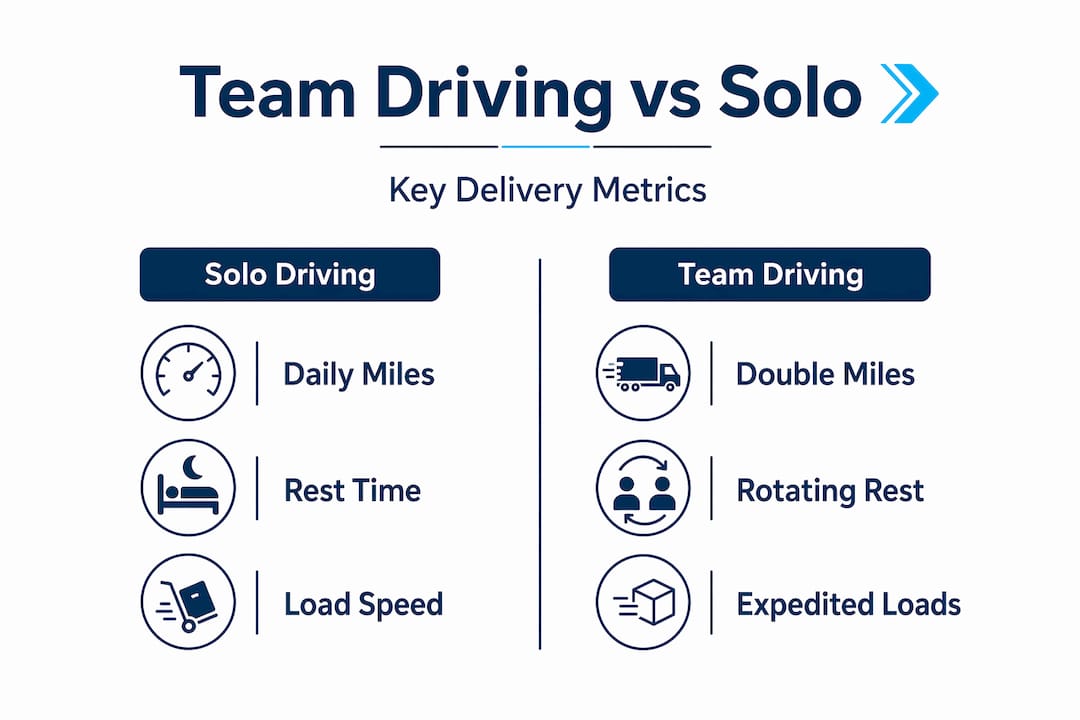
Team driving vs. solo driving: a direct comparison
| Factor | Solo driving | Team driving |
|---|---|---|
| Daily miles covered | 550 to 650 miles | 1,100 to 1,300 miles |
| Truck utilization per day | 10 to 11 hours moving | 20 to 22 hours moving |
| Suitability for hot loads | Limited | Primary use case |
| Pay per run | Standard | Higher for hot load assignments |
| Compliance complexity | Lower | Higher, two individual clocks |
| Driver fatigue risk | Lower (solo rest) | Higher (shared space, moving cab) |
The advantages of team driving are clear on paper, but the lifestyle tradeoffs are real and often underestimated. Drivers sleep in a moving truck, which is not restful for everyone. The cab is a shared living space for days at a time. Any friction between partners, whether about schedules, habits, or driving style, compounds quickly over a long run.
Key challenges to address in your recruitment and training process:
- Sleep disruption. The vibration and noise of a moving cab affect sleep quality. Some drivers adapt well. Others do not, and this shows up in performance and retention data.
- Personal compatibility. Drivers with different schedules, cleanliness standards, or communication styles can compromise an otherwise capable team.
- Simultaneous clock expiry. If both drivers exhaust their driving hours at the same time, the truck must stop and wait. This can happen if dispatch does not stagger start times or monitor clocks proactively.
Hot loads often carry higher pay rates, reflecting the added capacity and speed team drivers provide. For FedEx service providers, filling these assignments with well-matched, compliant teams is a direct revenue advantage.
Best practices for recruitment, training, and scheduling of team drivers
Many teams fail due to improper scheduling of sleeper split rest periods, driver handoff miscoordination, or misunderstanding ELD logs. Your recruitment and training process is where you prevent those failures.
Follow these steps when building your team driver program:
- Screen for compatibility, not just credentials. Require CDL-A with the correct endorsements, but also assess communication style and prior team driving experience during interviews. A pair of individually skilled drivers who cannot coordinate effectively will underperform.
- Train on ELD handoff procedures before the first run. Use a simulator or a stationary ELD walkthrough so drivers practice the exact sequence of status changes before they execute them under pressure on a live route.
- Schedule sleeper splits deliberately. Build dispatch schedules around the 7+ hour sleeper berth requirement. Do not leave rest periods as an afterthought. Use the 7/3 or 8/2 split structure based on route timing.
- Stagger driver start times. When onboarding a new team, stagger their initial clock starts so their hours available never expire at the same time.
- Train dispatchers to monitor two clocks per truck. Every team truck in your fleet has two independent HOS clocks running. Dispatchers who track only the active driver's hours create blind spots that cause forced stops.
- Prepare drivers for the lifestyle. Cover sleep hygiene in a moving cab, personal space etiquette, and conflict resolution in your orientation. These topics seem soft but directly affect retention.
Pro Tip: Pair new team drivers on shorter regional runs before assigning them to cross-country hot loads. This lets both drivers and dispatch teams identify coordination issues before they occur on a 1,200-mile overnight run.
For team driver recruitment and scheduling frameworks specific to FedEx contracted operations, review the full guide before finalizing your onboarding workflow.
Why typical views on team driving miss key operational truths
Most descriptions of team driving focus on the mileage upside and leave the hard part out. The result is that service providers hire two qualified CDL-A drivers, assign them to a team run, and then troubleshoot the operational failures that were entirely predictable.
The most common misconception is that team driving simply means doubling your driving capacity. It does not. It means managing two independent HOS clocks, two separate ELD logs, and two human beings who must coordinate precisely in a space smaller than most people's bathrooms. A core nuance is that "team" doesn't mean one set of rules for both drivers. Each driver's clock is separate, and the sleeper berth split pauses only one driver's 14-hour window while the other drives.
The sleeper berth provision is also routinely misunderstood. Many dispatchers and even some drivers believe that any time spent in the sleeper berth counts toward the required rest. It does not. The 7 consecutive hours must be logged correctly, and any on-duty activity during that window invalidates the qualifying period. Dock assistance, paperwork, and phone calls to dispatch all count as on-duty time.
ELDs support accurate logging, but they do not prevent a driver from logging the wrong status. The tool is only as reliable as the training behind it. Insights on team driving nuances consistently point to human error at the ELD, not system failure, as the leading cause of compliance violations in team operations.
The lifestyle dimension is where many team partnerships break down despite both drivers having strong individual records. Treating compatibility as a soft factor, secondary to credentials, is a recruitment error that shows up in turnover data. When you invest in matching drivers well and preparing them honestly for the shared-space reality of team driving, you retain teams longer and run more consistent freight.
Optimize your FedEx contracted team driving operations with UCEP
If you are a FedEx contracted service provider looking to fill CDL-A team driving positions with qualified, compatible drivers, UCEP is built specifically for that need. Our platform connects you with drivers who understand the compliance demands, HOS rules, and coordination requirements that team runs require.
UCEP recruitment and training solutions give you access to a focused pool of CDL-A candidates actively seeking FedEx-related linehaul and team driving opportunities. You can post team driving roles, filter for relevant experience, and reduce the time it takes to fill critical positions. For a complete operational framework, the detailed team driver success guide covers everything from ELD handoff training to sleeper berth scheduling. By working with UCEP, you reduce hiring guesswork and build teams that can consistently meet the demands of expedited FedEx freight.
Frequently asked questions
What are the main legal hour limits each team driver must follow?
Each driver must not exceed 11 hours of driving after 10 consecutive hours off duty and cannot drive beyond a 14-hour on-duty window, even when team driving. Each team driver independently follows the standard property-carrier HOS rules, including these limits, regardless of their partner's status.
How does the sleeper berth split provision work for team drivers?
Team drivers can split their mandatory 10 hours off duty into two periods, with one being at least 7 consecutive hours in the sleeper berth and the other at least 3 hours off duty or in the sleeper berth. The sleeper berth split pauses the active 14-hour clock during the qualifying 7+ hour segment, allowing the driver to legally extend their shift window.
What technology supports compliance and role handoffs in team driving?
Electronic Logging Devices with team driving features allow both drivers to maintain separate duty status logs on one device and switch the active driver role during handoffs. Team driving depends on ELDs for accurate status tracking, but disciplined handoff procedures and proper driver training are equally essential for compliance.
Why is driver compatibility important in team driving recruitment?
Team drivers share close quarters for extended periods and must coordinate sleep schedules, driving preferences, and communication under fatigue. Lifestyle tradeoffs like shared space and sleep disruptions challenge many team partnerships, making compatibility screening as important as credential verification during hiring.
How does team driving improve freight delivery speed for FedEx contractors?
Team driving allows trucks to operate nearly 24 hours a day with only brief stops, effectively doubling daily mileage compared to solo operations. Teams can cover 1,100 to 1,300 miles in 24 hours versus 550 to 650 miles for a solo driver, making team runs essential for meeting tight FedEx expedited delivery windows.