
Finding and keeping qualified drivers is one of the most persistent challenges FedEx Service Providers face. Driver replacement costs for a single position can run between $8,000 and $20,000 when you factor in recruiting ads, onboarding time, training, and service disruptions. Most contractors already use job boards, but posting a generic listing and waiting is rarely enough. This guide walks you through a structured, step-by-step approach to attracting the right drivers, screening them effectively, and building the kind of team that stays.
Table of Contents
- Understand your hiring needs and challenges
- Prepare to use job boards effectively
- Go beyond job boards: Multi-channel recruiting
- Screen, hire, and retain the right drivers
- Why the best ISPs treat hiring as a retention strategy, not just a numbers game
- Level up your driver hiring with UCEP
- Frequently asked questions
Key Takeaways
| Point | Details |
|---|---|
| Turnover is expensive | Replacing FedEx drivers costs thousands per hire, so efficient recruiting is essential. |
| Job boards aren’t enough | Combine job boards with referrals, local schools, and culture-building for best results. |
| Screen and retain | Rigorous vetting, onboarding, and culture investment keep high-value drivers for the long term. |
| Start early | Recruit before peak season to avoid high costs and competition. |
Understand your hiring needs and challenges
Now that you know the stakes, let's assess exactly what and who you're hiring for.
Not all driver roles carry the same requirements. Before you write a single job listing, you need to be clear about which positions you are filling and what each one demands from a candidate.
Role types and what they require
- Pickup and delivery (P&D) drivers: These drivers work local routes, interact directly with customers, and must handle high stop counts efficiently. Customer service attitude and physical stamina matter as much as driving record.
- CDL-A solo drivers: These positions require a valid Class A commercial driver's license (CDL-A), a clean Motor Vehicle Record (MVR), and the ability to manage longer routes independently.
- CDL-A team drivers: Two drivers share a truck and alternate driving shifts to cover more miles. Compatibility, communication, and scheduling flexibility are critical factors.
- Linehaul drivers: These drivers move freight between terminals on set schedules, often overnight. Reliability and familiarity with highway driving are top priorities.
Each role also has specific driver job requirements around licensing, endorsements, experience, and physical fitness. Knowing exactly which role you are hiring for shapes every other step in this process.
The real cost of turnover
Trucking industry turnover rates run between 72% and 94% annually, costing fleets hundreds of thousands of dollars each year. FedEx ISPs (Independent Service Providers) face the same pressure. Every time a driver leaves, you absorb both direct and indirect costs.
Direct costs include:
- Job board posting fees
- Background check and MVR pull fees
- Onboarding paperwork and processing time
- Initial training hours
Indirect costs are harder to see but just as real:
- Missed or delayed deliveries
- Overtime paid to remaining drivers
- Customer complaints and service score impact
- Manager time diverted from operations to recruiting
Pro Tip: Calculate your annual turnover cost by multiplying your average monthly churn by 12, then applying a conservative $10,000 per driver estimate. Many Service Providers are surprised by the total.
| Cost category | Estimated range per driver |
|---|---|
| Recruiting and advertising | $500 to $1,500 |
| Onboarding and paperwork | $300 to $800 |
| Training time | $1,000 to $2,500 |
| Lost productivity and delays | $3,000 to $8,000 |
| Manager time and admin | $500 to $1,500 |
| Total estimated cost | $8,000 to $20,000 |
Understanding these numbers before you start hiring changes how seriously you treat every step of the process.
Prepare to use job boards effectively
Once you know your needs, it is time to set up your hiring process for maximum efficiency.
FedEx Ground ISPs and contractors commonly use job boards like Indeed, Craigslist, and local classifieds to recruit drivers for P&D, linehaul, CDL-A solo, and team roles. These platforms give you access to a large pool of active job seekers. But the quality of your results depends heavily on how you use them.
Comparing your job board options
| Platform | Audience reach | Cost | Best for |
|---|---|---|---|
| Indeed | National, very large | Free and paid tiers | CDL-A solo, linehaul |
| Craigslist | Local and regional | Low flat fee | P&D, local routes |
| Industry-specific boards | Targeted driver audience | Moderate | All FedEx-related roles |
| Social media groups | Local and niche | Free | Referral-style outreach |
National boards like Indeed give you volume. Targeted job boards built for the trucking and delivery industry give you relevance. The difference matters. A driver who finds your listing on a board focused on FedEx-related roles already understands the work environment and expectations. That context reduces early turnover from mismatched expectations.

Niche job boards also tend to attract candidates who are actively looking for this type of work, not just any available job. That distinction affects how long they stay once hired.
How to write a listing that attracts qualified applicants
- State the role clearly. Use the exact title: P&D Driver, CDL-A Solo Driver, CDL-A Team Driver, or Linehaul Driver. Vague titles attract unqualified applicants.
- List your requirements upfront. Include MVR standards, license class, experience minimums, and any physical requirements. This filters out unqualified candidates before they apply.
- Be specific about the route and schedule. Drivers want to know if they are working mornings, nights, or weekends. Include the general service area.
- State your pay clearly. Listings with pay ranges receive significantly more qualified applications than those without. Include whether pay is hourly, per stop, or per mile.
- List your benefits. Health coverage, paid time off, equipment quality, and safety bonuses all influence a driver's decision to apply and to stay.
To post a job that performs well, treat your listing like a sales page for the position. The goal is to attract the right person, not just the most people.
Pro Tip: Use built-in screening questions on platforms like Indeed to filter for CDL status, MVR cleanliness, and availability before you review a single resume. This alone can cut your screening time by half.
Go beyond job boards: Multi-channel recruiting
Optimizing your presence on job boards is just the start. Smart contractors expand their reach for better results.
Successful FedEx contractors use multiple hiring channels including job boards, local driving schools, word-of-mouth referrals, and social media. Each channel attracts a different type of candidate and reduces your dependence on any single source.
Three channels to add alongside job boards
1. Employee referrals
Your current drivers know other drivers. A structured referral program, where you offer a cash bonus after a new hire completes 60 or 90 days, gives your team a reason to recruit for you. Referral hires tend to stay longer because they come pre-screened by someone who understands the job.
2. Local CDL driving schools
New CDL graduates are actively looking for their first opportunity. Building a relationship with one or two local schools gives you a consistent pipeline of candidates. Visit in person, leave materials, and offer to speak to graduating classes. Some schools maintain job boards of their own where you can post at no cost.
3. Social media and community groups
Facebook groups for local drivers, trucking communities, and regional job seekers can surface candidates who are not actively searching job boards. A simple, clear post describing the role and pay can generate strong leads. This is especially effective for P&D roles where local knowledge is an advantage.
Single-channel reliance increases your costs and leads to poorer candidate fits. When one channel dries up, you have no backup. Spreading your recruiting across three or four sources also gives you data. You can track which source produces drivers who stay the longest, then invest more in that channel.
When finding safe, reliable drivers, the goal is not just filling a seat. It is finding someone who will represent your operation professionally and handle your routes without incident.
Pro Tip: Build a relationship with at least one local CDL school now, even if you are not currently hiring. When you need drivers quickly, that relationship gives you a ready source that most competitors have not tapped.
Screen, hire, and retain the right drivers
With leads coming in, here is how to ensure you are hiring people who will grow with your company.
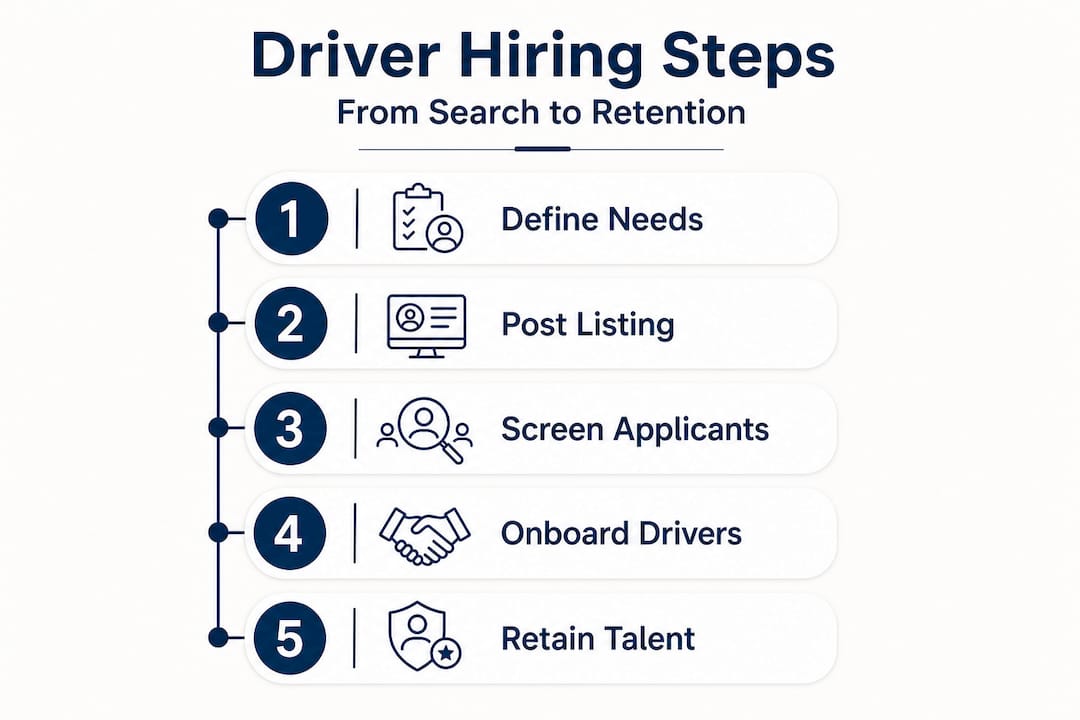
The hiring process does not end when someone accepts an offer. How you screen, onboard, and support drivers in their first 90 days determines whether they become long-term team members or another turnover statistic.
A five-step process for consistent hiring
- Screen applications. Review MVR, license class, and work history. Disqualify anyone who does not meet your stated requirements. Do not make exceptions on safety-critical criteria.
- Conduct a structured interview. Ask consistent questions across all candidates. Focus on reliability, customer service attitude, and how they handle problems on the road. Screening rigorously for attitude and reliability matters more than raw experience for P&D and linehaul success.
- Check references. Call previous employers and ask direct questions about attendance, reliability, and how the driver handled difficult situations. Most issues show up in references if you ask the right questions.
- Complete onboarding thoroughly. Do not rush this step. A driver who understands your systems, expectations, and culture from day one is far less likely to leave within the first 30 days.
- Conduct retention check-ins. Schedule brief conversations at 30, 60, and 90 days. Ask what is working and what is not. Small adjustments made early prevent larger problems later.
"High turnover often starts with poor onboarding and ignored retention signals. Investing in competitive pay, updated equipment, and a supportive work culture reduces how often you need to recruit." Driver Retention Guide
What to prioritize when evaluating candidates for team driver success factors:
- Clean MVR with no recent serious violations
- Consistent work history without unexplained gaps
- Demonstrated reliability in previous roles
- Positive attitude toward customer interaction
- Willingness to follow structured processes
Pro Tip: Start recruiting for peak season at least 60 days before you need drivers. Job board posting costs rise significantly from July through December, and the best candidates get hired quickly. Early recruiting gives you better options at lower cost.
Why the best ISPs treat hiring as a retention strategy, not just a numbers game
Most Service Providers approach hiring reactively. A driver leaves, a route goes uncovered, and the pressure to fill the seat quickly overrides the discipline to hire carefully. That cycle is expensive and predictable.
The ISPs who build stable, high-performing teams think about hiring differently. They treat every hire as a long-term investment and every onboarding experience as the foundation of retention. They know that a driver who leaves in 45 days cost them far more than the time it would have taken to find a better fit.
Slowing down your hiring process to assess fit, even if it means running a route short for a week, almost always produces better outcomes than rushing someone into a seat. The math is straightforward. A driver who stays 18 months costs you one set of recruiting and onboarding expenses. A driver who leaves in 60 days costs you that same amount, plus the cost of recruiting and onboarding their replacement, plus the service disruption in between.
The driver recruitment ROI analysis consistently supports this view. Contractors who invest in structured onboarding and cultural fit see measurably lower turnover rates than those who prioritize speed of hire above all else.
Job boards are a tool, not a strategy. The strategy is building a team that wants to stay. That requires combining the right sourcing channels with a structured hiring process, competitive compensation, and consistent communication after the hire. None of those elements works in isolation.
Set retention KPIs (key performance indicators) for every new hire. Track how long each driver stays and which recruiting channel they came from. Over time, that data tells you exactly where to invest your recruiting budget for the best return.
Level up your driver hiring with UCEP
Ready to make your next hire? Here is where to take action and access exclusive recruiting advantages.
UCEP is built specifically for FedEx Service Providers who need to find qualified drivers faster and with less guesswork. You can post jobs directly to a platform where drivers are already looking for FedEx-related opportunities, which means your listings reach a more relevant audience from day one.
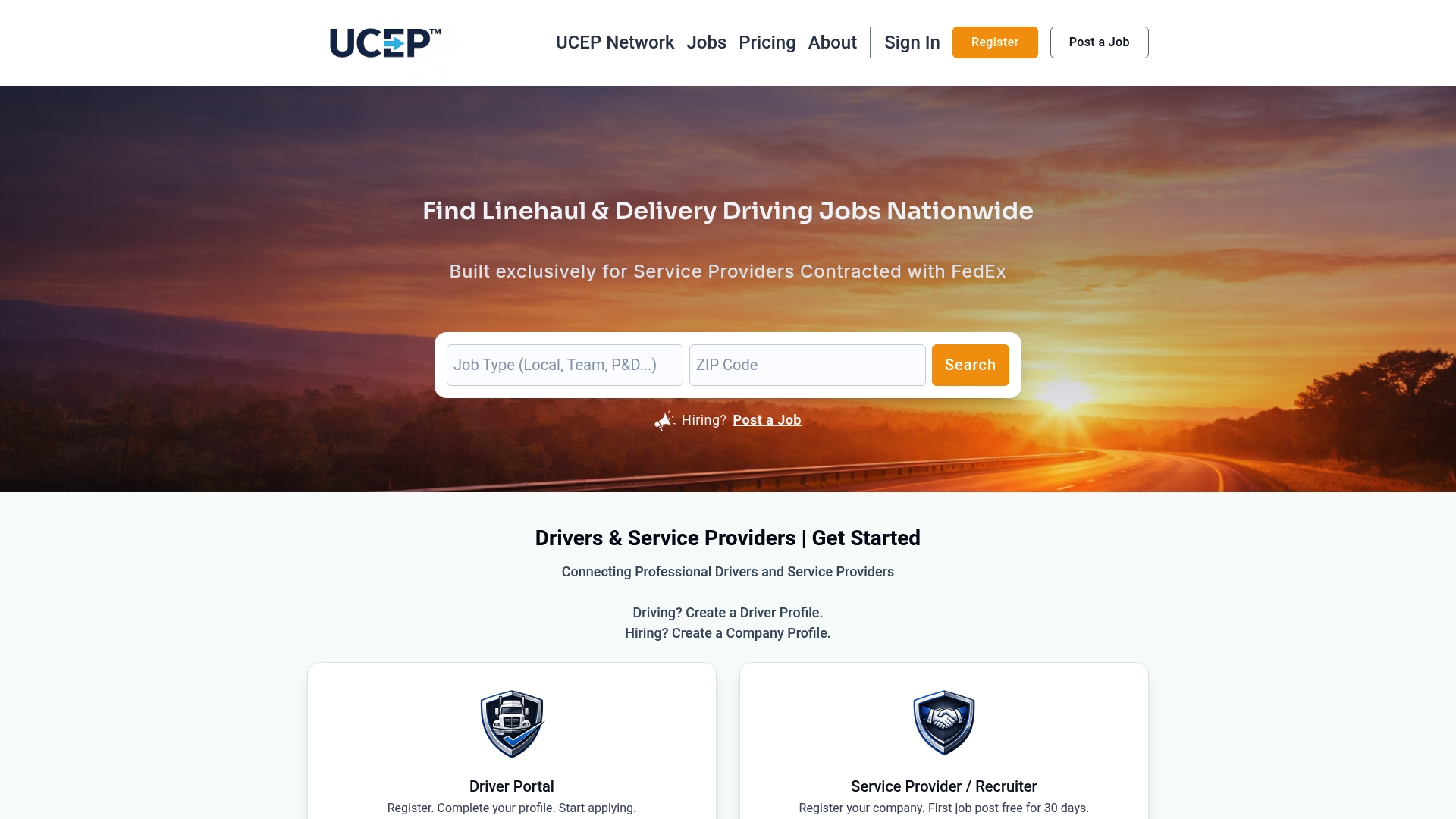
Browse UCEP pricing to find a plan that fits your hiring volume. Check which companies are hiring drivers to understand the competitive landscape in your market. You can also read service provider reviews from other contractors to learn what is working for ISPs in similar situations. UCEP gives you the tools to recruit smarter, reduce turnover costs, and build a more stable driving team.
Frequently asked questions
What are the best job boards for hiring FedEx drivers?
Top options include Indeed, Craigslist, local classifieds, and industry-specific boards focused on delivery and linehaul roles. Combining national reach with niche platforms gives you the best mix of volume and candidate quality.
How do FedEx contractors reduce driver turnover?
Invest in thorough onboarding, competitive pay and equipment, and a supportive work culture. Retention check-ins at 30, 60, and 90 days help you catch and address issues before a driver decides to leave.
How much does driver turnover cost for FedEx ISPs?
Replacing a single driver typically costs between $8,000 and $20,000 when you include recruiting, onboarding, training, and the indirect cost of service disruptions.
When is the best time to recruit drivers using job boards?
Recruit at least 60 days before peak season, as job board costs rise from July through December. Starting early gives you access to better candidates at lower posting costs before competition increases.