
Most service providers read their FedEx operating agreement once at signing and file it away. That is a costly mistake. The FedEx operating agreement explained in full reveals something most operators miss: the contract is not static. Your performance scores, driver compliance records, and safety metrics actively reshape your negotiation rights and renewal outcomes every single month. Understanding this distinction is what separates operators who hold strong territory positions from those who face open competitive bidding when renewal time arrives.
Table of Contents
- Understanding the FedEx ISP operating agreement model
- How FedEx's Gold, Silver, and Bronze grading system affects your operating agreement
- Driver recruitment and FMCSA compliance requirements under your FedEx operating agreement
- Contract renewals, route acquisitions, and the importance of operational documentation
- Why operational excellence beats contract terms alone in your FedEx agreement
- Streamline compliance and driver recruitment with United Contractor Employment Portal
- Frequently asked questions
Key Takeaways
| Point | Details |
|---|---|
| FedEx ISP operational model | ISPs are independent contractors responsible for hiring drivers and maintaining compliance under FedEx's operational controls. |
| Monthly grading system | FedEx assigns Gold, Silver, or Bronze grades monthly that influence renewal and negotiation rights significantly. |
| Compliance is critical | FMCSA driver qualification and drug testing compliance directly impact ISP performance grades and contract security. |
| Contract renewals depend on performance | Exclusive renewal rights are granted to Gold and Silver ISPs; Bronze ISPs face competitive bidding without improvement. |
| Documentation supports success | Maintaining thorough compliance and operational documentation facilitates smooth contract transfers, renewals, and audit readiness. |
Understanding the FedEx ISP operating agreement model
The FedEx Independent Service Provider (ISP) model is the foundation of everything in your operating agreement. Under this structure, you are not a FedEx employee or a franchisee in the traditional sense. You are an independent business owner contracted to deliver packages within an assigned territory.
What makes this model distinct is the split in control. FedEx Ground's ISP model requires you to hire drivers, maintain insurance, and operate within assigned territories while FedEx retains control over key operational aspects. That means FedEx sets the rules on vehicle specifications, uniform standards, branding requirements, delivery scan compliance, and route structure. You handle the people and the day-to-day execution.
This split matters for compliance and FedEx ISP driver recruitment because your obligations under the agreement extend well beyond delivering packages on time. Here is what falls squarely on your shoulders as an ISP:
- Hiring, training, and managing all drivers
- Maintaining commercial auto and general liability insurance
- Ensuring all vehicles meet FedEx appearance and mechanical standards
- Completing delivery confirmations and scan compliance
- Enforcing uniform and branding requirements across your team
- Carrying full employer responsibility for payroll, taxes, and workers' compensation
FedEx evaluates your execution of these responsibilities continuously. That evaluation feeds directly into the grading system that governs your contract rights.
With this model context established, we can examine how FedEx evaluates ISP performance through its grading system and what that means for your operating agreement.
How FedEx's Gold, Silver, and Bronze grading system affects your operating agreement
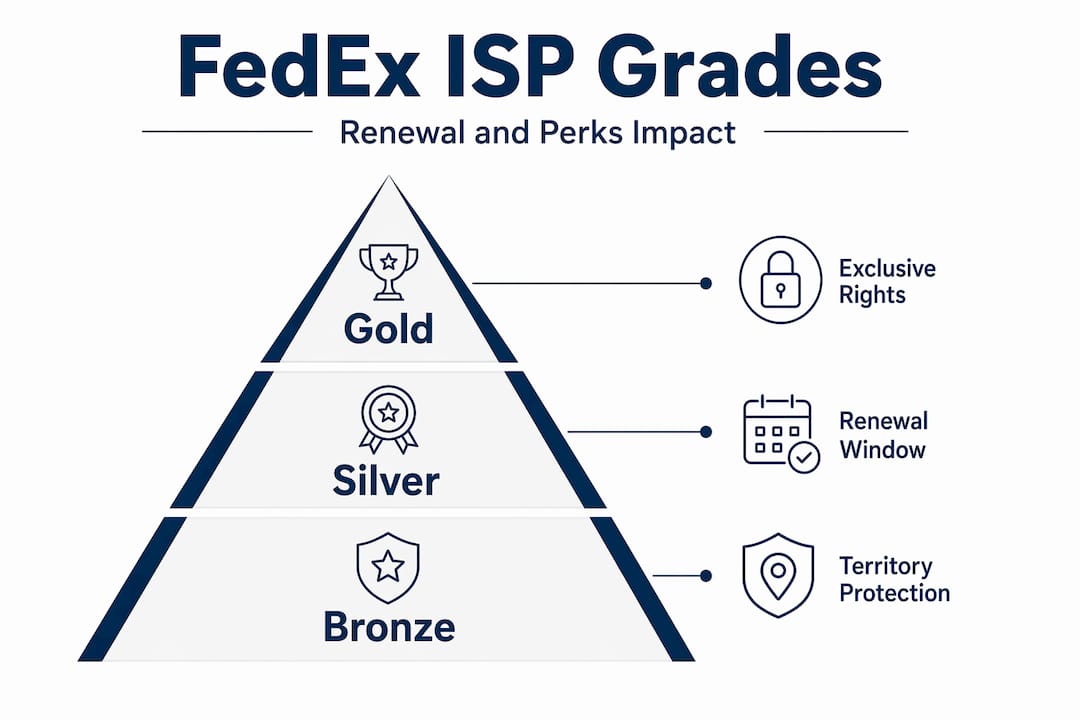
This is where the FedEx agreement breakdown becomes critical to understand. FedEx does not evaluate you once a year at renewal. Monthly grades are assigned based on service performance, safety metrics, and customer experience. Those grades determine your renewal rights, negotiation leverage, and territory protections.
Here is how the three tiers compare:
| Grade | Renewal rights | Negotiation window | Territory protection |
|---|---|---|---|
| Gold | Exclusive first acceptance | 14-day window | Full protection |
| Silver | Exclusive first acceptance | 14-day window | Full protection |
| Bronze | No exclusivity | Open competitive bidding after improvement window | At risk after 3 months |
The gap between Silver and Bronze is significant. Gold and Silver ISPs receive exclusive rights to accept or decline their contract renewal before FedEx can offer the territory to outside buyers. Bronze ISPs lose that exclusivity. After a three-month improvement window, FedEx can open the territory to competitive bidding. That means another operator could acquire your routes if you do not correct performance issues quickly.
The performance pillars that determine your grade include:
- On-time delivery rates across your territory
- Safety compliance, including driver records and incident history
- Customer experience scores, which reflect delivery accuracy and professionalism
- Scan compliance, meaning packages are scanned at the right points in the delivery process
"Your monthly grade is a real-time report card on how well your business operates. It is not a formality. It is the single most important factor in what happens to your territory at renewal."
Route valuation is also tied to your grade. Buyers and lenders look at grade history when assessing the value of a route package. A consistent Gold or Silver history supports higher valuations and better financing terms. Bronze grades suppress value and raise red flags for buyers.
Pro Tip: Track your performance metrics weekly, not just when FedEx publishes your monthly grade. Catching a dip in scan compliance or on-time delivery early gives you time to correct it before it affects your grade.
Understanding the grading system's effects clarifies why continuous compliance and driver management are vital, which leads us to the specifics of recruitment and regulatory obligations.
Driver recruitment and FMCSA compliance requirements under your FedEx operating agreement
Hiring drivers is where many ISPs create compliance risk without realizing it. The FedEx operating terms explained in your agreement require you to meet federal FMCSA (Federal Motor Carrier Safety Administration) standards for every driver you put on the road. These are not optional. They are federal law, and violations can result in fines, audit failures, and damage to your FedEx performance grade.
Here are the mandatory steps you must complete before any driver operates a commercial vehicle under your ISP:
- Complete a full FMCSA Clearinghouse query. This checks whether the driver has any unresolved drug or alcohol violations in the federal database. Full queries are mandatory pre-employment checks with no exceptions. You cannot start a driver while the query is pending.
- Conduct pre-employment drug testing. The driver must pass a DOT-compliant drug test before their first day behind the wheel.
- Build a complete Driver Qualification (DQ) file. This file must include the driver's application, motor vehicle record (MVR), medical certificate, road test certificate, and prior employment verification.
- Verify the driver's CDL and endorsements match the vehicle class they will operate.
- Run an annual MVR check for every active driver throughout their employment.
- Retain DQ files for the full duration of employment plus three years after separation.
- Retain drug and alcohol testing records for up to five years depending on the record type.
Noncompliance with any of these steps can result in FMCSA fines that reach thousands of dollars per violation. Beyond the fines, a safety audit failure or reported violation can directly impact your FedEx driver recruitment compliance standing and pull your grade down.
Pro Tip: Build your DQ file checklist into your onboarding workflow so that no driver reaches their first scheduled shift without every required document in place. A missing medical certificate or incomplete prior employment verification is one of the most common audit findings.

With recruitment and compliance obligations defined, the next step is understanding how these operational factors influence contract renewals and transfers.
Contract renewals, route acquisitions, and the importance of operational documentation
Renewal is not a single event. It is the outcome of twelve months of operational performance. Understanding FedEx contracts means recognizing that your documentation practices throughout the year determine what options you have when renewal arrives.
Key facts about the renewal and transfer process:
- Gold and Silver ISPs receive a 14-day exclusive window to accept their renewal offer before FedEx opens the territory to others.
- Bronze ISPs receive a three-month improvement window. If performance does not improve, FedEx can open the territory to competitive bidding.
- FedEx must approve all route transfers. Whether you are buying or selling a route package, FedEx approval is required and typically adds 30 to 60 days to the closing timeline.
- Transfer approval involves background and operational audits. FedEx reviews the incoming operator's qualifications and the seller's compliance history.
- SBA lenders require clean documentation. If you or a buyer is financing the acquisition through an SBA loan, the underwriter will review your compliance files, grade history, and operational records as part of due diligence.
Here is a summary of how documentation affects key milestones:
| Milestone | Documentation required | Risk of poor records |
|---|---|---|
| Annual renewal | Performance metrics, compliance files | Grade reduction, loss of exclusivity |
| Route sale | DQ files, drug testing records, grade history | Delayed closing, reduced sale price |
| Route acquisition | Seller's compliance history, operational records | Transfer denial, financing issues |
| FedEx audit | All FMCSA-required records | Fines, grade impact, contract risk |
Poor documentation does not just slow things down. It can reduce the assessed value of your territory, delay a sale by weeks, or cause FedEx to deny a transfer outright.
Pro Tip: Treat your compliance files as a permanent business asset. Organize them digitally so you can produce any record within 24 hours of a request. This readiness alone can prevent costly delays during audits or route transactions.
Now that renewal and transfer processes are clear, we will share a unique perspective on what really drives ISP success beyond just contract terms.
Why operational excellence beats contract terms alone in your FedEx agreement
Many ISPs spend significant energy focused on rate discussions and contract language. That focus is understandable, but it misses the more important variable. Operational execution including service quality, safety, and customer experience directly drives renewal leverage and contract outcomes more than rate negotiation under FedEx's grading framework.
Here is the reality most operators learn the hard way: you cannot negotiate your way out of a Bronze grade. No amount of pushback on contract language changes the fact that FedEx's grading system is performance-based. If your metrics are weak, your negotiation position is weak. Full stop.
What actually builds leverage is a consistent track record of Gold or Silver performance. That record gives you exclusive renewal rights, protects your territory, and supports higher route valuations if you ever want to sell. It also gives you credibility in any operational discussion with FedEx.
The operators who struggle most are those who treat compliance as a renewal-time task. They scramble to organize DQ files, address driver documentation gaps, and fix scan compliance issues only when renewal is approaching. By then, the grade damage is already done. The improvement window is short, and the stakes are high.
Continuous driver recruitment aligned with FMCSA standards is part of the foundation. When you hire correctly from day one, maintain complete records throughout employment, and monitor performance weekly, you are not just avoiding fines. You are building the operational history that gives you control over your contract's future.
Review service provider operational insights from other ISPs to understand how operators in similar positions have managed these challenges. The patterns are consistent: proactive operators retain territory. Reactive ones risk losing it.
Streamline compliance and driver recruitment with United Contractor Employment Portal
Managing driver recruitment and compliance documentation while running daily operations is a real operational challenge for FedEx service providers. United Contractor Employment Portal (UCEP) is built specifically for ISPs contracted with FedEx, offering tools designed to support your compliance readiness and driver recruitment needs in one place.
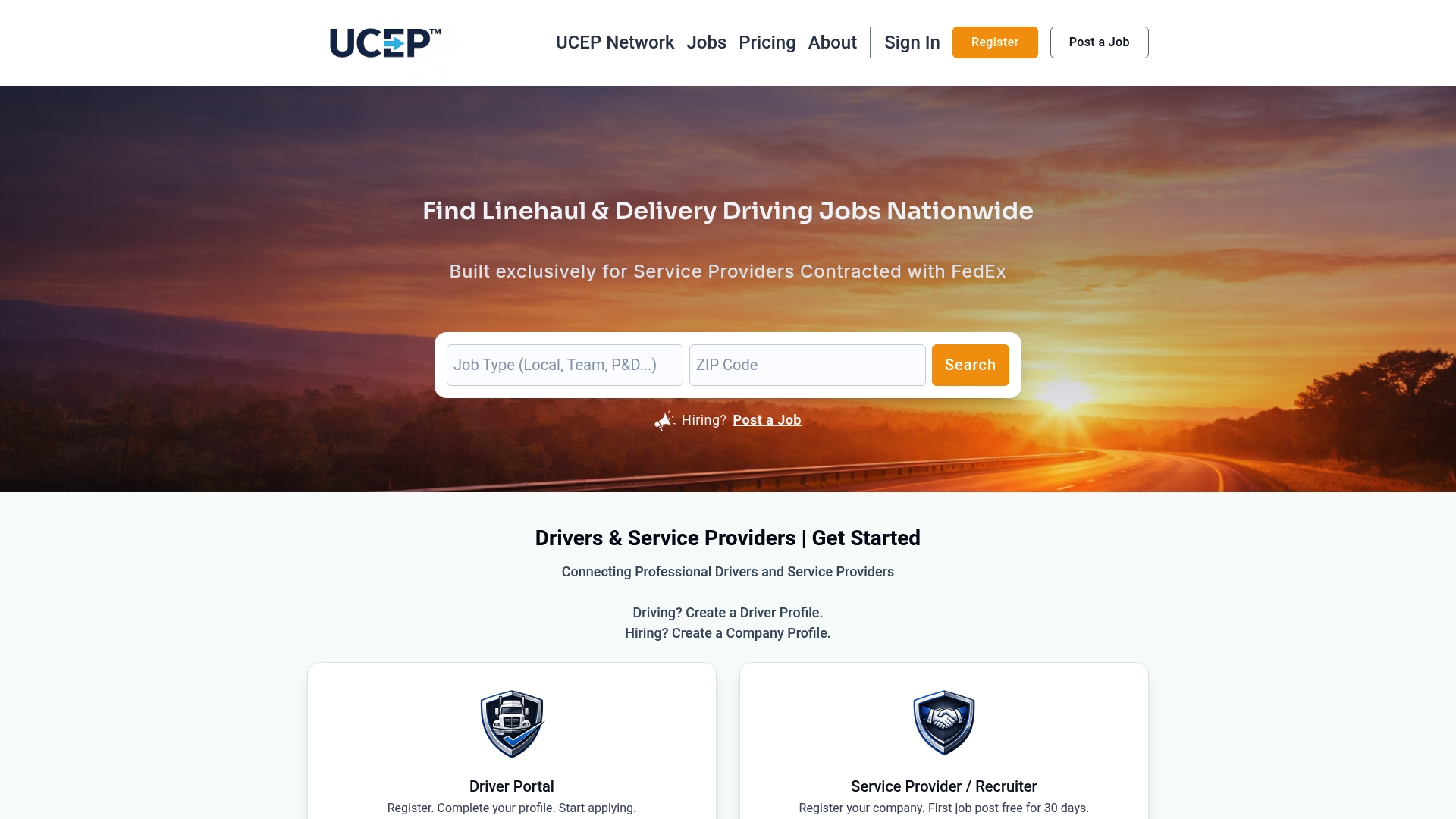
UCEP helps you maintain Driver Qualification file readiness, track performance indicators that affect your FedEx grade, and connect with qualified drivers for linehaul, CDL-A team, CDL-A solo, and pickup and delivery roles. You can also access reviews and insights from other service providers to benchmark your operations and identify improvement areas. Browse companies hiring drivers or explore UCEP pricing and packages to find a plan that fits your operation's size and stage.
Frequently asked questions
What determines FedEx ISP monthly grades and how do they impact my contract?
FedEx assigns monthly grades of Gold, Silver, or Bronze based on delivery service performance, safety compliance, and customer experience. These grades directly affect your renewal rights, negotiation leverage, and territory protections.
What are the key driver hiring compliance requirements for FedEx ISPs?
You must complete full FMCSA Clearinghouse queries and pre-employment drug tests before a driver operates, maintain a Driver Qualification file for the duration of employment plus three years, and keep detailed drug and alcohol testing records for up to five years.
How does FedEx handle contract transfers when buying or selling routes?
FedEx requires approval of the ISP agreement transfer to the new owner, including operational verification and background checks, typically adding 30 to 60 days to the closing timeline. All documents must demonstrate ongoing compliance and performance standards.
Can poor compliance affect my FedEx contract renewal chances?
Yes. Poor operational compliance, including driver hiring documentation gaps and weak safety metrics, can result in a Bronze grade, loss of exclusive negotiation rights, and possible territory loss through open competitive bidding after a short improvement window.
How can I maintain readiness for FedEx audits and renewal evaluations?
Maintain complete and organized compliance records continuously, including Driver Qualification files and drug and alcohol testing documentation, track performance metrics regularly, and address operational weaknesses promptly to ensure smooth FedEx evaluations and approvals.