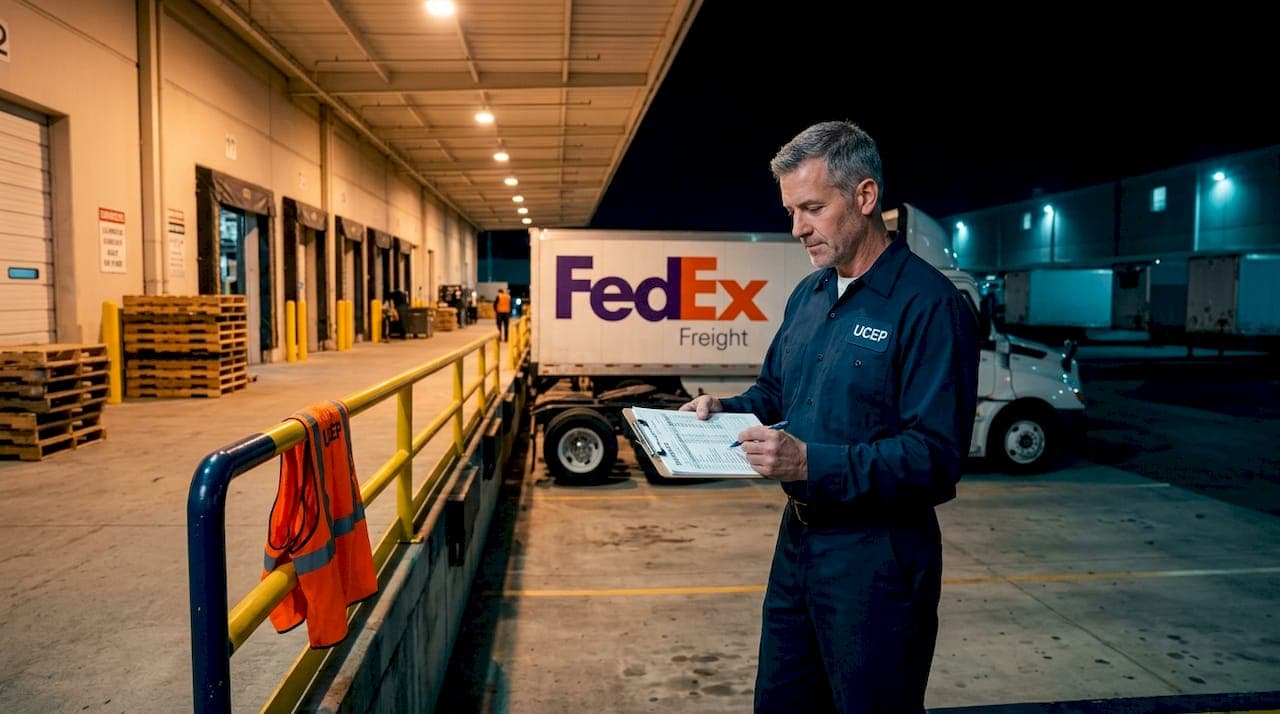
Most people assume a FedEx linehaul route is just long-haul trucking with a FedEx logo on the door. That assumption misses nearly everything that makes linehaul operations unique, profitable, and operationally demanding. A FedEx linehaul route is a transportation service operated by independent service providers (ISPs) contracted with FedEx Ground, involving the movement of loaded trailers between sorting facilities, hubs, and distribution centers over long distances. For service providers, understanding the full structure of these routes is the foundation for making smart decisions about contracts, staffing, logistics planning, and long-term profitability.
Table of Contents
- How FedEx linehaul routes are structured
- Types of FedEx linehaul runs and their features
- Contracts, payments, and compliance essentials
- Profit margins, driver pay, and the recruitment challenge
- What most service providers overlook about FedEx linehaul routes
- Connect with expert resources to grow your FedEx linehaul business
- Frequently asked questions
Key Takeaways
| Point | Details |
|---|---|
| Linehaul routes defined | A FedEx linehaul route connects distant sorting hubs with scheduled long-distance truck runs handled by contracted service providers. |
| Route types matter | Dedicated, unassigned, and spot runs require different strategies and driver arrangements based on regulatory and operational needs. |
| Driver requirements are strict | Linehaul drivers must hold a CDL, meet safety and drug standards, and often operate doubles or teams for efficiency. |
| Economic opportunities are strong | Linehaul contracts provide higher margins and driver pay than P&D, but require specialized recruitment and compliance focus. |
| Operational agility is essential | Network adaptation and risk management in 2026 are crucial for long-term FedEx linehaul service provider success. |
How FedEx linehaul routes are structured
FedEx linehaul routes sit in a different operational category than pickup and delivery (P&D) work. Where P&D involves local stops and residential deliveries, linehaul is about moving freight in volume between major FedEx facilities. The freight is already sorted. Your job is to move it on schedule, on time, every night.
Linehaul routes use tractor-trailers or straight trucks requiring CDL-licensed drivers, focus on scheduled freight movement, and operate mainly overnight to minimize traffic and support next-day delivery. That overnight schedule is not optional. It is built into the network design to support FedEx's delivery commitments to shippers and consumers.
The ISP model means you are not an employee of FedEx. You own and operate the business, hire the drivers, maintain the equipment, and take on the financial and compliance responsibilities. FedEx defines the routes, the schedules, and the performance standards. You execute them.
Here is a quick comparison of linehaul versus P&D operations:
| Feature | Linehaul | Pickup and delivery (P&D) |
|---|---|---|
| Distance per run | Hundreds to thousands of miles | Local, typically under 100 miles |
| Shift timing | Primarily overnight | Daytime |
| CDL required | Yes, Class A | No (varies) |
| Equipment | Tractor-trailers, doubles, triples | Cargo vans, box trucks |
| Profit margin | 15-35% | 10-20% |
| Driver pay scale | Higher | Lower |
| Scheduling complexity | High | Moderate |
Key structural features of linehaul operations include:
- Facility-to-facility movement: Drivers move loaded trailers between FedEx Ground sort facilities, not individual stops.
- Scheduled departure windows: Runs are timed to meet sort schedules at destination facilities.
- Equipment variety: Depending on volume and route, you may operate single trailers, doubles (two 28-foot trailers), or triples.
- Driver certification: CDL-A is standard, and doubles/triples endorsements are often required.
You can browse open FedEx service provider driver jobs to get a clearer picture of what qualifications are currently in demand across the network.
Types of FedEx linehaul runs and their features
Once you understand the structural basics, it is essential to recognize the different types of linehaul runs available and their specific requirements. Not all linehaul work looks the same, and the type of run you operate affects everything from scheduling to driver qualifications to revenue predictability.
Routes are categorized as Dedicated, Unassigned, and Spot Runs. Dedicated runs have a fixed origin and destination. Unassigned runs have a fixed start but variable end points. Spot Runs are local semi-truck hauls used to fill capacity gaps. Each run is made up of trip legs, and can be operated Solo (single driver) or Team (two drivers) based on distance and hours of service (HOS) limits.
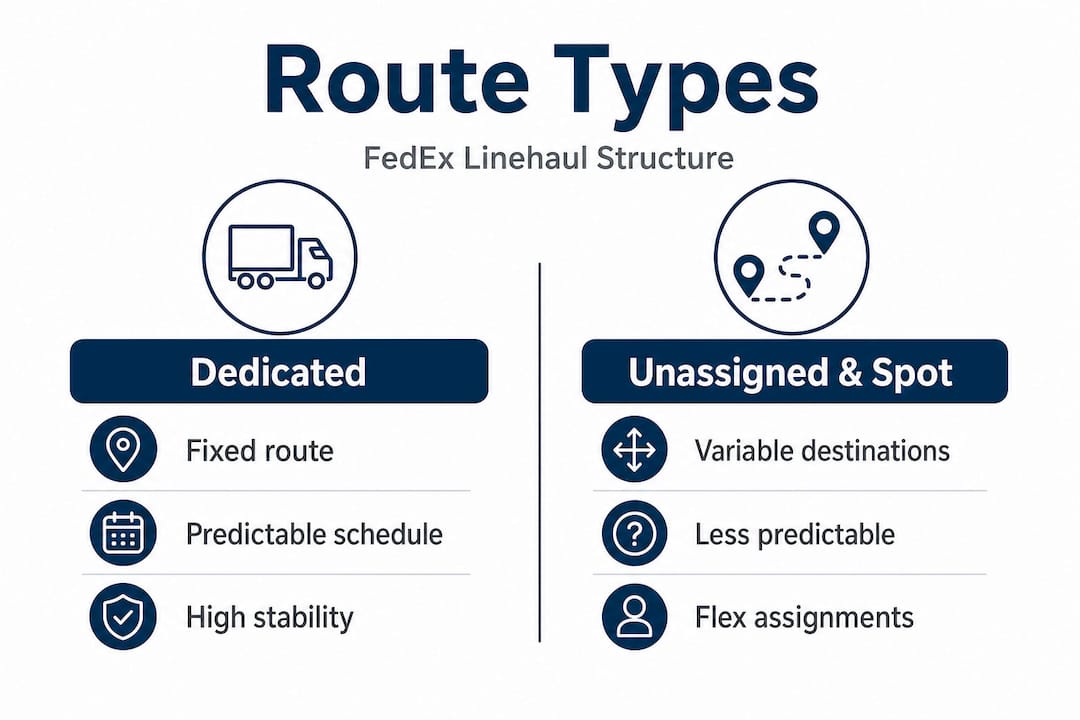
Here is how the three main run types compare:
| Run type | Origin | Destination | Predictability | Best for |
|---|---|---|---|---|
| Dedicated | Fixed | Fixed | High | Consistent scheduling, stable driver assignment |
| Unassigned | Fixed | Variable | Moderate | Flexible operators with experienced drivers |
| Spot Run | Local | Local | Low | Extra capacity, newer operators building volume |
Dedicated runs are the most straightforward to plan around. You know the route, the mileage, and the schedule in advance. This makes driver scheduling and equipment maintenance much easier to manage. Most established ISPs prefer dedicated runs for their predictability.
Unassigned runs require more operational flexibility. Your driver leaves from a known origin but may be dispatched to different destinations depending on freight volume that night. This requires drivers who are comfortable adapting and who have solid familiarity with the broader network.
Spot runs are shorter, local hauls that FedEx uses to fill capacity gaps. They are useful for newer service providers looking to build revenue or for operators who want to maximize equipment utilization during peak seasons.
Solo vs. team operations is one of the most consequential decisions you will make as a linehaul ISP. Solo drivers are limited by federal HOS rules, which cap driving time and require mandatory rest breaks. For runs exceeding roughly 500 to 600 miles, a solo driver may not be able to complete the run and return within a single shift without a layover. Team operations solve this problem. Two drivers alternate behind the wheel, allowing the truck to keep moving while one rests. This is why team runs typically cover 2,000 or more miles per week and generate significantly higher revenue.
Understanding what it takes when succeeding as a team driver is worth reviewing before you commit to building a team-based operation. The interpersonal and scheduling dynamics are different from solo work, and not every driver is suited for it.
Pro Tip: If you are evaluating a new linehaul contract, ask specifically whether the assigned run is dedicated or unassigned. Dedicated runs are far easier to staff consistently, which directly reduces your driver turnover costs.
Contracts, payments, and compliance essentials
Now that you know the route types, let us unpack the business mechanics. How contracts, compensation, and compliance shape your success is something every service provider needs to understand before signing or renewing an agreement.
Contract mechanics include binding agreements with fixed fees, per-mile pay ranging from $0.50 to $0.63 per mile for solo drivers and higher rates for teams, performance incentives, guaranteed minimum miles of approximately 1,800 miles weekly for solo and 4,000 miles weekly for team operations, and strict FMCSA compliance requirements covering safety, HOS, electronic logging devices (ELDs), and drug testing.
Here is a step-by-step breakdown of what to review in your contract:
- Per-mile rate and structure: Confirm whether your rate is fixed or variable. Understand what triggers rate adjustments and whether fuel surcharges are included or separate.
- Guaranteed minimums: Know your floor. If FedEx does not provide enough freight to hit the guaranteed miles, you still get paid for those miles. This is a critical buffer during slow freight periods.
- Performance incentives: Most contracts include bonuses tied to on-time performance, safety records, and inspection scores. These can add meaningful revenue if you hit the benchmarks consistently.
- Contract term and renewal conditions: Understand how long your contract runs and what performance thresholds you must maintain to qualify for renewal.
- Equipment and compliance requirements: Your tractors and trailers must meet FedEx standards. ELDs are mandatory. Drug and alcohol testing programs must be in place and documented.
"Compliance is not optional in linehaul. FMCSA regulations govern every hour your drivers are on the road, and FedEx holds ISPs accountable for maintaining clean safety records. A single compliance failure can put your contract at risk."
The FMCSA (Federal Motor Carrier Safety Administration) sets the federal rules your operation must follow. This includes driver qualification files, vehicle inspection records, HOS logs via ELD, and random drug testing programs. As the ISP, you are the motor carrier of record. That means the legal and financial liability sits with you, not with FedEx.
For practical guidance on maintaining your contract and keeping your operation safe, review these linehaul contract safety and performance tips before your next renewal period.
Pro Tip: Keep a compliance calendar. Track ELD audit dates, drug test cycles, vehicle inspection deadlines, and contract review windows in one place. Missed compliance deadlines are one of the most preventable reasons ISPs lose contracts.
Profit margins, driver pay, and the recruitment challenge
Understanding the financial and staffing realities is critical to maximizing your routes. Let us get specific about margins, pay, and what it takes to hire and keep high-caliber linehaul drivers.

Linehaul margins run 15 to 35 percent, compared to 10 to 20 percent for P&D routes. Driver pay for linehaul typically falls between $70,000 and $85,000 annually, or roughly $1,350 to $1,650 per week based on 2,200 to 2,500 miles driven. During peak seasons, double and triple trailer operations become common, which increases both revenue and the skill requirements for your drivers.
Those margins are real, but they come with real costs. Here is what drives the recruitment challenge:
- CDL-A requirement: Most FedEx linehaul contracts require drivers with at least one year of verified CDL-A experience or graduation from an approved CDL school.
- Doubles and triples endorsement: Pulling double or triple trailers requires a separate federal endorsement on the CDL. Not all CDL holders have it, which narrows your candidate pool.
- OTR schedule: Many linehaul operations run on over-the-road (OTR) cycles, such as three weeks on and one week off. This schedule does not suit every driver, particularly those with families or local ties.
- Overnight shifts: Consistent overnight work is a barrier for some candidates, even experienced ones.
FedEx can modify routes and contracts, and Network 2.0, which integrates FedEx Express and Ground for optimized loads, is actively reshaping how runs are structured. This creates both opportunity and uncertainty. Routes may be consolidated, extended, or reconfigured. ISPs who adapt quickly gain access to more volume. Those who are slow to adjust may find their contracts changed in ways that affect profitability.
Practical strategies for improving linehaul driver recruitment include:
- Post on platforms built for this audience. Generic job boards produce generic results. Targeted job board recruiting consistently outperforms broad postings when you are looking for CDL-A drivers familiar with the FedEx network.
- Offer structured pay transparency. Drivers compare offers quickly. Listing your per-mile rate, weekly mileage guarantee, and any performance bonuses upfront reduces time-to-hire.
- Build a training pipeline. Partner with CDL schools that offer doubles/triples endorsement training. Sponsoring training in exchange for a service commitment is a proven retention tool.
- Use spot runs strategically. Offering newer drivers spot runs before committing them to dedicated routes lets you evaluate performance before making a long-term scheduling commitment.
Stay current on how FedEx Network 2.0 impacts route structures so your staffing plans stay aligned with where the network is heading.
Pro Tip: When recruiting for team runs specifically, screen for prior team driving experience. Drivers who have never shared a cab on OTR cycles often underestimate the adjustment. High early turnover on team runs is expensive and disruptive.
What most service providers overlook about FedEx linehaul routes
With the practical and financial realities in view, it is time to consider what separates the truly successful linehaul operators from those always fighting fires.
The common assumption is that higher margins and good route assignments automatically produce a stable business. They do not. The ISPs who consistently outperform their peers are not the ones with the best routes. They are the ones who treat compliance, driver retention, and operational adaptability as core business functions rather than administrative tasks.
Risks include contract non-renewal, route changes, and driver turnover. Routes with stable revenue mixes, clean safety records, and low turnover are valued significantly higher, both as operating businesses and as assets if you ever choose to sell. That is not a coincidence. It reflects the fact that operational stability is the actual product you are delivering to FedEx, not just the freight.
Most service providers focus heavily on revenue per mile and not enough on the cost of driver turnover. Replacing a qualified CDL-A linehaul driver costs real money in recruiting, onboarding, and lost productivity. A driver who leaves after 60 days because they felt unsupported or uninformed about the schedule is a cost you could have avoided.
The other overlooked factor is Network 2.0 adaptation. Many ISPs treat network changes as disruptions to manage rather than opportunities to position for. The integration of Express and Ground operations creates new run types and new volume patterns. ISPs who build relationships with their FedEx contacts, attend industry events, and stay informed through resources like insights from the Linehaul Summit are better positioned to capture that volume before competitors do.
Software tools and pay incentives matter. But they are secondary to having a culture of compliance, a reliable driver team, and an operation that FedEx trusts to perform consistently. That trust is what protects your contract when the network changes around you.
Connect with expert resources to grow your FedEx linehaul business
Running a successful FedEx linehaul operation requires more than understanding route types and contract terms. You need qualified drivers, and finding them efficiently is one of the most persistent challenges ISPs face in 2026.
UCEP is a dedicated job board and recruiting platform built exclusively for service providers contracted with FedEx. Whether you are staffing CDL-A solo runs, team operations, or pickup and delivery routes, UCEP connects you with drivers who already understand the FedEx network. You are not sorting through general trucking applicants. You are reaching candidates who are specifically looking for FedEx-related opportunities. Browse driver jobs and staffing resources to post your open positions and find qualified linehaul drivers faster.
Frequently asked questions
What vehicles and licenses are required for FedEx linehaul routes?
FedEx linehaul routes use tractor-trailers or straight trucks and require CDL-A licensed drivers, often with doubles and triples endorsements for multi-trailer operations.
How do linehaul routes differ from FedEx P&D routes?
Linehaul routes cover long distances between facilities, run primarily overnight, require CDL-A drivers, and produce higher margins than P&D, typically 15 to 35 percent versus 10 to 20 percent for pickup and delivery work.
What are the main challenges for FedEx linehaul service providers in 2026?
Current challenges include recruiting CDL-A drivers with the required experience and endorsements, adapting to route and contract changes driven by Network 2.0, and maintaining consistent FMCSA compliance across all drivers and equipment.
How are linehaul drivers paid and what incentives exist?
Drivers are paid per-mile with performance incentives, guaranteed minimum weekly miles of approximately 1,800 for solo and 4,000 for team operations, and additional bonuses tied to safety scores and on-time delivery metrics.