
If you run a service provider business contracted with FedEx Ground, you already know the model is more complex than it first appears. FedEx ground contractor obligations go well beyond simply showing up and delivering packages. You operate as an independent business, yet FedEx controls your delivery windows, vehicle appearance, driver uniforms, and performance metrics. That gap between legal independence and operational control is where most contractors run into trouble. This guide breaks down what you actually owe under your contract, what it costs, and how to manage it without costly surprises.
Table of Contents
- Key Takeaways
- Core FedEx Ground contractor obligations in 2026
- Financial obligations and revenue structure
- Operational control and your liability exposure
- Contract management and renewal strategy
- My take on what actually matters for FedEx contractors
- How Ucep supports FedEx service providers
- FAQ
Key Takeaways
| Point | Details |
|---|---|
| Minimum scale thresholds apply | Contractors must maintain at least 5 routes or 500 daily stops, with a 15% terminal route cap. |
| Insurance is non-negotiable | Commercial auto, general liability, cargo, and workers' comp for W-2 employees are all required coverages. |
| Revenue is fixed and variable | P&D contracts combine weekly fixed payments with per-stop charges; linehaul pays by mileage plus fuel surcharges. |
| Schedule K requires careful review | Peak season amendments can raise stop thresholds and bonuses but may not always improve your bottom line. |
| Payroll compliance is a legal risk | Overtime miscalculations and underreported workers' comp payroll expose you to audits and back-pay claims. |
Core FedEx Ground contractor obligations in 2026
The structure of a FedEx Ground contractor agreement is built on specific operational thresholds that define your minimum business size. You are not allowed to operate as a micro-business doing a handful of routes. Contractors must maintain at least 5 routes or 500 daily stops, and no single contractor can control more than 15% of routes at one terminal. These thresholds exist to protect the network's capacity, and violating them can put your contract at risk.
Beyond scale, FedEx contractor requirements include specific entity and background standards:
- Your business must be incorporated. FedEx contracts exclusively with legal business entities, not individuals.
- All drivers must pass background checks that meet FedEx standards.
- Vehicles must conform to FedEx branding guidelines, including logo placement and color standards.
- Drivers must wear FedEx-approved uniforms during all delivery activities.
- You must use FedEx's proprietary scanning technology and GPS monitoring systems. Non-compliance with these tech requirements can trigger contract termination.
Insurance requirements under the FedEx partnership agreement are both specific and substantial. Required coverages include commercial auto, general liability, cargo, and workers' compensation for all W-2 employees. Workers' comp premiums typically run between 3% and 6% of payroll depending on your state and claims history. That is a significant line item when you are managing a team of 10 or more drivers.
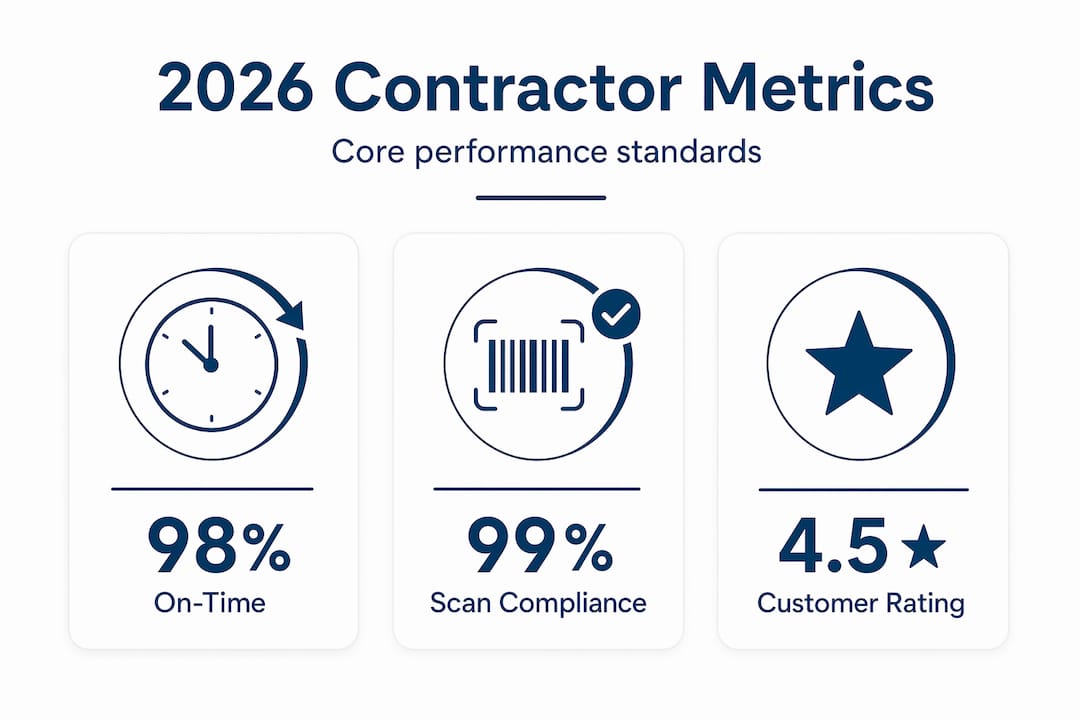
FedEx also holds you accountable through performance metrics. Your on-time delivery rate, scan compliance, and customer feedback scores all feed into your contract renewal evaluation. Falling below set thresholds does not just result in a warning. It can trigger contract termination.
Pro Tip: Before you sign or renew, request a copy of the performance metric thresholds used at your terminal. These are not always spelled out clearly in the base contract, but they directly affect your renewal status.
Financial obligations and revenue structure
Understanding how you get paid, and what you must pay out, is the foundation of running a profitable ground delivery operation. The revenue structure under FedEx Ground contracts combines fixed and variable components, and the balance between the two shapes your profitability more than most contractors initially realize.

For pickup and delivery (P&D) contracts, revenue combines fixed weekly payments with variable per-stop and per-package charges. Linehaul contracts operate differently, paying by mileage plus a fuel surcharge. Both structures include surge pricing provisions that activate during high-volume periods. Rates are negotiated based on your territory's expected volume and your documented expense projections, which means your ability to present accurate cost data directly affects what you earn.
Here is a comparison of the primary cost categories you are responsible for:
| Cost Category | Typical Scope |
|---|---|
| Driver wages and overtime | Varies by market; overtime compliance is legally required |
| Workers' comp insurance | 3–6% of total payroll; must cover all W-2 employees |
| Fleet acquisition and maintenance | Purchase or lease costs plus fuel, repairs, and inspections |
| Uniforms and equipment | FedEx-approved gear required for all drivers |
| Payroll administration | Includes bonuses, per-stop calculations, and tax filings |
One of the most overlooked financial risks is payroll compliance. Misunderstanding overtime calculations, per-stop pay structures, and bonus inclusion rules leads directly to back-pay claims and regulatory penalties. The pay structure for FedEx contractors is complex, and manual tracking systems are a liability.
Schedule K amendments offer peak-season incentives including higher daily stop thresholds, fixed pre-season payments, and volume bonuses. But they require careful evaluation. Higher stop thresholds mean more labor hours and vehicle wear. If your rate increase does not cover the added operational costs, Schedule K can actually reduce your net margin during your highest-volume period.
Pro Tip: Model your Schedule K numbers before signing. Calculate the expected labor cost increase against the bonus and fixed payment offered. If the math does not work in your favor, you can decline or negotiate specific terms.
Operational control and your liability exposure
This is where most contractors are caught off guard. FedEx Ground contractor obligations do not exist in isolation from FedEx's own control over your operations. FedEx exerts significant operational control over delivery schedules, route structure, vehicle standards, branding, and performance metrics. That level of control has direct legal consequences.
Courts have scrutinized the FedEx contractor model in multiple cases. Legal cases have challenged the independent contractor classification based on the degree of factual control FedEx exercises over drivers and delivery operations. Two legal doctrines are particularly relevant to you as a contractor:
- Apparent agency: If a third party reasonably believes your driver is a FedEx employee based on uniforms, branded vehicles, and scanning equipment, FedEx may face liability alongside you.
- Dangerous instrumentality: In some states, operating a commercial vehicle creates a liability chain that can extend upward to FedEx even when you are the named contractor.
These doctrines matter to you because they affect how claims are handled after accidents and how aggressively plaintiffs pursue both you and FedEx. If your drivers are poorly trained, your vehicles are out of compliance, or your documentation is weak, you absorb more of the risk exposure in any litigation.
"The contractor label offers legal structure, but it does not fully insulate you from the operational control FedEx maintains. Managing that gap through documentation, training, and compliance is the real work of running a FedEx ground business."
Best practices to reduce your liability exposure include maintaining thorough driver training records, keeping all vehicle inspection and maintenance logs current, ensuring every driver has signed and dated copies of your internal policies, and conducting regular internal audits of FedEx tech compliance. Resources like safe delivery practices for ground operations can also help you build a documentation-first culture across your team.
Contract management and renewal strategy
FedEx Ground contractor agreements are not one-size-fits-all documents, and treating them as static paperwork is a costly mistake. P&D contracts typically run 1 to 2 years, while linehaul contracts are evergreen, meaning they renew automatically without a set expiration date unless either party acts. Understanding that distinction changes how you approach renewal planning for each contract type.
Here is a practical process for managing your contract cycle:
- Review your performance data 90 days before renewal. Pull your on-time rates, scan compliance records, and any written warnings from your terminal manager. Address deficiencies before they become renewal issues.
- Document your territory's volume and expense trends. Rate negotiations are data-driven. If your stop volume increased 15% over the prior year but your rates stayed flat, you have a documented case for adjustment.
- Evaluate every amendment independently. Schedule K and other seasonal amendments are separate from your base contract. Read each one on its own terms and run your own financial projections before signing.
- Engage your terminal manager directly. Many contractors assume rates and terms are fixed. Ground delivery contract terms are more negotiable than the standard documents suggest, particularly when you bring documented volume and expense data to the table.
- Track your exclusivity rights. Your contract grants you service rights to a defined territory. Verify annually that those boundaries have not shifted and that your exclusivity is intact.
Pro Tip: Keep a contract management log that records every amendment date, the specific terms changed, and your financial projection for each change. This log becomes your primary tool during renewal discussions and protects you if disputes arise.
Comparing your network position relative to emerging logistics changes can also help you make better long-term decisions about contract renewal and business scaling.
My take on what actually matters for FedEx contractors
I've reviewed enough FedEx contractor situations to know that the operators who struggle share one common pattern. They treat the contract as a starting point rather than an ongoing document to manage. The obligations of FedEx partners are not static. They compound over time through amendments, rate adjustments, and compliance requirements that accumulate without warning.
In my experience, the biggest hidden risk is not the insurance or the branding requirements. It is payroll. Overtime miscalculations and inaccurate workers' comp reporting generate more financial damage than almost any other operational failure. I've seen contractors hit with retroactive premium audits that wiped out months of profit because their payroll records were inconsistent.
My honest advice: automate your payroll processing before you scale your route count. The complexity grows faster than most contractors expect. The contractors who sustain profitability long-term are the ones who treat compliance as a daily operational function, not an annual checkbox. They also use targeted resources for driver recruitment rather than generic hiring tools, because qualified drivers who understand the FedEx Ground environment reduce your training burden and compliance risk from day one.
— Aaron
How Ucep supports FedEx service providers
Running a FedEx Ground operation means managing drivers, compliance, and contracts at the same time. Finding qualified candidates who already understand the FedEx environment is one of the fastest ways to reduce your operational burden.
Ucep is a recruiting platform built exclusively for FedEx service providers. You can post open roles for linehaul, CDL-A solo, CDL-A team, and pickup and delivery positions, and reach drivers who are specifically looking for FedEx-related opportunities. Ucep also provides resources to help you understand your contractor requirements and hire drivers who are already oriented to FedEx operational standards. If you are scaling your routes or managing driver turnover, finding qualified candidates through a FedEx-focused platform reduces your time-to-hire and improves fit.
FAQ
What are the minimum route requirements for FedEx Ground contractors?
FedEx Ground contractors must operate a minimum of 5 routes or 500 daily stops, and cannot control more than 15% of routes at a single terminal. These thresholds are written into the contractor agreement and are monitored for compliance.
What insurance does a FedEx Ground contractor need?
Required coverages include commercial auto, general liability, cargo insurance, and workers' compensation for all W-2 employees. Workers' comp premiums typically range from 3% to 6% of total payroll depending on state and claims history.
Can FedEx terminate a contractor's agreement?
Yes. FedEx can terminate contracts for failure to meet performance metrics, branding non-compliance, or misuse of required technology such as scanning systems. Contractors should monitor their performance data regularly to avoid surprises at renewal.
How does Schedule K affect contractor profitability?
Schedule K offers peak-season stop bonuses and fixed pre-season payments, but it also raises daily stop thresholds. Contractors should model the added labor and operational costs against the incentive payments before signing, as the net result is not always profitable.
Are FedEx Ground contractors truly independent businesses?
Legally yes, but courts have scrutinized the classification because FedEx controls significant operational details including uniforms, vehicle standards, delivery schedules, and technology use. This operational control has been cited in legal cases challenging the independent contractor classification.