
Running a FedEx contracted fleet without a clear picture of the compliance requirements is a fast path to operational problems. The FedEx contractor fleet requirements explained in this article cover the Independent Service Provider (ISP) model, equipment and safety standards under federal regulations, mandatory insurance coverage, and the monthly grading system that directly affects your contract renewal and route value. Whether you are considering becoming a FedEx contractor or already managing an active fleet, understanding these requirements in full will help you avoid costly gaps and keep your operation performing at the level FedEx expects.
Table of Contents
- Key Takeaways
- FedEx contractor fleet requirements explained: the ISP model
- Equipment and safety compliance standards
- Insurance and documentation requirements
- How FedEx grades your performance monthly
- Best practices for fleet compliance and efficiency
- My take on the compliance details most owners miss
- How Ucep helps you stay ahead as a FedEx contractor
- FAQ
Key Takeaways
| Point | Details |
|---|---|
| ISP model governs operations | FedEx contracts through Independent Service Providers who are responsible for fleet, drivers, and compliance within defined territories. |
| Federal equipment standards apply | All vehicles must comply with 49 CFR Part 393 covering brakes, lights, tires, and cargo securement before dispatch. |
| Insurance must name FedEx Ground | Contractors need auto liability, workers' comp, cargo insurance, and general liability with FedEx Ground listed as certificate holder. |
| Monthly grades affect contract value | FedEx scores ISPs on service performance, safety metrics, and customer experience, with grades directly tied to renewal rights. |
| DVIR documentation protects compliance | Daily driver vehicle inspection reports, especially electronic versions, create the accountability chain that protects you during audits. |
FedEx contractor fleet requirements explained: the ISP model
FedEx Ground and Home Delivery do not employ drivers directly. They operate through the ISP model, where independent business owners contract to cover specific delivery territories using their own vehicles, drivers, and management structure. This distinction matters immediately when you start thinking about compliance, because the responsibility for every vehicle in your fleet sits entirely with you, not with FedEx.
When you acquire a route or bid for a new territory, FedEx reviews your business credentials, background, and operational readiness before approving the contract. Fleet condition and compliance documentation are not afterthoughts in this process. They are gating factors.
Here is what the ISP model places on your plate operationally:
- Owning or leasing the delivery vehicles that meet FedEx vehicle specifications
- Hiring, training, and supervising your own drivers
- Maintaining fleet insurance at the required coverage levels
- Following FedEx branding and uniform requirements for vehicles and personnel
- Meeting delivery territory obligations under your operating agreement
- Complying with federal motor carrier regulations for all vehicles over 10,001 lbs GVWR
FedEx ISP contracts impose specific operational controls including vehicle specs, insurance, branding, and driver hiring, all of which tie directly to your renewal rights. Understanding this structure early prevents the common mistake of treating FedEx fleet requirements as loosely enforced suggestions.
Equipment and safety compliance standards
The baseline for vehicle compliance in a FedEx fleet is 49 CFR Part 393, the federal regulation covering required parts and accessories for commercial motor vehicles. This regulation is not FedEx-specific. It applies to any commercial vehicle operating on public roads. But FedEx holds you accountable to it through your operating agreement, and DOT roadside inspections can pull your vehicles out of service immediately if violations are found.
The core equipment areas covered under 49 CFR 393 include:
- Braking systems: Service brakes, parking brakes, and air brake components (where applicable) must be fully functional and properly adjusted.
- Lighting: Headlights, brake lights, turn signals, and clearance lights must work correctly. A burned-out marker light is a citable violation.
- Tires: No retreads on front steering axles for certain weight classes; tires must meet minimum tread depth requirements and show no structural damage.
- Cargo securement: Loads must be secured to prevent shifting or falling using approved tie-down methods and rated equipment.
- Coupling devices: Hitches, fifth wheels, and safety chains must be properly maintained and matched to their rated loads.
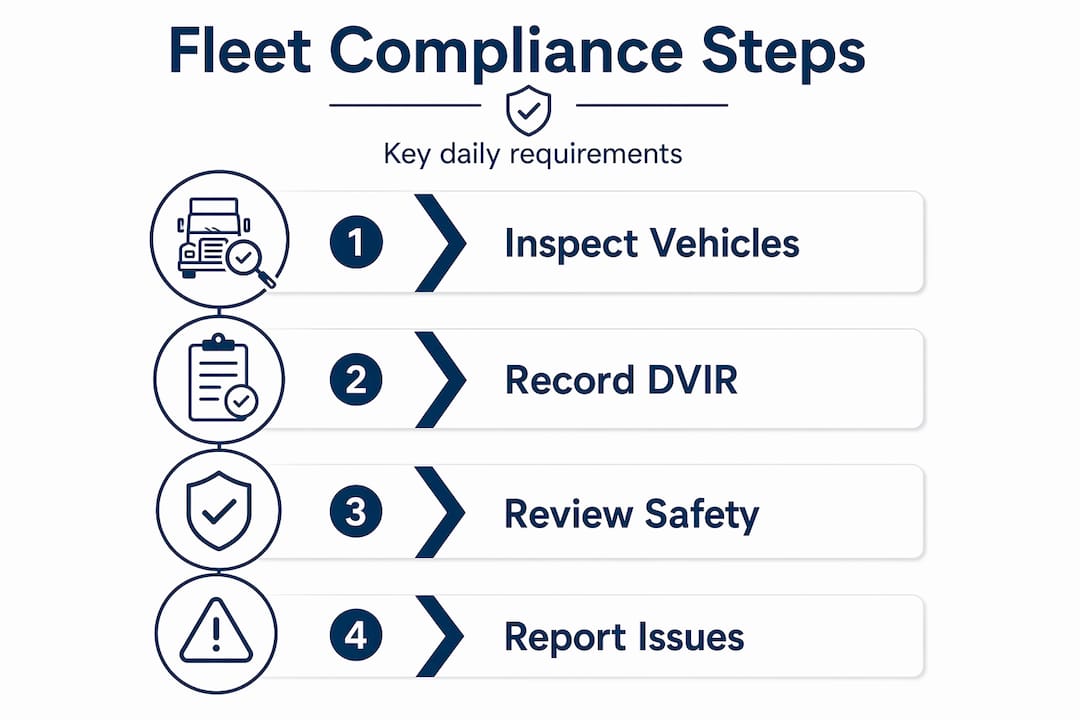
Beyond the equipment itself, the daily inspection process is where compliance becomes a documented practice. FMCSA regulations under 49 CFR 396.11 and 396.13 require pre-trip and post-trip driver vehicle inspection reports. If a defect is found, it must be documented, reported, and repaired before the vehicle returns to service. The mechanic who performs the repair must sign off, and the next driver must acknowledge the repair before dispatch. This closed-loop process is what DVIR compliance actually means in practice.
Pro Tip: Switch to an electronic DVIR system rather than paper logs. eDVIR platforms automatically timestamp entries, flag unresolved defects, and create an auditable trail that protects you during DOT compliance reviews and FedEx operational audits.
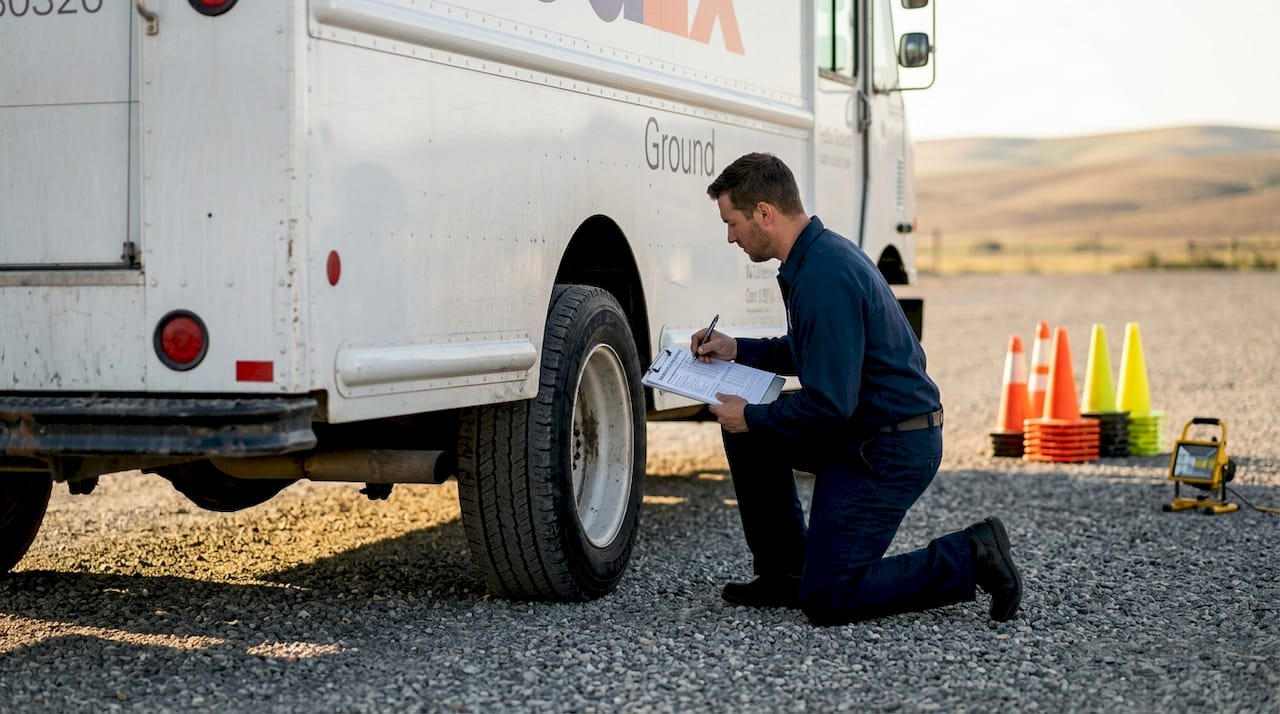
Consistent daily inspections also feed directly into your safety metrics under FedEx's grading system. Skipping this step does not just create a regulatory gap. It creates a scoring gap as well.
Insurance and documentation requirements
Insurance compliance is one of the most common areas where FedEx contractors run into contract problems. The requirements go beyond a basic commercial auto policy. FedEx mandates multiple coverage types that must be active before you operate a single vehicle under your agreement.
The required coverage types include:
- Commercial auto liability: Minimum limits are set by FedEx and typically exceed standard state minimums. This covers bodily injury and property damage involving your vehicles.
- Workers' compensation: Required for all employees. If you use independent contractors as drivers, you still need to verify coverage requirements under your state's law.
- General liability: Covers non-vehicle-related business exposures such as premises liability and completed operations.
- Cargo insurance: Protects the packages in your vehicles. FedEx packages have value, and cargo loss or damage is a real financial exposure.
Every policy must name FedEx Ground as an additional insured and certificate holder. The Certificates of Insurance (COIs) must be current at all times. An expired COI or a lapse in coverage can trigger a contract suspension.
Working with an insurance broker who has direct experience with FedEx ISP compliance is worth the effort. A generalist broker may structure policies that meet state minimums but fall short of FedEx's specific requirements, and you may not discover the gap until it costs you. Brokers familiar with fleet management for FedEx contractors understand which endorsements are needed and how to avoid coverage gaps that put your operating agreement at risk.
How FedEx grades your performance monthly
FedEx evaluates ISPs on a monthly basis through a structured scoring system that places contractors into Gold, Silver, or Bronze tiers. This grading system is where FedEx fleet guidelines translate directly into financial consequences. Your tier affects your contract renewal terms, your ability to expand your territory, and ultimately the market value of your routes if you decide to sell.
The three pillars of the FedEx grading system are:
- Service performance: On-time delivery rates, pickup compliance, and scan compliance. This is the metric most contractors focus on.
- Safety metrics: Accident rates, DOT compliance, injury frequency, and vehicle inspection results. Poor safety scores can offset strong delivery numbers.
- Customer experience: Package complaint rates, driver behavior feedback, and delivery attempt quality.
The grading cycle and its implications follow a clear escalation path:
Gold tier ISPs retain strong renewal rights and typically command higher route valuations in the acquisition market. Bronze tier contractors may face open competitive bidding on their territory at renewal, which means another operator can bid for your routes. Repeated poor performance can lead to contract termination.
What catches many fleet owners off guard is that safety metrics carry real weight in the scoring. You can be hitting strong delivery numbers and still drop from Gold to Silver if your accident rate climbs or your DVIR compliance falls short. Neglecting safety documentation can silently hurt your overall score even when your drivers are performing well on the road.
The practical response is to treat all three pillars as equally important on a daily operational level. That means tracking safety-related data with the same discipline you apply to on-time delivery numbers.
Best practices for fleet compliance and efficiency
Fleet owners who maintain consistent Gold tier performance share a few operational habits that go beyond the minimum requirements. These practices are worth adopting regardless of where your fleet currently stands.
The table below compares reactive versus proactive compliance approaches across key operational areas:
| Area | Reactive approach | Proactive approach |
|---|---|---|
| Vehicle inspections | Complete DVIRs only when issues arise | Conduct pre-trip and post-trip DVIRs on every vehicle every operating day |
| Defect resolution | Repair vehicles when drivers report problems | Track all defects in a digital system with repair verification before release |
| Preventive maintenance | Service vehicles at fixed mileage intervals | Use mileage plus condition-based scheduling adjusted for route demand |
| Insurance documentation | Renew policies at expiration | Set 60-day advance reminders for COI renewals and carrier notifications |
| Fleet acquisition | Purchase vehicles based on price and availability | Conduct third-party pre-purchase inspections to assess deferred maintenance risk |
Deferred maintenance is one of the most overlooked risks when acquiring vehicles or purchasing an existing route. A fleet that looks functional can carry thousands of dollars in pending repairs that become your liability the moment you take ownership. A thorough pre-purchase inspection by an independent mechanic should be non-negotiable.
The DVIR chain of accountability is worth reinforcing specifically. Compliance is not just filling out the form. It means tracking defects from the moment a driver identifies them, through the repair process, to the verified sign-off before that vehicle goes back on the road. Digital DVIR systems create this chain automatically and give you documentation you can present during FedEx audits or DOT reviews.
Pro Tip: Review your fleet's delivery safety practices at least quarterly. Many compliance gaps that affect grading scores are found in routine operational reviews, not after incidents occur.
For fleet owners who want to understand what succeeding as a FedEx contractor looks like from a driver-level perspective, reviewing driver performance expectations is a useful complement to the fleet-level compliance work above.
My take on the compliance details most owners miss
I have seen fleet owners do everything right on paper and still struggle with their FedEx grades. In my experience, the gap is almost always in the daily process discipline, not the policy knowledge.
The DVIR chain of accountability is probably the most underestimated piece of FedEx contractor fleet compliance. Everyone knows inspections are required. Far fewer operators actually maintain the closed loop from defect discovery to verified repair to documented vehicle release. When an audit happens, that paper trail is the only thing standing between you and a compliance finding.
What I have also learned is that fleet condition at the time of route acquisition matters far more than most buyers realize. Routes often look profitable based on revenue and stop counts, but I have seen operators turn a solid route into a cash drain because the fleet they inherited had deferred maintenance problems that surfaced within the first 90 days. A pre-purchase inspection is not optional. It is the difference between a good acquisition and a bad one.
The grading system is another area where the hidden impact becomes clear over time. Your Gold tier status is not just about bragging rights. It directly affects the market value of your routes and your leverage in contract negotiations. Dropping to Silver for even two or three months can affect buyer confidence if you ever decide to sell, and it can shift your renewal terms in ways that are hard to recover from. Protecting your grade is, in practical terms, protecting the asset value of your business.
— Aaron
How Ucep helps you stay ahead as a FedEx contractor
Running a compliant, high-performing FedEx fleet depends on more than operational checklists. You also need qualified drivers who understand the expectations of FedEx ISP routes and a community of service providers where you can benchmark your practices.
Ucep is built specifically for FedEx service providers and the drivers who work with them. You can browse service provider reviews to evaluate operational reputations before hiring or entering partnerships. You can also access the Ucep contractor network for resources that support compliance and fleet performance. If you are actively hiring drivers for linehaul, CDL-A, or pickup and delivery roles, find qualified candidates through a platform built exclusively around FedEx contractor operations.
FAQ
What is the FedEx ISP model?
The FedEx ISP (Independent Service Provider) model is the contracting structure through which FedEx Ground works with independent business owners to handle package delivery within defined territories. ISPs own their vehicles, hire their drivers, and are fully responsible for fleet compliance.
What insurance does a FedEx contractor need?
FedEx contractors must carry commercial auto liability, workers' compensation, general liability, and cargo insurance. All policies must list FedEx Ground as an additional insured and certificate holder, with current COIs maintained at all times.
How does the FedEx contractor grading system work?
FedEx scores ISPs monthly using a Gold, Silver, and Bronze tier based on service performance, safety metrics, and customer experience. Your grade affects contract renewal terms and the market value of your routes.
What is a DVIR and why does it matter for FedEx fleets?
A DVIR (Driver Vehicle Inspection Report) is a federally required daily inspection document under 49 CFR 396.11. For FedEx fleets, consistent DVIR completion and defect resolution directly affect your safety metrics and DOT compliance standing.
What federal regulation covers vehicle equipment standards for FedEx fleets?
49 CFR Part 393 establishes the required equipment standards for commercial vehicles, including brakes, lights, tires, and cargo securement. All FedEx contractor vehicles must comply with this regulation before operating on public roads.