
Hiring a CDL driver without completing every required screening step can cost you far more than the time saved. FedEx-contracted service providers face a specific combination of federal DOT and FMCSA obligations, and missing even one element before a driver starts safety-sensitive work can expose your operation to serious legal liability, failed audits, and contract risk. This guide breaks down every required and recommended screening step, the documents you need, the timing rules you must follow, and the benchmarks that separate compliant operations from consistently high-performing ones.
Table of Contents
- Understanding regulatory and FedEx-specific screening requirements
- Building your CDL driver screening toolkit
- Step-by-step: Executing a compliant CDL screening process
- Avoiding liability and reducing turnover: Practical benchmarks
- Why minimum compliance isn't enough for FedEx contractors
- Streamline your screening and hiring with UCEP
- Frequently asked questions
Key Takeaways
| Point | Details |
|---|---|
| Compliance is non-negotiable | All federal screening steps—including MVR, Clearinghouse, and drug test—must be completed before drivers begin safety-sensitive work. |
| Organize for audit-readiness | Maintain a complete Driver Qualification File with every required record to ensure smooth compliance checks. |
| Go beyond the basics | Broader screening criteria, such as reliability and work-history, deliver safer, more stable FedEx operations. |
| Track every step | Document timestamped consents and responses to avoid interim liability or regulatory gaps. |
| The right tools save time | Using prebuilt resources and checklists simplifies compliance and helps avoid costly mistakes. |
Understanding regulatory and FedEx-specific screening requirements
Before you post a job opening or schedule an interview, you need a clear picture of what federal law actually requires. The FMCSA mandates a specific set of pre-hire checks, and a defensible CDL pre-hire screening program must implement the full federal "stack" of checks before any driver operates a commercial vehicle.
The federal screening stack includes:
- Motor Vehicle Record (MVR) from every state the driver held a license in during the past three years
- FMCSA Drug and Alcohol Clearinghouse full query
- Safety Performance History from all DOT-regulated employers within the past three years
- Pre-employment DOT drug test with a verified negative result
- Medical examiner's certificate confirming current physical qualification
- Road test or equivalent certification
Timing matters here. All steps must be completed before the driver performs any safety-sensitive function. This is not a suggestion. Drivers cannot perform safety-sensitive functions until the employer has a verified negative pre-employment drug test result on file. That applies to linehaul runs, CDL-A team operations, and pickup and delivery routes equally.
FedEx contractors operate as independent businesses, but that independence does not reduce your screening obligations. You must meet or exceed federal standards. In practice, many contractors should exceed them, because the operational demands of FedEx routes require drivers who go beyond the minimum qualification threshold. When screening for team driver success, additional criteria around reliability and customer interaction become especially important.
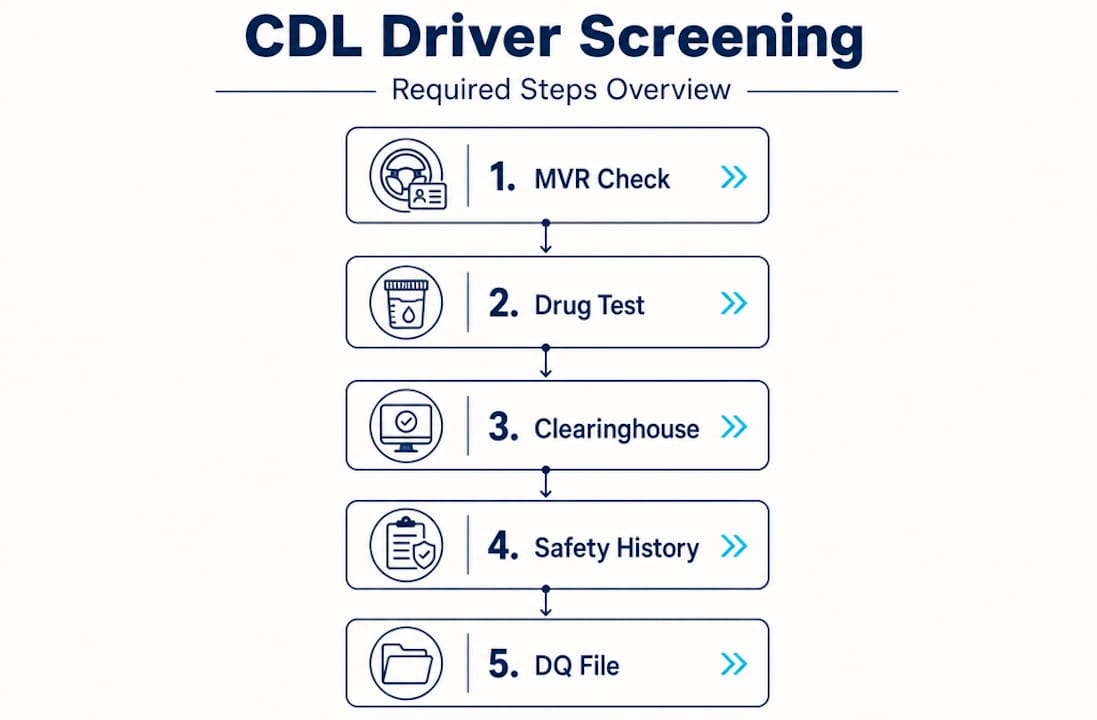
Federal requirement comparison by check type:
| Screening element | Required by FMCSA | Timing requirement |
|---|---|---|
| MVR check | Yes | Before hire |
| Clearinghouse full query | Yes | Before hire |
| Safety Performance History | Yes | Before hire |
| Pre-employment drug test | Yes | Before safety-sensitive work |
| Medical examiner's certificate | Yes | Before hire |
| Road test documentation | Yes | Before first solo operation |
| Criminal background check | No (federal) | Recommended best practice |
The distinction between required and recommended matters for audit purposes. Document required steps as mandatory compliance actions and recommended steps as part of your internal hiring policy.
Building your CDL driver screening toolkit
With the requirements established, let's gather exactly what tools, files, and steps you need to stay fully compliant. The foundation of every compliant CDL hire is the Driver Qualification File (DQF). CDL screening must be documented in a Driver Qualification File containing all required documentation.
Every DQF must include:
- Completed driver application (FMCSA-compliant format)
- MVR from each state licensed in over the past three years
- Written consent form for MVR, background, and drug test authorization
- Safety Performance History request and response from each prior DOT employer
- Clearinghouse full query results and consent
- Pre-employment drug test result (lab-verified negative)
- Medical examiner's certificate and medical examiner's name and registry number
- Road test certificate or equivalent (such as a valid CDL with appropriate endorsements)
- Annual review of driving record
- Documentation of any driver violations or corrective actions
Organizing these files for audit readiness is just as important as collecting them. Use a consistent folder structure, either physical or digital, so that every required document is immediately accessible during a DOT audit. Group files by driver, label each document by type and date, and verify completeness before the driver's first day.
Retention timelines you must follow:
| Document type | Minimum retention period |
|---|---|
| Driver application | 3 years |
| MVR | 3 years from date of issue |
| Drug test results | 5 years (positive), 1 year (negative) |
| Safety Performance History | 3 years |
| Medical certificate | Duration of employment plus 3 years |
| Road test certificate | Duration of employment plus 3 years |
Pro Tip: Schedule a quarterly internal audit of your DQFs. Pull five random driver files and verify that every required document is present and current. Catching a missing medical certificate before a DOT roadside check is far less costly than addressing it after.
You will also need access to the DOT testing resources your operation relies on, and a clear process for requesting previous employer investigations that meets the FMCSA's written inquiry and response requirements.
Step-by-step: Executing a compliant CDL screening process
Now, with your toolkit prepared, let's walk through each step you must follow to ensure airtight compliance. The steps below apply to every new CDL driver hire, regardless of route type or employment duration.
-
Post the position and collect applications. Use an FMCSA-compliant driver application form that captures employment history for the past ten years, license history, accident history, and any previous DOT violations. Generic online application forms are often insufficient.
-
Verify CDL validity and endorsements. Confirm the driver holds a current, valid CDL with the correct class and endorsements for your operation before investing time in further screening.
-
Request signed consent forms. Before pulling any records, obtain written authorization from the applicant for MVR checks, background checks, Clearinghouse queries, and drug testing. Missing consent documentation is a common audit finding.
-
Run the MVR check. Request the MVR from every state where the driver held a commercial or personal license in the past three years. Review the record for disqualifying violations such as DUI, excessive speeding, or a suspended license.
-
Submit the FMCSA Clearinghouse full query. A limited query is not sufficient for pre-employment purposes. A full query requires driver consent and provides a complete history of drug and alcohol program violations. Complete this through the FMCSA Clearinghouse portal and document the result.
-
Conduct Safety Performance History inquiries. Contact every DOT-regulated employer from the past three years in writing. Request information on accidents, violations, and drug or alcohol testing results. Document your outreach date and any responses received.
-
Extend a conditional offer. Make your employment offer contingent on a verified negative drug test result. Do not allow the driver to begin any work until this condition is met.
-
Administer the pre-employment DOT drug test. Send the driver to a certified collection site. A pre-employment DOT drug test must be performed and returned negative after the conditional offer and before the driver works. The Medical Review Officer (MRO) verifies and reports the result directly to you.
-
Verify the medical examiner's certificate. Confirm the certificate is current and that the examiner is listed on the FMCSA National Registry. Record the certificate number and expiration date in the DQF.
-
Complete the road test or verify CDL equivalency. If the driver's CDL does not meet FMCSA equivalency requirements for your specific vehicle type, you must administer a road test and issue a certificate. Screening includes road test documentation as a required element of the DQF.
-
Final DQF review. Before the driver's first day, verify that every required document is present, dated, and signed. Create a checklist specific to your operation and sign off on it.
A driver who completes orientation but has not yet received a verified negative drug test result cannot legally perform safety-sensitive functions. This includes driving any commercial motor vehicle on public roads, regardless of supervision.
Pro Tip: Use the Clearinghouse compliance checklist to verify your query process is fully current. FMCSA rules around Clearinghouse have evolved, and using an outdated workflow can result in non-compliant queries.
The most frequent mistake contractors make is allowing a driver to start training or running a short unaccompanied route while waiting on a Safety Performance History response or drug test result. Even a single trip before all steps are complete creates liability.

Avoiding liability and reducing turnover: Practical benchmarks
Beyond checkboxes, adopting these benchmarks can help your fleet avoid liability and keep strong drivers onboard. Compliance is the floor, not the ceiling, and treating it as the finish line leads to preventable problems.
Compliance gaps and liability exposure:
Interim liability and compliance gaps can occur if carriers delay Safety Performance History and Clearinghouse steps. If you hire a driver and something goes wrong before these checks are complete, your liability exposure is significantly higher because you cannot demonstrate due diligence. Document the date each request was sent, the date each response was received, and the name of the person who reviewed each result.
Operational benchmarks beyond minimum qualification:
Minimum federal qualifications may not produce good operational outcomes. Structured criteria are recommended for fleets that want to reduce turnover and build reliable teams. Consider these additional screening criteria as part of your internal hiring policy:
- MVR standard: No more than two moving violations in the past three years; zero DUI or DWI history in the past seven years
- Accident history: No preventable accidents involving bodily injury or significant property damage in the past three years
- Employment stability: No more than two employer changes in the past three years without documented legitimate reasons
- Customer service indicators: Verifiable experience in time-sensitive delivery environments, positive reference from prior dispatch supervisors
- Physical reliability: History of consistent attendance and no patterns of unexplained absence or early departure
Structured evaluation criteria also improve your ability to defend hiring decisions if a driver is involved in an incident post-hire. A documented scoring framework shows that you applied consistent, objective standards to every applicant.
Pro Tip: Before investing in outreach, review the job board ROI for CDL hiring to understand how a focused recruitment strategy reduces the volume of unqualified applicants you have to screen in the first place. Fewer unqualified candidates means faster time-to-hire and lower screening costs per placement.
Turnover is expensive. Industry estimates place the cost of replacing a single CDL driver at several thousand dollars when you account for recruiting, screening, onboarding, and temporary coverage. Contractors who apply structured benchmarks consistently report lower early-exit rates and fewer performance issues within the first 90 days.
For further guidance on managing compliance risk specific to FedEx operations, and to review common compliance Q&A scenarios, those resources provide practical, situation-specific answers.
Why minimum compliance isn't enough for FedEx contractors
Stepping back from the details, let's look at why proactive screening creates a strategic advantage for your FedEx operation.
The reality is that passing a DOT audit and running a high-performing operation are two different outcomes. Contractors who focus exclusively on checking required boxes tend to see higher turnover, more performance-related terminations, and more frequent conflicts with FedEx operational standards. The screening process is your single best opportunity to gather the information you need to make a genuinely good hire. Once a driver is behind the wheel, your ability to course-correct is limited.
FedEx operations, particularly linehaul and CDL-A team routes, have demanding scheduling requirements and narrow tolerance for no-shows or service failures. A driver who meets minimum federal qualifications but has a pattern of short-tenured employment or inconsistent customer interaction history is a poor fit for these roles, even if their MVR is technically clean. The federal stack tells you whether a driver can legally operate. It does not tell you whether they will show up reliably at 3:00 a.m. or handle a damaged delivery situation professionally.
That's where broader criteria and ongoing review change the equation. Contractors who conduct periodic MVR re-checks (not just at hire), maintain open communication channels with drivers, and apply consistent performance documentation consistently outperform those who only engage with compliance requirements at the point of hire. These practices also support better outcomes when routes grow or team assignments change.
Team driver best practices reinforce this point directly. The skills and reliability indicators that predict success in a CDL-A team role are not captured by the federal stack alone. Behavioral consistency, communication habits, and operational reliability must be evaluated through structured reference checks and behavioral interview questions.
The contractors who retain drivers longest are not necessarily the ones paying the highest rates. They are the ones who screen thoroughly, communicate expectations clearly during onboarding, and treat the hiring decision as a strategic choice rather than a compliance task.
Streamline your screening and hiring with UCEP
Ready to turn these steps into simple, actionable tasks? UCEP is built specifically for FedEx-contracted service providers who need access to qualified CDL drivers without sifting through irrelevant applicants from general job boards.
UCEP connects you directly with drivers experienced in FedEx linehaul, CDL-A team, CDL-A solo, and pickup and delivery roles. Every posting reaches an audience that already understands the FedEx contractor environment, which means fewer unqualified applications and faster time-to-hire. Review the UCEP pricing packages to find the right plan for your fleet size, or visit the UCEP platform to post your first opening and access driver-facing resources that support a compliant, efficient hiring process.
Frequently asked questions
What records are required in a Driver Qualification File (DQF) for CDL drivers?
A DQF must contain the driver application, motor vehicle records and safety history from each state for the past three years, previous employer safety performance history, medical examiner's certificate, and road test or equivalent certification.
Can a driver start working before the pre-employment drug test result is received?
No. A driver must not perform any safety-sensitive functions until a verified negative pre-employment drug test result is on file, regardless of route type or supervision status.
What happens if Safety Performance History or Clearinghouse queries are delayed?
Delays in these steps create compliance gaps and interim liability exposure, so all checks must be completed and documented before a driver begins any safety-sensitive function.
Do FedEx contractors have to follow additional screening rules beyond federal requirements?
FedEx contractors are independent operators but are expected to meet or exceed federal DOT and FMCSA standards. Using broad fit criteria beyond minimum requirements for clean MVR history, reliability, and logistics experience is strongly recommended for operational success.