
Hiring a CDL driver for your FedEx service provider operation is not a simple transaction. One missed document, one skipped verification step, or one incomplete Driver Qualification File (DQF) can remove a driver from your routes before they ever complete a shift. The compliance requirements tied to FedEx contracts and federal DOT regulations are specific, sequential, and unforgiving. This checklist-based guide walks you through every critical step, from defining candidate criteria to completing the final audit file, so your hiring process is both efficient and fully defensible.
Table of Contents
- Defining the CDL driver job search criteria
- Building a compliance-first CDL driver screening process
- Step-by-step checklist for compliant CDL recruiting
- Comparing digital onboarding vs. manual paperwork
- Final audit: Safety performance and DOT investigations
- Why shortcuts in CDL driver recruiting aren't worth the risk
- Simplify your CDL driver recruiting with UCEP
- Frequently asked questions
Key Takeaways
| Point | Details |
|---|---|
| Compliance comes first | Prioritizing audit-ready documentation prevents risk and keeps your FedEx contract secure. |
| Step-by-step workflow | A sequential checklist from search to onboarding streamlines hiring and avoids costly mistakes. |
| Digital beats paper | Digital onboarding tools save time, reduce errors, and support compliance audits with instant access. |
| Audits are real | DOT investigation files and background checks must be complete to pass inspections and keep drivers qualified. |
Defining the CDL driver job search criteria
With the importance of structure established, let's clarify exactly what makes a candidate eligible and select the factors you must document immediately.
Before you post a job or review a single application, you need a clear picture of what a qualified candidate looks like on paper. Skipping this step means spending time on applicants who will fail screening later. That wastes your time and delays your routes.
A compliant CDL driver candidate must meet these minimum requirements at the point of application:
- Valid CDL with required endorsements for the specific role (linehaul, CDL-A team, CDL-A solo, or pickup and delivery)
- Clean Motor Vehicle Record (MVR) with no disqualifying violations within the applicable lookback period
- Current DOT medical certificate issued by a certified medical examiner listed in the National Registry
- Verified legal work authorization in the United States
- No pending disqualifications in the FMCSA Drug and Alcohol Clearinghouse
- Completed pre-employment drug and alcohol testing with a verified negative result before any route operation
A practical pre-hire checklist should cover CDL/license verification, DOT drug and alcohol pre-employment testing, DQF setup and maintenance, safety and background history checks, skills and road testing, and policy acknowledgements. These six categories form the backbone of every compliant CDL hire.
For roles that require two drivers operating in tandem, review the specific team driver qualifications that apply to FedEx service provider contracts. Team roles carry additional scheduling and endorsement considerations that affect your criteria upfront.

Pro Tip: Define your minimum criteria in a written document before you open a job posting. When you screen candidates against a written standard, you reduce subjective decisions and create a defensible record if your process is ever questioned.
Building a compliance-first CDL driver screening process
Once you know your must-have criteria, the next phase is to build a screening and file-building workflow that is both compliant and defensible in audits.
Screening is where most service providers lose ground. The steps feel repetitive, the paperwork feels excessive, and it is tempting to move a promising candidate forward before every box is checked. That approach creates liability.
For CDL driver hiring, you must compile a Driver Qualification File (DQF) for each qualified driver and ensure the required pre-employment compliance items are completed and documented before the driver operates any commercial motor vehicle. The DQF is not optional. It is the central record that regulators and FedEx network supervisors will examine if a compliance question arises.
What belongs in a DQF
| DQF Element | Required Documentation | Compliance Purpose |
|---|---|---|
| CDL verification | Copy of valid CDL with endorsements | Confirms operating authority |
| DOT medical certificate | Current examiner certificate | Confirms physical fitness to operate |
| Pre-employment drug test | Lab result with negative status | Federal requirement before first dispatch |
| FMCSA Clearinghouse query | Full query result, signed consent | Identifies active drug/alcohol violations |
| Safety performance history | Prior employer responses | Identifies prior accidents or violations |
| MVR | State-issued driving record | Documents violation history |
| Road/skills test | Completed examiner form | Confirms operational competency |
Most commonly missed DQF items
These are the items service providers most frequently overlook, and each one can trigger an audit finding:
- Prior employer inquiry responses not documented or follow-up attempts not recorded
- DOT drug test date missing from the file or not matched to the lab report
- FMCSA Clearinghouse query type recorded incorrectly (limited vs. full query)
- Signed release forms for safety performance history requests
- Medical certificate expiration date not tracked or updated in the file
Checking driver review records as part of your screening process can give you additional context on a candidate's professional history. Cross-referencing that information with your formal DQF steps adds a practical layer of due diligence. Maintaining a focus on safe driving background verification at this stage protects your operation before a driver ever touches a vehicle.
Step-by-step checklist for compliant CDL recruiting
With compliance as your steering wheel, here is a plain-English, step-by-step checklist you can deploy immediately for recruiting and onboarding.
A robust job search checklist for contract recruiting functions as a compliance-first funnel: create an audit-ready DQF and process, front-load qualification screening covering CDL and endorsements, MVR, DOT medical, clearinghouse and drug testing, and safety performance, then conduct role-fit steps such as road test and skills assessment, followed by staged onboarding.
Here is how that funnel looks in practice:
-
Source candidates through FedEx-specific job boards and targeted outreach. Broad general job boards produce high volume but low qualification rates. Posting on niche job boards focused on FedEx service provider roles improves candidate quality from the first application.
-
Pre-screen by phone or form to confirm CDL class, endorsements, DOT medical status, and Clearinghouse consent before investing time in a full application review.
-
Collect the formal application including employment history for the prior three years, accident history, and traffic violation record.
-
Run the MVR through your approved vendor to verify the driving record against your established criteria.
-
Submit the FMCSA Clearinghouse query with signed driver consent. A full query is required for pre-employment.
-
Order the pre-employment drug test and confirm the negative result before proceeding. No driver advances past this point without a verified result.
-
Begin the DQF file using the documentation collected to this point. Assign a file number and document every step with dates.
-
Contact prior DOT-regulated employers for safety performance history. Document every attempt, including non-responses.
-
Schedule and complete the road and skills test with a qualified examiner. Record results in the DQF.
-
Complete policy acknowledgements including company safety policies, hours of service rules, and any FedEx-specific conduct requirements.
-
Conduct orientation covering route-specific procedures, reporting structures, and vehicle inspection requirements.
"Compliance-first means no driver touches a truck without every box checked."
Pro Tip: Use a digital document capture tool to collect signatures and upload files at each step. When every document is timestamped and stored in one place, your audit preparation time drops significantly and the risk of a missing item drops with it.
Comparing digital onboarding vs. manual paperwork
Now that you have your checklist and process mapped, the decision remains: paper forms or digital solutions? Here is how they stack up.
Structured digital onboarding workflows that include document capture, consent capture, and audit trails reduce missed-step risk and keep DQ materials organized for inspection. That is the core argument for going digital. But the choice depends on your operation size and current infrastructure.
Digital vs. manual onboarding comparison
| Factor | Digital onboarding | Manual paperwork |
|---|---|---|
| Processing speed | Fast, often same-day | Slower, dependent on physical delivery |
| Error risk | Low, with validation prompts | Higher, prone to missing fields |
| Audit-readiness | High, with automatic audit trails | Variable, depends on filing discipline |
| Cost | Moderate upfront, lower long-term | Low upfront, higher labor cost over time |
| Integration with FedEx systems | Supported by most platforms | Limited or requires manual data entry |
| Scalability | Scales easily with volume | Difficult to scale without added staff |
When manual processes may still make sense
There are specific situations where paper-based onboarding remains practical:
- Very small operations with one to three drivers where digital infrastructure is not yet in place
- Temporary or short-term contract coverage where setup time for a digital system exceeds the contract duration
- Locations with limited internet access that make digital submission unreliable
- Transitional periods when migrating from one system to another and a paper backup is maintained
For most service providers managing multiple drivers across multiple routes, using digital onboarding tools reduces the administrative burden and keeps your files inspection-ready at all times. Explore digital onboarding resources tailored to FedEx service provider operations to identify the right fit for your team size and workflow.
Final audit: Safety performance and DOT investigations
Before you put a driver behind the wheel, finish with these make-or-break historical investigations and documentation checks.
The investigation phase is the last compliance gate before a driver is cleared to operate. DOT regulations require contacting DOT-regulated employers from the prior lookback window and maintaining a record of those contacts and efforts as part of your driver investigation file responsibilities.
This step trips up many service providers because it requires active follow-up, not just sending a request and moving on. If a prior employer does not respond, you must document your attempts. If a driver disputes information in their safety performance history, you must include their rebuttal in the file.
Investigation file audit-readiness checklist
Make sure your investigation file includes all of the following before clearing a driver:
- Dated written request sent to each DOT-regulated employer from the prior three years
- Documented employer responses or written record of non-response with follow-up attempts
- Employment gap explanations for any periods not covered by employer contact
- Driver's signed release authorizing the safety performance history inquiry
- Accident register information from prior employers if applicable
- Driver rebuttal documentation if the driver contests any information received
- File completion date recorded before the driver's first day of operation
A complete investigation file does more than satisfy a regulatory requirement. It protects your operation in the event of an FMCSA audit and demonstrates that your hiring process is thorough and consistent. Maintaining a focus on investigating safety performance at this stage is one of the most important risk management steps you can take as a service provider.
Why shortcuts in CDL driver recruiting aren't worth the risk
Every service provider reaches a point in the hiring process where a step feels redundant or a candidate seems obviously qualified. The temptation to skip a prior employer follow-up or delay a drug test result confirmation is real. Here is why that decision almost always creates a larger problem.
Audit-readiness is not just about having paperwork. It is about having the right paperwork, in the right sequence, with the right dates. FedEx network supervisors and FMCSA auditors are trained to look for gaps in sequence, not just missing documents. A DQF that is complete but out of order raises the same flags as one with a missing item.
Shortcuts also create a compounding risk. When one step is skipped, the steps that depend on it become unreliable. A pre-employment drug test that was ordered before the FMCSA Clearinghouse query was completed, for example, does not satisfy the regulatory sequence even if both results are negative. The order matters as much as the completion.
There is also the cost of rehiring to consider. When a driver is disqualified after starting because a compliance step was missed, you lose the time invested in recruiting, screening, and onboarding. You also face route gaps that affect your FedEx contract performance. The cost of doing it right the first time is always lower than the cost of doing it twice.
Running a rigorous, documented process also makes your operation more attractive to experienced drivers. Drivers with strong records know that compliant operations are better managed. They are more likely to stay with a service provider who demonstrates professionalism in the hiring process. Visit the CDL hiring Q&A to get answers to specific questions about building a compliant and competitive recruiting operation.
The checklist is not bureaucracy. It is the foundation of an operation that runs without interruption.
Simplify your CDL driver recruiting with UCEP
Managing a compliant CDL driver recruiting process takes time, attention to detail, and a consistent workflow. UCEP is built specifically for FedEx service providers who need a structured, efficient way to find qualified drivers and keep their hiring process audit-ready.
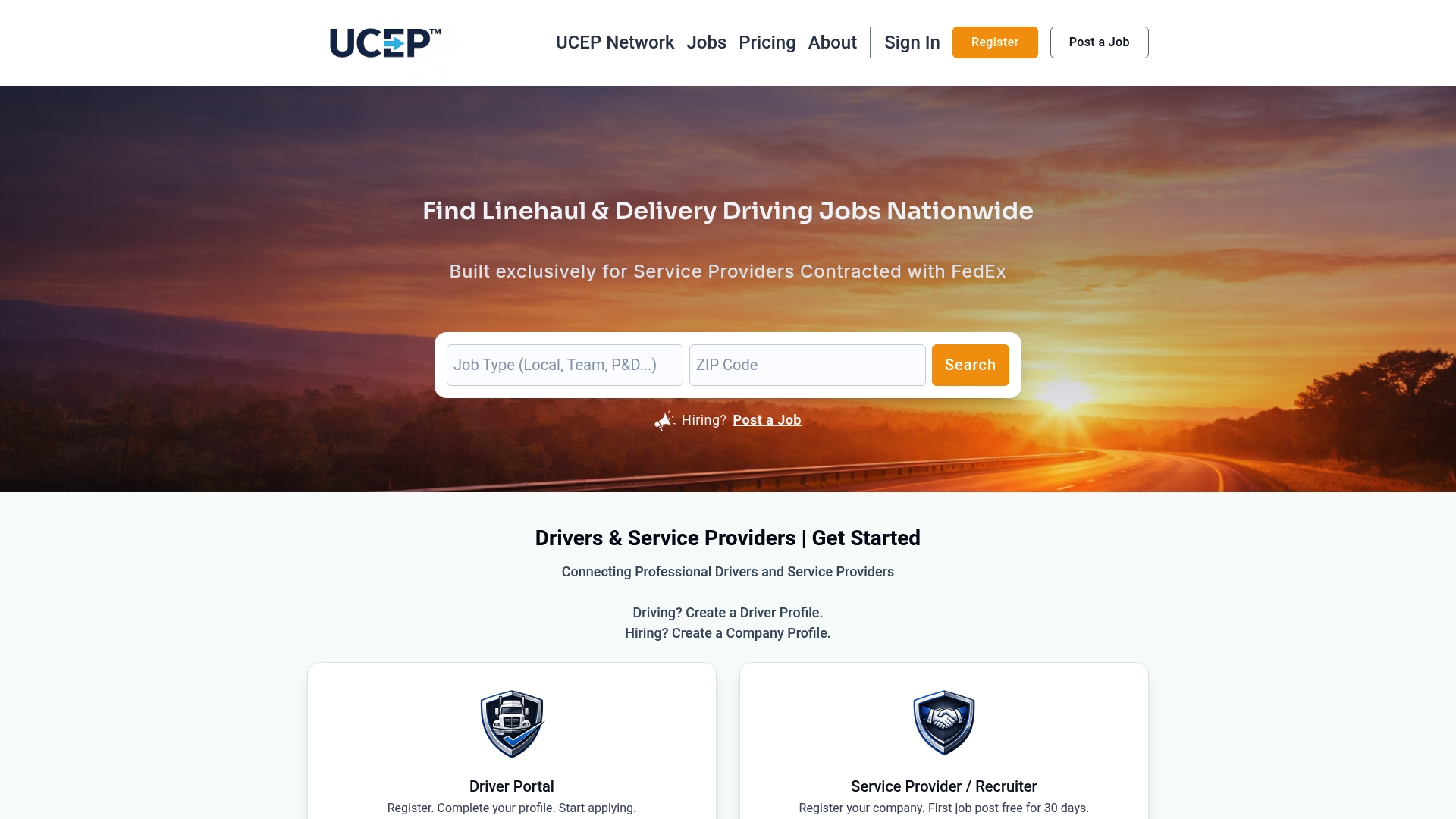
UCEP connects you with CDL-A candidates for linehaul, team, solo, and pickup and delivery roles, all in one focused platform. You can post jobs, review applicants, and manage your recruiting pipeline without sorting through unqualified candidates from general job boards. Review UCEP pricing and plans to find the right option for your operation size. Visit ucep.co to explore the full range of FedEx driver recruiting services available to service providers today.
Frequently asked questions
What documents are required before a CDL driver can operate for a FedEx service provider?
You must complete CDL license verification, DOT medical certificate, pre-employment drug test, FMCSA Clearinghouse query, and background and safety checks prior to operation. The DQF must include all of these items documented and on file before the driver operates any commercial motor vehicle.
How long does a DOT employer investigation lookback period cover?
DOT requires contacting regulated employers from at least the past three years for CDL driver applicants. Carriers must document each employer contact attempt and retain that record as part of the driver investigation file.
Which digital onboarding tools help with CDL hiring compliance?
Tools that support document capture, e-consent, and audit trails streamline compliance and reduce error risk. Structured digital workflows reduce missed-step risk and keep DQ materials organized and ready for inspection.
What happens if a required DQF document is missing?
Missing DQF elements may cause audit failures and disqualify drivers from operating on FedEx contracts. The DQF must include CDL license verification, DOT medical examiner certificate, pre-employment drug test result, FMCSA Clearinghouse query, and safety performance history records to be considered complete.