
A defensive driving course for CDL holders is a specialized safety training program that teaches commercial drivers to anticipate hazards, manage risk, and prevent accidents while operating large vehicles. Unlike a standard traffic school class, this training addresses the unique physics and operational demands of trucks, semis, and other commercial vehicles. Providers like the National Safety Council, e-Training Inc., and CDL Schools USA offer programs built specifically for commercial license holders. Completing this training can satisfy employer safety requirements, reduce insurance premiums, and strengthen your professional record.
What does a CDL defensive driving course cover?
CDL defensive driving training covers far more than basic traffic rules. The curriculum focuses on skills that directly apply to operating a large commercial vehicle in real-world conditions.
Core topics include:
- Situational awareness and hazard prediction: You learn to read traffic patterns, identify road hazards early, and plan your response before a situation becomes critical.
- Visual scanning technique: Effective scanning means looking 12–15 seconds ahead of your vehicle. Most drivers focus on only a 2–3 second horizon, which is dangerously short for a loaded semi.
- Space and following distance management: Courses teach a minimum three-second following distance, with adjustments for weather, load weight, and road conditions.
- Fatigue, distraction, and aggression management: You learn to recognize the early signs of fatigue and how to respond to aggressive drivers without escalating the situation.
- Collision avoidance techniques: Emergency braking, evasive steering, and controlled stops are practiced in context, not just described.
- Blind spot and stopping distance awareness: Large vehicles have significantly longer stopping distances and wider blind spots than passenger cars. Courses address both in detail.
Course formats vary. You can complete training online at your own pace, in a classroom setting, or through an app-based program. Some employers sponsor in-house sessions as part of their fleet safety programs.
Pro Tip: If you choose an online format, confirm the course meets your state's DMV approval requirements before you pay. Not all online programs qualify for insurance discounts or point reduction.
How does CDL defensive driving differ from standard courses?
The difference between a CDL defensive driving course and a standard program is significant. Standard courses target passenger vehicle drivers and focus on general traffic law and basic hazard awareness. CDL courses are built around the physical and operational realities of commercial vehicles.
CDL-specific training focuses on managing large vehicle limitations like increased stopping distances, blind spots, and vehicle physics rather than just basic traffic law compliance. A loaded 80,000-pound semi can take 40% longer to stop than a passenger car at highway speed. That difference demands a completely different mental model for risk management.
| Feature | Standard Defensive Driving | CDL Defensive Driving |
|---|---|---|
| Target vehicle | Passenger cars | Commercial trucks and semis |
| Stopping distance focus | Basic | Extended, load-dependent |
| Blind spot coverage | Minimal | Detailed, mirror-check protocols |
| Regulatory environment | State traffic law | DOT, FMCSA, fleet safety programs |
| Course length | 4–8 hours typical | 45 minutes to 8 hours |
| Certification use | Point reduction, insurance | Employer compliance, insurance, career |
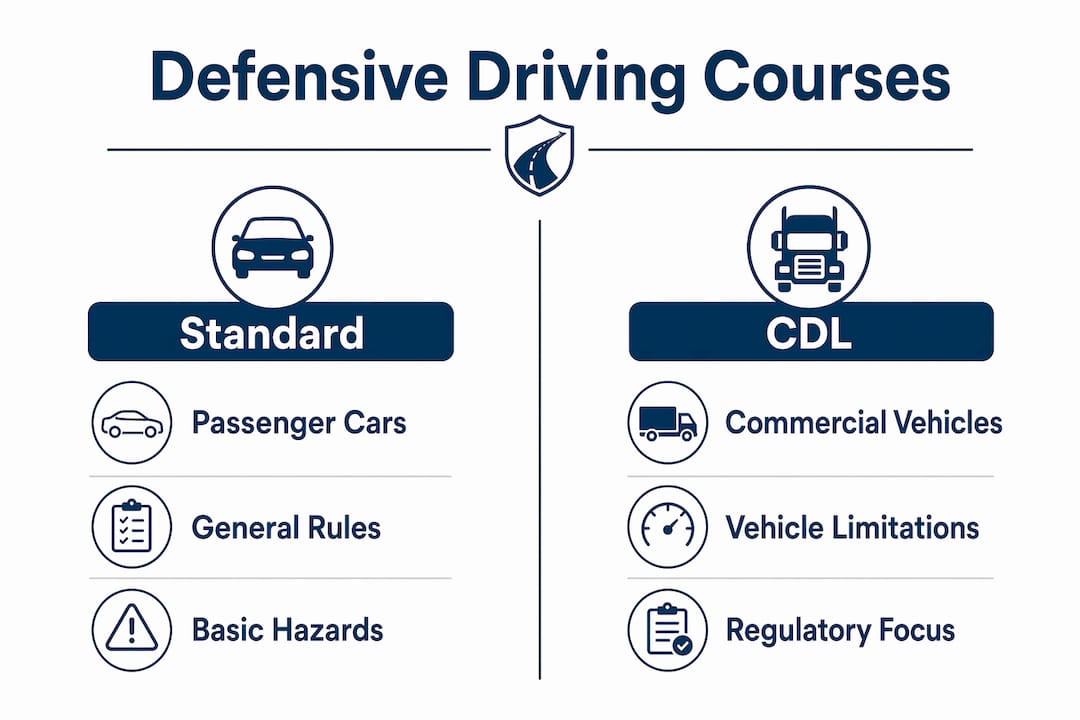
CDL courses also address the regulatory environment specific to commercial drivers. Fleet safety programs, FMCSA compliance, and employer safety records all factor into the training content. Standard courses do not cover any of this. The certification process also differs. CDL training certificates are often required by carriers and service providers as proof of compliance, not just as a personal record.
What are the benefits of completing CDL defensive driving training?
The benefits of completing a CDL defensive driving course are concrete and measurable. Safety is the most direct outcome.
Defensive driving programs reduce overall crash rates by 20%–25% and can lower the risk of rear-end collisions by up to 27%. For a CDL driver, a single preventable accident can end a career, so those numbers carry real weight.
Additional benefits include:
- Insurance premium reductions: Certified training completion can reduce insurance premiums by 2%–20% depending on your state and insurer. New York offers a 10% discount for approved course completion. That discount applies to both personal and commercial policies in many cases.
- Employer marketability: Carriers and FedEx service providers increasingly require proof of safety training. A defensive driving certificate on your record signals that you take safety seriously.
- Fleet safety compliance: Many fleet operators require periodic defensive driving refreshers as part of their internal safety programs. Completing training keeps you compliant and employable.
- Point reduction (where applicable): Some states allow CDL holders to reduce traffic violation points by completing an approved course. However, point reduction rules vary significantly by state, and some states explicitly prohibit point reductions for CDL violations. Check your state's DMV rules before enrolling for this purpose.
Experienced drivers benefit from refresher courses too. Situational awareness techniques like scanning far ahead and space management are frequently overlooked even by veteran commercial drivers. A refresher course recalibrates habits that drift over time.
How to choose and complete the right CDL defensive driving course
Selecting the right course depends on your goal, your state's requirements, and your employer's expectations. Follow these steps to make the right choice:
- Identify your purpose. Are you completing training for insurance savings, employer compliance, point reduction, or personal skill development? Each goal may point to a different course type or provider.
- Check state approval. Your state's DMV or motor vehicle agency maintains a list of approved providers. Only approved courses qualify for insurance discounts or point reduction. CDL Schools USA and the National Safety Council both offer state-approved options in many jurisdictions.
- Choose your format. Online self-paced courses offer flexibility. In-person classroom sessions provide hands-on instruction and direct feedback. Company-sponsored programs are often free and tailored to your fleet's specific vehicles and routes.
- Review course length and cost. CDL defensive driving courses range from 45 minutes to 8 hours and cost between $25 and $120 depending on format and state requirements. Shorter online courses tend to cost less but may not satisfy all employer or state requirements.
- Confirm technical requirements for online courses. Online course completion often depends on meeting minimum time requirements and having a compatible technical setup. A slow connection or an unsupported browser can prevent you from finishing and receiving your certificate.
- Submit your certificate. After completion, send your certificate to your employer, insurer, or DMV as required. Keep a digital copy for your records.
| Course Format | Typical Duration | Typical Cost | Best For |
|---|---|---|---|
| Online self-paced | 45 min–4 hours | $25–$75 | Flexibility, insurance discount |
| In-person classroom | 4–8 hours | $75–$120 | Hands-on learning, employer compliance |
| Company-sponsored | Varies | Free | Fleet compliance, new hire onboarding |
Pro Tip: If you drive for a FedEx service provider, ask your dispatcher or HR contact whether the company has a preferred course provider. Many carriers have negotiated group rates or have specific certification requirements that a generic course may not satisfy.
Safe delivery driving practices and defensive driving techniques work together to reduce accident risk on high-volume routes. Pairing your course completion with consistent on-road habits produces the best long-term results.
Key takeaways
A CDL defensive driving course is the most direct investment a commercial driver can make in career longevity, safety compliance, and insurance savings.
| Point | Details |
|---|---|
| CDL courses are specialized | Training targets commercial vehicle physics, blind spots, and stopping distances, not general traffic rules. |
| Crash risk drops measurably | Certified programs reduce overall crash rates by 20%–25% and rear-end collisions by up to 27%. |
| Insurance savings are real | Completion can reduce premiums by 2%–20%; New York offers a confirmed 10% discount. |
| Point reduction is not guaranteed | State rules vary widely; some states prohibit point reductions for CDL violations after course completion. |
| Course costs are accessible | Programs range from $25 to $120 and from 45 minutes to 8 hours depending on format and state. |
Why experienced CDL drivers still need this training
Most experienced CDL drivers I talk to assume defensive driving courses are for beginners. That assumption is wrong, and it costs people.
The skills that erode fastest in experienced drivers are not the mechanical ones. Backing into a dock or managing a long turn stays sharp. What fades is situational awareness. The 12–15 second visual scanning rule is a perfect example. Drivers who have been on the road for ten years often compress that horizon back to three or four seconds without realizing it. A refresher course forces you to recalibrate.
The other misconception I see constantly is that defensive driving training is about following rules. It is not. It is about building a mental model of what can go wrong before it does. That model is what separates drivers who have clean records after 20 years from drivers who have had two or three preventable incidents.
Fleet safety programs increasingly require documented defensive driving training for good reason. Carriers that track safety certifications see lower incident rates and lower insurance costs. That data is not accidental. It reflects what happens when drivers actively maintain their skills rather than assuming experience is enough.
My recommendation: treat defensive driving training as a professional maintenance item, the same way you treat a medical exam or a license renewal. Schedule a refresher every two to three years regardless of whether your employer requires it. The career protection alone is worth the cost.
— Aaron
Find CDL opportunities that value your safety training
Completing a defensive driving course puts you ahead of other applicants. Carriers and FedEx service providers actively look for drivers with documented safety training when filling linehaul, CDL-A solo, and CDL-A team roles.
Ucep connects qualified CDL drivers with FedEx service providers nationwide. You can browse companies hiring drivers that prioritize safety certifications and review provider ratings before you apply. Ucep also publishes service provider reviews so you can evaluate carriers based on real driver experiences, including how they handle safety training requirements and compliance support. If you hold a defensive driving certificate, make sure the employers you target can see it.
FAQ
What is a defensive driving course for CDL drivers?
A CDL defensive driving course is a specialized training program that teaches commercial drivers to anticipate hazards, manage space, and avoid accidents while operating large vehicles. It covers topics like blind spot management, stopping distances, and fatigue awareness that standard courses do not address.
Is defensive driving training required for CDL holders?
Defensive driving training is not federally mandated by the DOT for all CDL holders, but many fleet operators and service providers require it as part of their internal safety programs. Requirements vary by employer and state.
How long does a CDL defensive driving course take?
CDL defensive driving courses range from 45 minutes to 8 hours depending on the format and state requirements. Online self-paced courses tend to be shorter, while in-person classroom sessions typically run four to eight hours.
Will completing a CDL defensive driving course reduce my insurance premiums?
Completion of a certified course can reduce insurance premiums by 2%–20% depending on your state and insurer. New York offers a confirmed 10% discount for approved course completion.
Can a defensive driving course remove points from my CDL?
Point reduction after a defensive driving course depends entirely on your state. Some states allow it for CDL holders, while others explicitly prohibit it. Check your state DMV rules before enrolling if point reduction is your primary goal.